Translate

Monday, July 23, 2012

My mother battles the geese

You may know my mother, the estimable Monique, as the take-no-prisoners architectural historian, as the Maven of Fenestration, as the Correct Color tsarina and as the Ray Kroc of omelettes, but there is another side to her, a dark underbelly to all that sweetness and light, and just the other day that sinister side broke through the surface and shook her neighbors on Fulling Mill Pond to their very core.
Let’s just say it: Monique is a rabid anseri-phobe.
And her exquisite front lawn & gardens - not to mention her back lawn, orchard and surrounding fields – lure all the geese in a 50-mile radius, just as the Amazonian highlands lure seekers of hallucinations and insect-borne diseases.
Geese come to my mother’s lawn and nibble the greenery and leave their squirts of greenish goo. They honk incessantly. They honk without melody or rhythm. They defy her inhospitality. She shouts at them, cursing in French and Arabic. She waves her arms and stamps her feet. Upon waking in the morning you look outside to the perfect lawn extending far out back to the stone wall and the woods beyond. And littering, speckling, and ruining that perfect lawn will be dozens of geese, a gaggle as they are called on the ground. In the air they are called a skein or a wedge, but they are too fat or lazy to fly. And why should they, when the pickings are so delicious on my mother’s lawn?
So the other night we were having cocktails when we noticed an unusually large gaggle of geese on the front lawn. Monique decided to take up arms. She took out her slingshot, which is technically called a wrist rocket & was the gift of one of her bellicose sons, and went in search of projectiles. Specifically, she looked for pistachios. She told me she usually shoots pistachio nuts at the geese.

“Huh? Could this explain why you still have so many geese?” I asked.
“Of course not.”
But there were no pistachio nuts. I suggested pebbles. No, rocks. Rocks as large as possible, given that the idea is to injure the geese and discourage their tenure.
“We don’t have any rocks,” my mother said.
“This is New England,” I said. “Of course you have rocks.”
“Not on my lawn.”
So she went in search of artillery, and returned with a bag of gourmet pasta. Penne pasta. Then, holding the bag of penne pasta between her front teeth and armed with her wrist rocket, she went out to the front lawn and began shooting at the geese.
I cannot say for certain whether she actually hit a goose, but her shooing and shouting and Arabic imprecations did in fact move the geese from the lawn down towards the street. (Fulling Mill Pond is across the street, and if the geese have to be anywhere, they should be in the pond rather than the lawn.) The geese began crossing the street, and as sometimes happens on country roads, the cars driving by slowed down and then stopped to allow the geese to cross the road.
This infuriated my mother. To have gone to all this trouble to banish the geese, and then to have them coddled by namby-pamby animal-loving drivers, seemed profoundly unfair.
“Don’t slow down,” she shouted. “Run them over. Look what they’ve done.”
But the cars slowed and stopped, and the geese took their sweet time crossing the road.
“Step on the gas!” my mother urged them. “”Look at my driveway.” And indeed her driveway was as redolent of green & white-flecked squirts as a newly daubed Abstract Expressionist masterpiece.


Tuesday, July 17, 2012


I found this treasure in a box my mother unloaded on me last month. In it were reams of school papers from my academic heyday at parochial school (all those A+'s in religion), stacks of crayon drawings revealing a total lack of artistic talent, swimming certificates and this, from a ski trip to Ste Adele, Quebec sometime in the 1960's.Everything but this has gone straight into the recycling bin.
CSB took one look and said, "It's a good thing I know you now. Those glasses would have scared off a bear."
He did not mention the snowball hat or the braces.

Saturday, July 14, 2012

What is really a river?

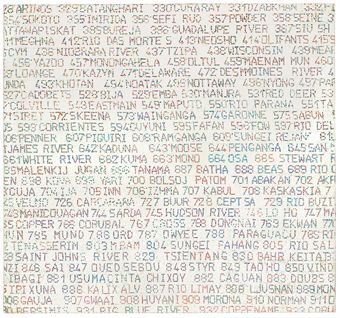
Perhaps because we think we are so very funny when we pose with objects of art, or with half-naked and very buff bouncers at some store on Fifth Avenue, my dear friends B and M-A (the only person I know who is actually, genuinely descended from/related to a saint: St. André Bessette) and I went to see the Alighieri Boetti show at MOMA yesterday. I will take some credit for having dragged them there; I have been longing to go since it opened. Boetti creates maps, or he created maps along with Afghani weavers, and I have been obsessed with maps since my days as a stellar student in parochial school making maps for everything, and dreaming of becoming a cartographer.

Until it became clear that modern mapmaking involved accuracy, and a facility with mathematics, and I headed straight for the funhouse of fiction.

And not only maps, but also words and letters. One huge woven piece listed the 1000 longest rivers on earth, in order. And while there may be agreement as to the 10 longest and even the 100 longest, after that it begins to require some research to determine the length of these rivers.
More than you would think. In fact the project was a 7-year collaboration of Boetti with his first wife. I get that.
I looked and looked for the Hudson River (315 miles long or 507 kms) and could not find it. I looked on the 2nd floor in the big atrium space where I saw the first iteration of I mille fiume piu linghi del mundo, and looked and looked, but could not find the Hudson River. Yes, I know that – though it looms large in my life and viewshed – the Hudson is not a huge river. But the last river listed, the 1000th, was the Agusan, (217.8 miles or 350 kilometers) on the island of Mindanao.
This is definitely shorter than the Hudson by almost 100 miles, unless Boetti was classifying the Hudson, as some hydrologists do, as an estuary all the way to Albany, which I suppose could make the ‘river’ part even shorter. But that seemed like the kind of distinction that could cloud the issue for countless bodies of water all over the planet, so I doubted it, and kept looking for the Hudson.
Up on the 6th floor where the bulk of the exhibition was, there was another version of I mille fiume piu linghi del mundo, also in descending order, but this time indicating their length in kilometers, rather than their ordinal value. And I kept searching for the Hudson. We found the Connecticut and the Osage and the Rio Plata, but we did not find the Kennebec (170 miles or 270 kms) where not so long ago forests full of vast trees floated down river to the mills of Skowhegan and Madison; nor did we find the Rio San Juan (119 miles or 192 kms), where Horatio Nelson lost his eye in 1780, while fighting the pirate Henry Morgan. Everyone in Nicaragua knows this for a fact, and they will tell you that his eyeball is still at the bottom of the Rio San Juan. Although if you contact the Nelson Society in London – which I did a few years ago - a very nice gentlemen will gently inform you that Nelson never lost his eye at all. And never in Nicaragua. He had a spot of malaria is all.
I did not stop there. At home I had a book with a reproduction of the I mille fiume piu linghi del mundo, and after not much time at all I found it: The Hudson River, there at spot #744. This was an enormous relief. (This was also an example of the kind of thing one can obsess about that serves ABSOLUTELY NO PURPOSE.) But to continue.
Right ahead of the Hudson, in position #743, is the Sarda. What and where is the Sarda River? It turns out this question is not so easily answered. The Sarda comprises part of the border between India and Nepal and that is the only uncontested thing about it. Some Nepalese call it the Mahakali River and other Nepalese, the Pahiri, call it Kali Gad. As the Kali River, its length is listed as 350 kms, or 217 miles. Also as the Kali, the river is famous for the Kali River goonch attacks, by the man-eating goonch catfish. But when I read about the Sarda River, it is given a length of 223 kms (138 miles) in Nepal and 323 kms (200 miles) in India, up to its confluence with the Ghagra River. And these two lengths add up to 546 kms, or 339 miles.
Just after the Hudson, is Lo Ho, in position #745. If you put Lo Ho into your internet search engine, you will get a bunch of real estate concerns in the lower east side of Manhattan, and only at the bottom of the page will you find: Lo Ho, also Ilo Ho, a river in China, 421 kms long, or Lo Ho, also Peilo Ho, another river in China, 500 kms long. “Geody” will give you Loho Jhal. Loho River in Baluchistan, Pakistan, and you can even see a Google earth picture that looks like the moon, or the beach at low tide with my footprints. But I think the one in Pakistan is what we know as the Daro River. Which begs the question as to why they have to alternately call it the Lo Ho, when the earth is already replete with Lo Ho’s. There is also a Lô River in Vietname – where they call it Song Lô – and that is 470 kms long.
Tragically, the index of my Times Atlas of the World, Seventh Comprehensive Edition, 11 pounds, lists no Lo Ho’s anywhere. There is a Loholoho in Celebes, and that is all.
Can you imagine going through this about 1000 times? I for one, think it would be lovely.


Friday, July 13, 2012

Honeymoon secret location revealed

Many of you have asked where we went for a honeymoon, and while we considered keeping our location a secret requiring Grade 12 Classification, we opted for transparency. And here we are.
Why Bingham?
Well, CSB wanted to go south and test his mettle with some Amazonian bees, while Christine wanted to go north to the pole because she didn’t get to eat enough raw seal meat last time she was there.
But as we know – or so we have been told – marriage is about compromise, and that is what we did. We went to Bingham, Maine (current plywood storefront capital of the state) halfway between the two.*

*If this picture looks photo-shopped, that is because it is. You try taking a time lapse photo when the only place to put the camera is dangling from a tree branch.


What to do on July Fourth in Maine when there is no more parade in West Athens?*

Check out Father Sébastien Rasle.
Who?
At a pit stop a few days earlier, on our drive north, I picked up a brochure about Somerset Country. All the other brochures were gone, and amazingly, coincidentally, Somerset Country is where are. In that brochure I learned of the existence of Father Rasle, who is named as one of the four (4) famous people of the county. The other three are Benedict Arnold, Margaret Chase Smith, and George Walter Hinckley of the Good Will-Hinckley School, so you can see he is in good company. The brochure, when it isn’t misspelling his name, tells us that Father Rasle was a Jesuit of the early 1700’s, at the time of the French and Indian Wars. The Abenaki Indians – in what was not yet known as Somerset County - were allied with the French against the English. Fr. Rasle worked to convert the Indians, and to that end he created the first French-Abenaki dictionary, the first Abenaki dictionary of any kind.

This is where I became quite excited, because I am interested in early saints and missionaries who, in the course of trying to convert native peoples - an enterprise I am not in favor of - often compiled dictionaries and wrote down languages - enterprises I think are entirely brilliant and worthwhile. (Another of these lexicological priests was Jean de Brebeuf, who compiled the French-Huron dictionary, and famously named the Huron’s favorite sport Lacrosse, because the stick they used reminded him of a bishop’s crozier.)
I also learned that Fr. Rasle’s grave is in Madison, on the other side of the Old Canada Highway from West Athens, and not so far from us. What else could we possibly hope to do on the anniversary of independence? CSB, whose interest in Jesuit philologists could not fill a thimble, was wonderfully agreeable about heading over to Madison, a town we generally note only for its frequent appearance in the Morning Sentinel’s Police Blotter.
So without even stopping for a quick drink at the Solon Hotel (ever-tempting)
we went to Madison and found the cemetery where Father Rasle was buried. Here is CSB looking really happy to pose. The cemetery was full of French Canadian names, and some wonderful gravestones. But this was my favorite. I am guessing that both Robert and Beverly love to play golf. CSB pointed out that they are not yet dead.
On our way home, via Skowhagen, we met up with the Grannies for Peace, marching back and forth across the Old Mill Bridge over the Kennebec, all day long. Being deprived of marching their annual plea for peace in West Athens, they brought their cause to the metropolis. They were delighted to have their picture taken, and of course we talked about our grandchildren.


Saturday, June 30, 2012

More basement archeology

I certainly do not want to suggest that this comprises the weirdest list of random items dredged from the parental basement and barn; nothing has yet topped, for sheer delight, the shelf of dusty, moldy & empty wine bottles, labeled “Empty Bottles with Good Memories”. But still, there are nuggets to be gleaned here:

• An Ethiopian one-dollar bill featuring a lovely portrait of Haile Selassie, the original Rasta (Who went to Ethiopia? And when? And why? That is to say, I know why I went - long story - but why did the procurer of this dollar?)


• Typed school reports my father and his brother, from Brush Hill School, Spring 1934. Given that we were raised to think that my father, from his earliest years, was brilliant, tri-lingual and able to perform calculus in his sleep, it is rather shocking to read this from Dad’s science teacher: “Philip has shown little progress through the year in extending his interest. Is interested in the things we do without caring to know why we do them.” (Hmmm.)
Or this from his PhysEd teacher: “Philip is keenly interested in baseball…He responds more accurately in rhythms. He is over-critical of others.” (Okay, that last bit does seem more like the Dad we know & love.)
However, this from his music teacher seems apt, then and now: “He still uses only one or two tones in his voice, and he ought to have one or two minutes of daily work to overcome this handicap.
• A collection of certificates certifying the bearer to have circumnavigated the world, crossed the International Date Line, or the Equator, or some other landmark, imaginary or otherwise, issued by assorted airlines, such as the International Date Line Club, Northwest Orient Airlines (last name misspelled); Jupiter Rex/Pan American-Grace Airways/Panagra; Neptune Rex, TWA; Domain of Phoebus Apollo (first name misspelled).
• The House Beautiful Climate Control Project, printed in 1951 by the American Institute of Architects
• Among several items attesting to my wasted youth (all those A+’s in religion), a report made by yours truly when a student in parochial school, in which the sacraments are defined AND illustrated. As this example of genuine contrition:

But what I find most compelling is a brown manila accordion folder, the kind with attached matching ribbons, labeled in my grandmother’s unmistakable perfect convent script: Hans Lehner. That is my grandfather, my father’s father. The script is that of my mother’s mother. Inside this manila envelope I found:
• Hans Lehner’s passports for the years, 1947, 1951, 1955 and 1959
• A program of my Uncle Claude’s marriage to Nancy Mansfield in Seekonk, Massachusetts
• Several photographs of my father and uncle and their father, with lots of dead fish hanging from a string, somewhere
• Lists (both typed and handwritten) of the guests who came to my grandfather (Hans Lehner’s) funeral in January 1965. The lists are long, and only the male member of a couple is named.
• A catalog for machinery and supplies for carding, combing and weaving (50,000 spindles)
• An ink stained handwritten family tree, entirely in German, hence incomprehensible to me
• Three fond birthday cards from Reine (mother’s mother) to Hans (father’s father)

What was not found in the basement or anywhere else, what cannot be quantified or labeled, what is worth all the dredging, the inhaling of old dust, and the grimy fingers, are the stories that get retold, and sometimes, just sometimes, they are even stories I have never heard before.
Thus, peripherally related to the subject of having all this junk in the basement, my mother explained to CSB that when she and her brother and mother left Indochina in 1940, they left in a VERY BIG RUSH. Specifically, European women and children had exactly 24 hours to pack and get on the boat heading east, if they wanted to evade the Japanese army as it scorch-earthed its way south. My grandmother backed up her children, their toys & clothes & books, and left everything else behind. And among that everything else was her collection of Chinese jade.
I always knew that my grandmother loved jade, and I suppose I always knew that my mother’s father was color-blind, because all three of my brothers are color blind, and color blindness is a recessive trait carried by the female. But here is the part I never knew. As he traveled throughout Indochina, my grandfather Arnold, known to me as Bon Papa, often bought jade for his wife, but being color blind he could not distinguish between green jade and pink jade, and he bought numerous pieces of pink jade jewelry and carved pink jade figures, thinking they were green jade. Because he actually had no idea that jade came in many different hues and colors. And Reine, my grandmother of the convent script, known as Bonne Maman, did not want to disillusion her husband, so she gratefully accepted the pink jade, which was lovely, but it was not green.
According to my mother, that pink jade would be very very valuable now, but what do we know? We do not have it in our basement; it is in some Japanese general’s basement – or so said Bonne Maman – although I don’t think of Japanese houses as having basements, and we hope they are enjoying it, pink or green.