Translate

Showing posts with label Cairo. Show all posts

Monday, February 18, 2019

SUNDAY ROUTINE (with apologies to the New York Times)*

How Christine L, blogger, beekeeper, egg collector, terrible typist, and ranter, spends her Sundays

THE NEW YORK TIMES. “I am a very hardworking person,” Christine told us. “So on Sundays I like to wake up at 8, a full hour earlier than 9, which is when I wake up on Saturdays. Then I roll over and reread the book I was reading last night when I fell asleep with my nose between pages 84 and 85. (Or whatever. Feel free to insert your lucky numbers here.) Lately it’s been Walker Percy’s Love in the Ruins, a book that warrants multiple re-readings because it is so weird and prescient. CSB, meanwhile, has milked the chickens, burned yesterday’s manuscripts, and taken my mother to church. I know it is time to get out of bed when he comes back from the early service and tells me what comments my mother made during the sermon. Examples are: “There many of them have beards [points to the ceiling] and they all have toes,” and “Phew. Now I can find what I lost.” Attendance at the early service ranges from three to seven; CSB reports to me exactly who was present, and how many times my mother counted. In French. My mother, not CSB.”
BREAKFAST LIKE A QUEEN “Then it’s time to caffeinate.” Christine is a tea drinker. We asked her why. “Because I am not a coffee drinker, and those two are the only options.” Unsurprisingly, Christine takes nutrition seriously. “If there is any dessert left over in the frig I will definitely eat that for my first breakfast course. Fruit tarts are best, but in a pinch I will have chocolate mousse or baked Alaska. Second breakfast is always two poached eggs over Gallo Pinto with a dollop of yogurt. Some things never change, nor should they.” In addition to her other attributes, Christine is thoughtful and discreet. “Because yours is a so-called Family Newspaper, I will skip over the next hour of my Sunday Routine. Let your imaginations run wild.”
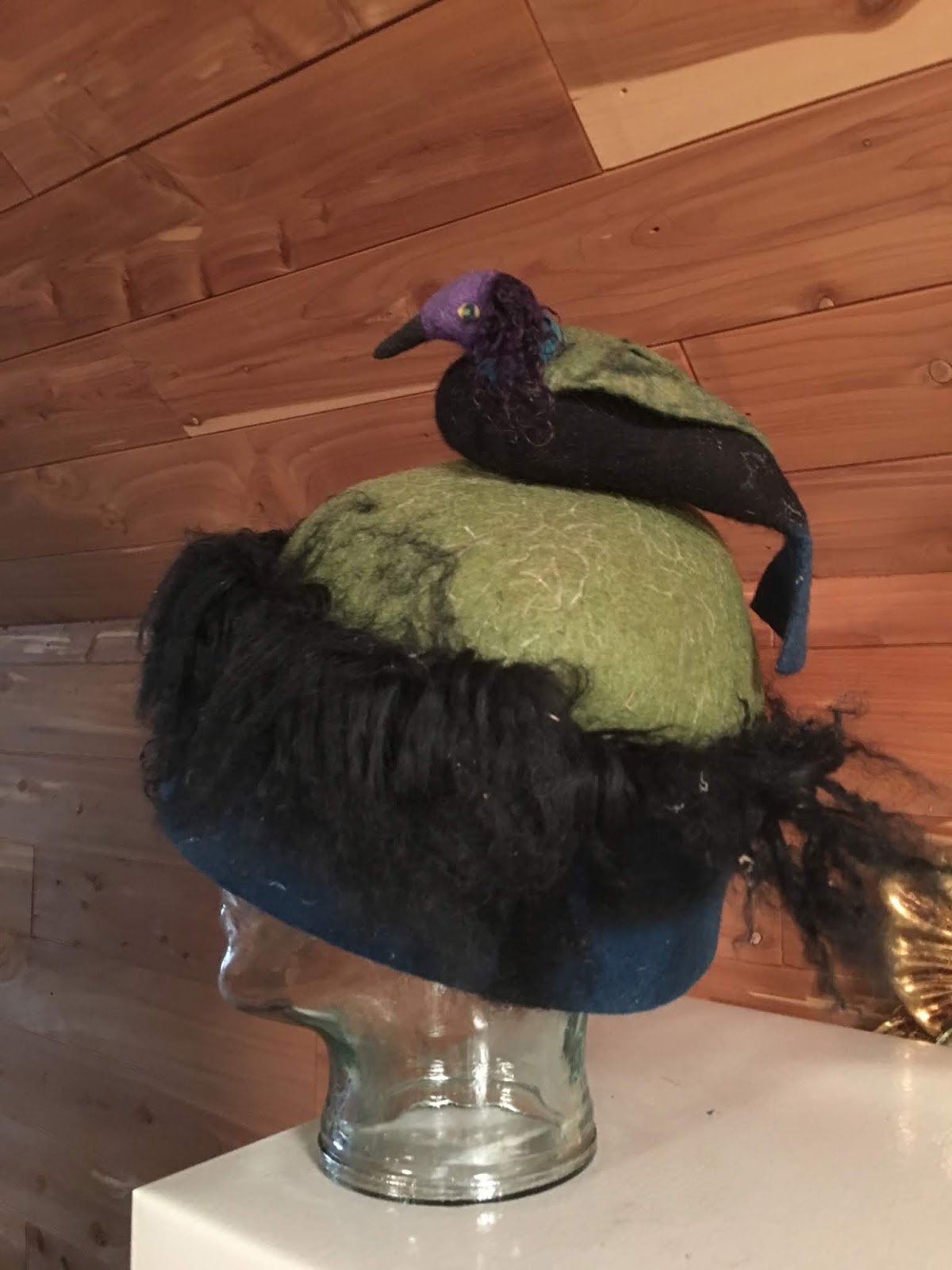
WHAT TO WEAR WHETHER YOU ARE SEEING THE POPE OR NOT… “Since all week long I dress for success with bespoke corduroys pants, flannel shirts, vintage cashmere sweaters with almost no moth holes, and socks featuring bees or chickens, on Sundays I like to turn off my inner fashion-meter. Just this past Sunday I garbed myself in silk pajamas dotted with congealed egg yolk, and a djellaba from Cairo my grandfather wore in 1951. To keep warm I draped myself with a fur stole, but don’t worry, whatever it was has been dead longer than you have been alive. I always wear a hat on Sundays. Sometimes choosing the right one can take a very long time.” We saw a small complement of the hats in question, and can sympathize with challenge to choose just one.
KEEPING FITTER “Friends tell me that exercise is very popular these days, so on Sundays I often exercise. Unless I participated in exercise during the previous week, in which case I will rest. My favorite exercise is ping-pong. I used to be the Costa Rican junior ping pong champion so it tends to be difficult to find players who are willing to compete against me, because I will beat the pants off them and then gloat. Just thinking about the difficulty of finding a suitable opponent tires me out.”
MORE FOOD “On Sundays CSB and I like to throw caution to the winds and radically alter our lunch menu. Just last week I had almond butter instead of peanut butter. That was fun, but one shouldn’t indulge too often.”
KULCHUR “I can’t help noticing that most of the subjects of this feature feel compelled to tell you about their Sunday’s cultural activities. I don’t know where to start. I like art projects that also reduce clutter. My latest masterpiece involves burning old postcards and gluing them onto my grandmother’s watercolors. Since I have thousands of old postcards (still) and hundreds of my grandmother’s paintings (numbers may be inexact), this is a very useful and cultural thing to do.”
AND MORE FOOD “My fondest childhood memories are of Sunday dinners at my grandfather’s house. Under the dining room table my grandfather had a button, cleverly concealed beneath the Persian carpet, which he would depress with his foot to summon the cook. A favorite activity for those of us who were not required to discuss fluctuations in the cotton market was to slide under the table and press the button. Frequently. Relentlessly. Very soon after her untimely death, my grandfather’s cook, Mrs. Herlihy, was nominated for sainthood, on account of her saintly refusal to kill us. Her beatification sped through the Vatican red tape. Countless friends and colleagues of my grandfather eagerly wrote to the Holy See to testify on behalf of Mrs. Herlihy’s sanctity, as well as to confess their dismay that she never once dismembered even one of us. That tells you everything you need to know about our Sunday Dinner Routine.”
AND FINALLY “Come Sunday evening I need to mentally prepare myself for the week ahead. This often involves scuba diving. Bedtime cannot come soon enough.”


*If you are not a regular reader of the Times’ “Sunday Routine” feature, you will probably not find this funny. You will most likely find it puerile and pointless.

Thursday, July 18, 2013

Telegrams, adieu!

Until I learned there would be no more, that in fact there had been no telegrams in the U.S. for seven years, I had no idea how attached I was to telegrams, or the idea of telegrams, or the possibility of telegrams.
This past Sunday the last telegrams were sent in India, the last stronghold of telegrams; they announced births and deaths and offered congratulations. And then the Indian telegraph shut down for good.
Western Union, based in Colorado, ceased sending telegrams back in 2006 and I am chagrined that I never noted its passing. I would like to rectify that.
One of the more cumbersome (and hence delightful) methods of long distance communication I learned about was an electrochemical telegraph devised by Samuel Thomas von Sömmering in 1809. The process involved physically laying as many as 35 wires from one place to another, and submerging each end of the wires in a glass vial of acid, next to a card indicating which letter or number it represents. The transmitter applied eclectic current to his end of the wire, which caused the wire at the receiver’s end to release hydrogen bubbles. Then all you do is match up the bubbles to the letters and voilà, a message: Does your wife like aubergines?

But back to telegrams: Most of us consider Samuel Morse the progenitor of those filmy pieces of paper with words pasted onto them. In 1837 Morse patented an electrical telegraph capable of sending long and short signals (dits and dahs) across several miles of wire. That eponymous code was still considered a useful thing to learn when I was a kid; an uncle of ours once promised that he would give $5 to whichever of we cousins first learned Morse code one summer, and no, I was not the grand prize winner. But I am sure that in one of the Nancy Drew mysteries our heroine, trapped inside the trunk of a car by a wicked villain, was able to pound out the Morse code to signal her plight, and was rescued. Or maybe it was another plucky heroine.
Then came Tesla and Marconi and wireless telegraphy, and the terse but potent messages in what we recognize as telegraphese. In their brevity telegrams can be compared to Tweets, with their 140-character limit. Brevity was important because telegraph companies charged by the word and the beauty of that is the burden of making every word earn its keep. Though I was surprised to learn that the word STOP was free, while punctuation of any kind cost extra, hence the punctuation-less messages with their frequent STOPS.
Like our email and telephone communications (viz. Snowden’s NSA leakage) telegrams were easily intercepted and not exactly secure. So codes were developed, like the one used in this telegram of 1920 I discovered in the parental basement, dating to the days when my grandfather was a cotton merchant in Boston traveling often to Europe. And this one upon which someone, presumably a secretary, has kindly typed the translation. Also in the dusty piles of papers was a key to the code. There is much to wonder about: had my grandfather memorized this list of randomized letters? Did he carry the key secreted on his person, in some hidden pocket or the false bottom of his valise? Just how cutthroat was the cotton business in the 1920’s such that these precautions were deemed necessary?

Also in a cabinet in the parental basement, in a pile mercifully left un-nibbled by the mice, was a stack of congratulatory telegrams sent on the occasion of my parents’ betrothal. Many of them were sent from friends in Cairo to my mother, then a student at Smith, care of the home of her husband to be, the home she still lives in. The best thing about these telegrams is that on each one my beloved grandmother wrote the name and address of the sender, presumably so that my mother could send a proper thank you note. Just to see my Bonne-Maman’s unmistakable Belgian convent script fills me with longing.For the time I am holding these perishable pieces of old paper, she is entirely present: lovely, kind and toujours well-organized.

And now, all relics.

Wednesday, February 20, 2013

Every family has their myths, the stories they tell in lieu of the real stories, the stories they tell to make themselves appear interesting or sane or law-abiding, or not. Our family had the story of my mother’s belly dancing past.
We presume the story started with my father, but he is dead now so we can’t check that fact, and even when he was alive, his memory of the sixty-plus years that constituted his life with my mother was the part of his memory that was largely eviscerated by the stroke. What remained intact, oddly, was his capacity to fully engage in the myth-making.

The myth was not complicated. The myth was that she was a belly dancer in her youth. My mother (known to my readers as SBM, or Sainted Belgian Mother) grew up in mostly in Cairo, Egypt. She was not Egyptian. She was the lithe and elegant daughter of a Belgian oil executive and his beautiful Belgian wife. Whatever African blood my mother had was last seen when her earliest ancestors departed East Africa and the mitochondrial Eve, headed north, crossed the Red Sea during the African Ice Age, and ended up in the Anatolian/Caucasian region. Eventually they traveled west in Europe, coinciding with the spread of the Aurignacian culture. As you can imagine, from there it was a mere matter of a few thousand years to waffles, frites, moules, 800 varieties of beer, TinTin, and Manneken Pis.
My mother did not have a belly dancer’s build, which as children we were led to believe involved serious avoirdupois, particularly in the mammary glands and the ventral region, that undulating belly of a thousand and one nights. But according to the myth, despite her slenderness and flat chest, the young Belgian schoolgirl one of Cairo’s most sought-after and scintillating belly dancers. Her specialty was the Dance of the Seven Veils, which she performed with seventeen veils. It was on an early business trip to purchase cotton waste from purveyors of the famously soft Egyptian cotton, that my father was taken for a night on the town, and encountered La Monica of Belgica, Belly-dancing sensation. He was smitten, and the rest is history.
My father loved to tell us this story. When he and Mom returned from vacations or dinner parties, he often vividly described how my mother, only slightly inebriated, would willingly belly dance atop a table and impress the assembled friends, and business acquaintances with her skill and dexterity. As children, we too were impressed and frequently told our friends that our mother was a belly dancer. As far as we could tell, they all believed us.

Then this morning, I read in the New York Times, that the popular Al-Tet ‘belly dancing channel’ is being forced off the air for ‘operating without a license’. You can thank the Muslim Brotherhood for another cultural icon thrown to the infidels.
Is it possible that SBM must now single-handedly carry the banner of belly dancing into the New World?


Friday, August 7, 2009

Today's geography


It’s after 5 pm and only just now, while reading Butler’s re BB. Agathangelo and Cassian and their evangelical trip to Abyssinia (which ended in a bizarre martyrdom) did I realize that today is the 7th and that today, with zero fanfare, my book (Absent a Miracle – have I mentioned this before?) is officially published. Agathangelo was born in Vendôme, France in 1598. About 300 years later the luxurious Vendôme Hotel was built on Commonwealth Avenue in Boston, and 101 years later it burned down in the “worst firefighting tragedy in Boston history”. My paternal grandmother (she of the inscrutable horoscope and the countless abstract watercolors) lived at the Vendôme Hotel in the 1950’s and 1960’s. She lived in a suite with Mrs. Downey, her companion, who disappeared one day without a trace. Nana wore long dressing gowns and painted all day long in her Grumbacher sketchbooks. (Are they no longer made?) She was pathologically averse to cutting her toenails and she rarely wore shoes, so her long yellowing toenails were a source of wonder to her 10 grandchildren. (Recent research has taught me that toenails grow at a quarter the rate of fingernails, making long toenails a far more remarkable feat than long fingernails. People can reasonably differ on which is more revolting.) Nana was not living in the Vendôme when it burned down in 1972, but she was there in the 1960’s when it caught fire, and she was being evacuated – in her silk dressing gown – onto Commonwealth Avenue late one night when a friend of mine(Jeannie Nicholson, a tall redhead) emerged from a local bar, saw Nana, and took her in.
As a young priest Agathangelo went to Aleppo where he learned to speak Arabic and was friendly with Moslems and Christians alike. When I was a child, my father travelled to Aleppo 3 or 4 times every year to buy cotton waste because there used to be lots of cotton grown in Syria, and where there is cotton, there is cotton waste. When my mother and I went to Aleppo we took a cab out of the city because I insisted we visit the ruins of the shrine of Saint Simeon Stylites, the 5th century ascetic who lived on top of a pillar for 37 years. We saw a lot of rocks and used our imaginations.
From Aleppo, Agathangelo went to Cairo, where my mother attended high school and my other grandmother – Bonne Maman – attended costume parties. They both loved Cairo.
Having become well acquainted with the Coptic bishops, and his companion Cassian having learned Amharic, the friars Agathangelo and Cassian went south to Ethiopia. Amharic is an ancient and beautiful language, but not easy to learn. Once I was in Washington DC in a taxicab on my way to a funeral and the language being spoken on the radio was incomprehensible but strangely familiar. I finally asked the driver what it was he said it was Amharic. He said there were 4 Amharic radio station in DC; that’s how many Ethiopians lived there. When my sister and I were in Ethiopia in the 90’s we spent a lot of time speculating about the location of the Arc of the Covenant. But Agathangelo and Cassian were preceded in Ethiopia by a Lutheran missionary with a special aversion to Catholics, so with his encouragement, King Basilides decided to execute the 2 friars. They were taken out to the tree from which they were to be hanged, but there was no rope. Everyone had to wait around while the executioner sent for rope. “But wait,” said the friars, “we have ropes right here on our habits.” So they did. And they were hung by their own rope belts.
And their feast is today, August 7th. Which just so happens to be the publication day of my novel, Absent a Miracle.