Translate

Showing posts with label st sebastian. Show all posts

Wednesday, May 1, 2019

Everything about the Holy Thorn

Of all the things I expected from a sojourn in the Umbrian countryside (olive trees, wild boars, pasta, Roman noses, Etruscan vases, vin de table), the very last was the semiannual appearance of the Holy Thorn in Montone.

As we all know, a couple of weeks ago, Notre Dame in Paris was burning. Watchers around the world were horrified. But a mere twenty-four hours later, things were not looking so bleak. The Crown of Thorns and the beehives on the roof were unhurt by the fire. We received several emails from bee-loving friends with the news of the still-flying bees. But I had to learn of the Crown of Thorn’s escape on my own.

Then we were visiting friends at their exquisitely restored tobacco-drying barn, Bacciana. Montone is a walled town in Umbria, with some lovely restaurants, no decent postcards, and the ex-church of San Francesco featuring frescoes in terrible condition. But of the frescoes that are still extant, there are a cephalophore* and a very young and nubile Saint Sebastian.
While roaming around town reading menus, we learned that on every Easter Monday Montone celebrates the Gift of the Holy Thorn (Donazione della Santa Spina) with a day of pageantry, costumes, archery, puppetry, and handsome men in bicolored tights. Religiosity and shapely calves. What could be better?

In the 15th century, the Venetians, grateful for his help in defeating the Turkish invaders, gave Montone’s local squire, Braccio Fortebraccio** a single thorn from the crown of thorns: the Santa Spina. The Venetians had acquired the Crown a couple of centuries earlier, as collateral for a loan made to the warmongering Baldwin II of Constantinople. Baldwin never redeemed the Crown, but Louis IX of France did. Apparently the Venetians held back a few thorns.

If you care to research the history of the Crown of Thorns, and the various extracted thorns, you must be prepared for conjecture, legend, wishful thinking, and contradictions. Also just plain heresy.
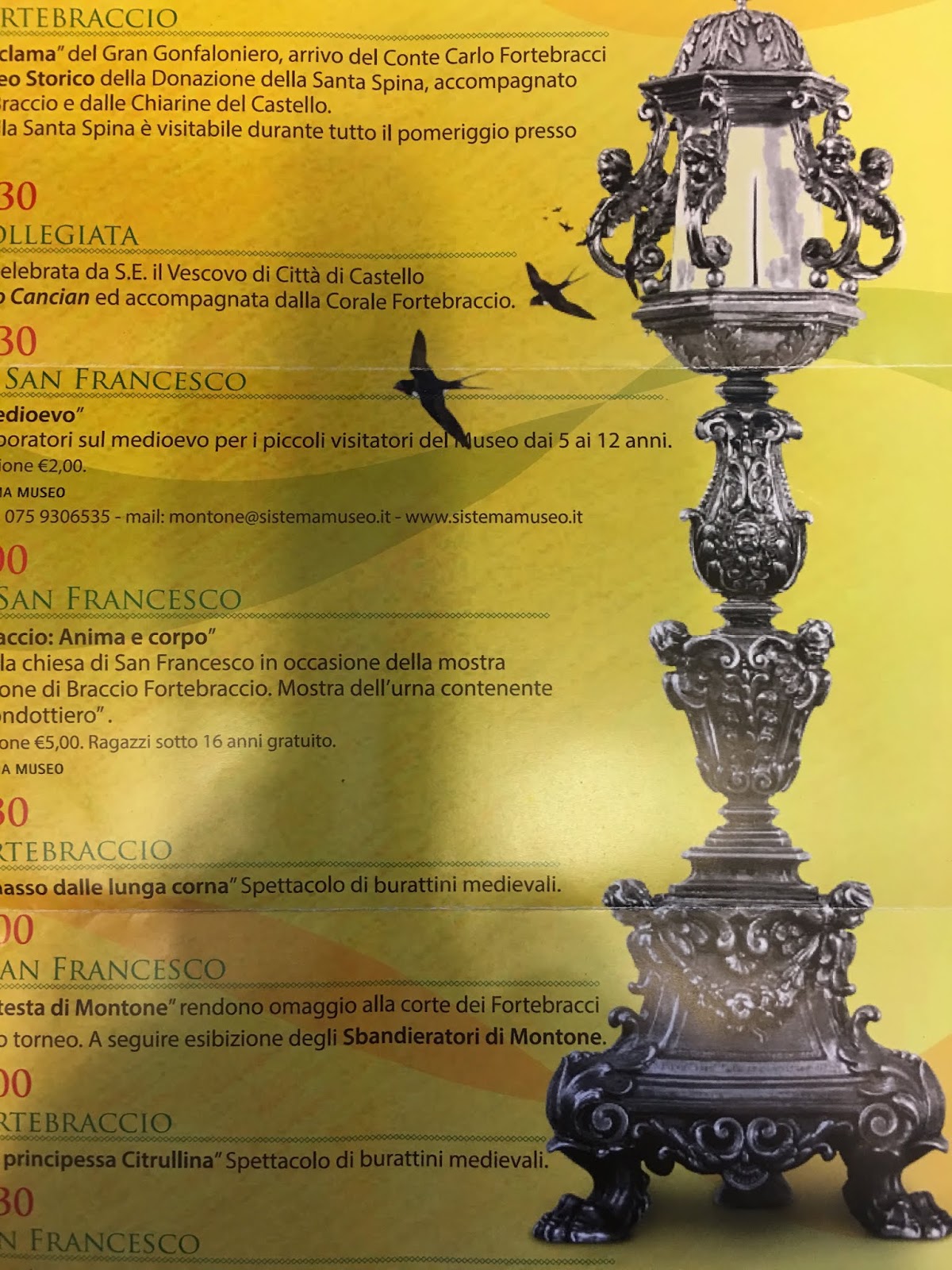
Eagerly, I texted my sister that we would be seeing the Holy Thorn in Montone, and wasn’t this a fantastic coincidence, or just plain serendipity, that we would be in Montone for this celebration? She texted back that according to her research (Wiki) there was no Holy Thorn in Montone. I sent her a picture of the reliquary that was featured in the flyers all around town. She sent me a link to the Wiki page enumerating all the cities in Europe claiming one or more thorns. Montone was not among them. Cities in Belgium, France, the Czech Republic, Spain, Germany, Britain, Ukraine and five cities in Italy all lay claim to a portion, or a branch, or a thorn, or a fragment, of the Crown of Thorns. Even a chapel in Pittsburgh, USA, claims a thorn. But not Montone.

This is obviously yet another example of the fact that you can’t believe something just because you read it on the internet. I was in Montone and I saw the Holy Thorn. Well, I didn’t actually see the Holy Thorn because it was inside its special box. It wasn’t even in the beautiful reliquary shown on all the flyers, because at last year’s celebration, there was a touchy moment when the Montonian carrying the reliquary almost fell off his horse. But I did see the special box that was used in lieu of the reliquary. And I know what I saw.

*Cephalo-phore: a saint who has been decapitated and then carries around his/her head. If you don’t know this already, you haven’t been paying attention.
**His Wiki page also does not mention Montone’s Holy Thorn: a dereliction that makes me suspect a possible conspiracy by the other Thorn-Hoarding cities.


Monday, September 5, 2011

A Tale of Two Irenes


So how did Irene-the-downgraded-hurricane measure up against her saintly namesake? While Tropical Storm Irene may have done significant damage up and down the coast, and flooded towns far away from the coast, and washed away wooden bridges, will she be remembered in 2000 years?

In the year 3372 (2011 + 1361, the number of years after the martyrdom of St Sebastian that George de la Tour painted his St Irene) will a tenebrist artist paint T.S. Irene by candlelight – as she surely was experienced by many – as Georges de la Tour painted Saint Irene tending the wounds of St Sebastian?
If you know of St Sebastian at all, you probably think of him as the naked young man with six-pack abs and a come-hither look, loosely tied to a tree and pierced with arrows. Sebastian had the misfortune to be Christian in the era of Diocletian, the 3rd century emperor who considered a day ill-spent if it did not include a nubile young Christian being eaten alive by wild beasts, or boiled in oil, or nailed upside down. If you know of St Sebastian at all, you probably assume he expired as a result of all those arrows piercing his handsome body.
But you would be wrong. Hearing of his torments, Irene, the widow of St Castulus (stretched on the rack, buried alive), went to bury Sebastian’s punctured body. But he was not dead. So she took him home with her, nursed him, tended his wounds with raw honey, and he recovered nicely. Still, Sebastian refused to stay out of trouble, and when he next saw Diocletian he repeated his creed. This time Diocletian ordered that poor Sebastian be cudgeled and then tossed into the sewer. He did not survive.

All the Irenic drama (yes, something of a paradox) chez Let it Bee Farm happened on the front end. We battened the hatches, the eternal hatches. We closed the Palladian windows that grace the hen house and fluffed up the nesting boxes. We encouraged (the late) Hamlette to stay inside her comfy quarters and not venture out to be bonked by a falling tree, and she complied. We picked all the sunflowers, anticipating that they would be flattened by the 80 mph winds. Now a fine layer of vivid yellow pollen coats every surface in the house; I’ve been wiping it up and eating it with my morning cereal and on my peanut butter sandwiches. We gathered bushels of tomatoes, and then we had to figure out what to do with that many tomatoes. (Guess.)
Then the winds fizzled out before they got here. The Saw Mill Parkway flooded, but the Saw Mill Parkway always floods– living proof of the merits of building a road alongside a river. We could have left the sunflowers standing.