Translate

Showing posts with label Hagiographers Club. Show all posts

Friday, January 20, 2012

Rollerskating in the cloisters

In the annals of unwanted gifts mothers give their sons, this is hardly the worst. My son would probably rank it several notches above the desktop croquet set or lifetime membership to the Hagiographers Club or the plaid vest with antler buttons. Still, it is disconcerting to read the inscription: To Phil, Christmas 1949, love Mother, on the flyleaf of this book, filled with vignettes of the paranormal, the weird, the impossible, and the miraculous. It is hard to imagine what would interest Phil, the man who was not yet my father, less than the paranormal, weird and miraculous tales contained therein, except perhaps his horoscope or membership in his local Theosophical Society. It speaks volumes of the gap between mother and son.
But ill-considered gifts are not the true topic of this particular screed. The true topic may well be the same old topic, which is: It is a Good Idea to Keep Books, no matter how weird and random and useless they appear. (And yes, there are always exceptions.) As in this book, which has probably been in the basement since that Christmas of 1949. This time it is Patrick Mahony’s Out of the Silence, (1948 edition, Storm Publishers). If the generic title does not intrigue you, continue on to the subtitle: A Book of Factual Fantasies.
Given my fondness for lives of the paranormal, weird, impossible and miraculous saints, it seems logical that I would be compelled. Equally compelling, the introduction was written by Maurice Maeterlinck (1862-1949), the Belgian writer who was also a beekeeper and wrote the exquisite The Life of the Bee, in which he goes into raptures about the sexual adventures of the queen bee. It is true that MM is probably better known for his plays, particularly, Pelléas and Mélisande, and receiving the Nobel Prize, but think it is The Life of the Bee that will endure. So I sat among the dusty pages and read Out of the Silence.*
I read about the Vennums of Watseka, Illinois and how their daughter Lurancy had a cataleptic fit and then turned into the dead daughter of a family across town, the Roffs. Her transformation was so absolute that all agreed she should move in with the Roffs. They were happy to have their dead daughter back. Then a year later Lurancy, now Mary Roff, had another cataleptic fit and turned back into Lurancy Vennum.
I read about the French teacher in Latvia whose astral projection picked flowers while she was teaching irregular verbs in the classroom.
I read about the brother-in-law’s ghost spelling the word F-O-R-E-V-E-R in the sand.
But this is where it all came together: Mahony relates how when Maeterlinck and his lover Georgette LeBlanc lived at the Abbey of St Wandrille, they encountered the ghost of a monk Bernard who had died in 1693, and how they discovered his bones inside a secret room. (That’s the “factual fantasy”.)
It so happens that I had read about Maeterlinck’s stay in that monastery when I was reading his Life of the Bee.
[Saints will now be mentioned, but very little.It is really just one saint, and more about architecture.] Saint Wandrille or Wandregisilus (d. 668) was born near Verdun and from his earliest years was determined to be a monk. However, to please his parents he married, but went to on to have a chaste marriage. (Depending on the version: it is also said that Wandrille and his bride were the parents of St Landrada, which implies they were not entirely chaste.) The bride is heard from no more, and Wandrille went into a monastery. Around 657 he built the Abbey and a basilica in the Carolingian style. The church burned to the ground in 756 but was later rebuilt in another style. In the 9th century the abbey was the frequent target of Viking raids, and was burned again. This time the monks grabbed St Wandrille’s bones and fled the flames. The church and abbey were restored in the 10th century and proceeded to have several good centuries; it was the heyday of monasteries. One of the many privileges afforded to the good monks was an exemption from river tolls on the Seine.
Then, in 1631, the central tower fell with no warning and crushed large sections of the abbey. During the Revolution the abbey was suppressed, and sold for auction in 1791. Several more bad years followed when it was used as a factory. But then George Stacpoole, a quirky Irishman hoping to ingratiate himself with the pope, bought the abbey and lived there until 1896. On his death, he gave the property to the French Benedictines, but they were expelled by the French government in 1901 and had to seek exile in Belgium. Then – and this is the time that especially concerns us – Maurice Maeterlinck rented the abbey from 1907 to 1914, and lived there with his lover Georgette LeBlanc.** According to Mahony they entertained lavishly and rehearsed many of his plays. This is Georgette when she is not dressed as a nun.
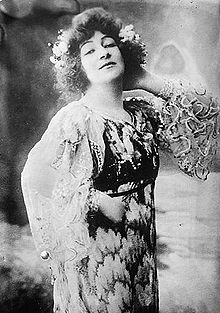
Mahony does not mention Maurice and Georgette dressing up as monks and nuns and roller-skating through the vast courtyards and cloisters and halls of St Wandrille. Nor does he mention Maeterlinck’s bees.
In 1931 the Benedictines got the monastery back and they are still there, praying in silence and being hospitable to visitors, but given the history of the abbey, we hope that the monks have a plan B.

This block of 1951 stamps of St Wandrille Abbey sold on eBay for $13.00 on the last day of last year.


*Not to be confused with Patrick Leigh Fermor’s A Time to Keep Silence, in which he describes his stay with the monks of St Wandrille Abbey.

**I can highly recommend Georgette’s memoir, Souvenirs: My Life with Maeterlinck, in which she recounts how she stalked and seduced and landed Maeterlinck as her lover.

Friday, September 25, 2009

The swarm that didn't happen

After a long morning of recovering from the previous night’s book party with Hubert van Toots in the Library at the Hagiographers Club with a relic, (If you don’t get the reference, you obviously haven’t read the book.) I was finally about to sit down & work. When outside my window I espied thousands of bees flying in that apparently random yet purposeful way they have only when they are swarming. My desk window is quite close to the bay window in the living room where the observation hive lives, and as you may recall, the observation hive has been acting strangely of late. (The dearth of brood. Then the hasty and mysterious dispatch of the newly installed marked Queen. Reginicide?)
I looked and indeed the bees were bearding the extended runway from the observation hive. I ran over to check the hive itself, and – this was the strangest part – it was completely empty. There was not a bee anywhere, not even a single lone bee emerging from a single honeycomb cell.

Of course I immediately called CSB. Sit tight, he said. Go back to work. I normally take unmitigated delight in a swarm (something like a Ringhead at Bayreuth) but in this case I had mixed feelings, because the observation hive’s population was so small to begin with and because of the season (autumn has just begin) which is most definitely not swarming season.
There was nothing to be done.
I stood still among the dancing, careening, swooping bees. My eyes are not good enough to discern a direction. I waited for them to alight on a nearby branch and gather.
I waited in vain.
The bees dissipated into the upper regions.
I returned to my desk.

About an hour later I forlornly went to see the observation hive, and …the bees had returned. All of them.
Did they contemplate swarming and then reconsider mid-flight?
Did something scare them from their comfortable home chez nous?
I have no idea.

One of the odder things I have noted about swarms, or swarming, is that this phenomenon, this brilliant divide-and-increase technique of the honeybees, is always used metaphorically in a negative way. A recent cursory search came up with these examples:
Swarming as a terrorist technique in Mumbai (Times Op-Ed, 2/2009);
Swarming lobbyists (Times, 11/08)
Swarming to characterize E-bay’s takeover strategy (Times, 8/07)
Swarming swindlers (Times, 11/07)
Perhaps more significantly, in NO cases were swarms used to describe behavior viewed as positive, or persons or groups regarded as benign.

Segueing in the most arbitrary fashion, from a swarm that did not occur, to a roman à clef that is not:

At the aforementioned lovely book party my dear friend and gracious host, Paco, pointed out that despite our long friendship and history together, he has never found himself as a character in one of my books. And – this is the remarkable part – he lamented this fact!
I know Paco quite well and did not expect to be surprised by his remarks (honored, delighted, mortified, chagrined maybe), but this did surprise me because the truth is that certain people who think they appear in my stories are not pleased. They object to being in the book, and then they object because I got it wrong! And despite all my reassurances that I write fiction and that the characters really are fictional (I’ve even been told they are “all lies” as if that were a problem) the objections continue.

A former relative (how’s that for an awkward epithet?) was fearful that she or my ex would appear in Absent a Miracle and so, long before the book was available for sale, she bought an Advance Review Copy on E-bay.
(Pity the poor reviewer with stacks of ARCs clamoring for shelf space. And then, mirabile dictu, E-Bay) According to my ex I should be flattered because she (former relative) actually finished the book. Was this meant as a comment on the quality of the book or on her reading skill?

In my long ago short novel, Expecting, the narrator had a brother. I have 3 brothers and all three of them objected to the fact that they were not identifiably in the book and that I had lumped all brothers into one generic brother.

What’s a writer to do?