Translate

Showing posts with label Maurice MAeterlinck. Show all posts

Friday, July 14, 2017

The Ones Not Chosen

While we are on the subject of how to stay sane while rehabbing and regaining the full flexion, extension and strength in one’s right knee, I should point out that I have had an unequalled opportunity to sink and swim in Belgian writing.

The theme to be explored, elucidated, exhausted and ultimately wrung dry in our Literature Club this year is “Literature of Our Ancestors”. As with more or less every theme we devise, this one can be interpreted in multiple ways. It can be the literature written by a particular ancestor. It can be the literature written by fellow countrymen of your ancestors. It may be whatever literature your ancestors chose to read. But which ancestors? Your parents may have been reading Ladies’ Home Journal, Saturday Evening Post, John Updike and John Cheever; while your great-great-great grandparents back in the swamps of Wallonia were reading Balzac by gaslight; while your other great-great-great grandparents on the Norman coast were reading ships’ manifests and not much else. You just hope they were reading at all.

I could complicate the matter endlessly, but this year I will not. Or not entirely. Because no one else has Belgian ancestors (how odd that I feel confident this is the case) I have decided to present a program on Belgian writers, or a Belgian writer.

The first Belgian writer I considered was Maurice Maeterlinck. But several years ago, when our theme was Science and Literature, I presented a program that included Maeterlinck’s classic Life of the Bee. So forget Maurice, even if he and his lover, Georgette LeBlanc, did live for several years in a ruined abbey (Abbey of St Wandrille in Normandy) so vast that they went from room to room on roller skates.
Then I happened to hear of Emile Verhauren (1855-1916). I had never in my life heard of Emile Verhauren, but according to Stefan Zweig, who knew a lot, Verhauren was supremely important, the Francophone equivalent of Walt Whitman, and a founder of the school of Symbolist poetry. Arthur Symons wrote that Verhauren’s poetry “is made directly out of the complaining voices of the nerves.” He also wrote of Verhauren, that “there is something lacerating, and the same time bewildering, which conveys to one the sense of all that is most solitary, picturesque, and poignant in the transformation of an intensely active and keen-sighted reason into a thing of conflicting visionary moods.” Could this be fated? Many years ago, when our theme was Latin American Literature, my subject was Ruben Dario (1867-1916), who created the Spanish Modernismo movement, akin to Symbolism.
But I happened to have dinner soon thereafter with Annabelle, Marc and Maude, all genuine Belgians. Neither Annabelle or Marc (no slouches) had ever heard of Verhauren; Maude said she had read him in school and that he was very boring.
The next writer I considered presenting was Georges Simenon. The creator of Inspector Maigret, Simenon wrote at least 500 books and at some time in the 1960’s he was the most translated writer in the world. Yet for all that, nowadays he doesn’t even consistently make the list of Top Ten Most Famous Belgians.
Simenon wrote all the time, and he wrote a lot. He also had a lot of sex. In 1977, Simenon told Fellini that, according to his calculations, since the age of 13 and a half [I like the distinction of the half] he had sex with 10,000 women. If my math is correct, that is 61 years, or 22,265 days. So, he could have had sex with a different woman every other day, religiously, for 61 years. All while being married, serially, to two women and having two or three long-term and devoted extra-marital relationships.
Another interesting fact about Simenon is that his very first novel, Au Pont des Arches (never translated into English) was partially set in an apothecary specializing in laxatives for pigeons.
If you, like me, cannot fathom why a pigeon would need a laxative, or how a pigeon would express the need for a laxative, you will perhaps understand why I will not be presenting a program on Georges Simenon to Literature Club this year.

STAY TUNED FOR THE BELGIAN WRITER ACTUALLY CHOSEN…

Wednesday, July 30, 2014

Dispatch from Morphistan #34

Suggested reading while on Morphine
1. Anything in large type
2. The Wikipedia entry on morphine; especially as it relates the facts and myths about Samuel Taylor Coleridge’s opium consumption and the creation of Kubla Khan; especially because you can enlarge the font size as much as you want on Wiki.
3. Amok by Stefan Zweig, and I cannot explain why.
4. The Life of the Bee, by Maurice Maeterlinck, but only if you have read it before multiple times. The key is knowing it almost my heart already.
5. Recipes with many pictures, but do not try to actually cook any of the recipes.
6. Art books, especially books about surrealistic or abstract or extra-abstract art, because you will enjoy them more than at any other time. No photo-realism or Jeff Koons.
7. Proust. Seriously. Pick it up anywhere and anywhere. It makes no difference and it will engage you entirely.
8. In tearing haste, Letters Between Deborah Devonshire and Patrick Leigh Fermor, edited by Charlotte Mosley. Darling Debo and Darling Pad. It is full of descriptions of “curly scimitars glittering[ing] from the saddles” and “ troglodyte villages” and multi-colored flocks of sheep, and beaucoup de gossip. Many thanks dear Nonnie, for this treasure.
9. Audio books: do these count as reading? (Feelings can run to temperature extremes when debating this subject, but not when you are on morphine.)

Friday, January 20, 2012

Rollerskating in the cloisters

In the annals of unwanted gifts mothers give their sons, this is hardly the worst. My son would probably rank it several notches above the desktop croquet set or lifetime membership to the Hagiographers Club or the plaid vest with antler buttons. Still, it is disconcerting to read the inscription: To Phil, Christmas 1949, love Mother, on the flyleaf of this book, filled with vignettes of the paranormal, the weird, the impossible, and the miraculous. It is hard to imagine what would interest Phil, the man who was not yet my father, less than the paranormal, weird and miraculous tales contained therein, except perhaps his horoscope or membership in his local Theosophical Society. It speaks volumes of the gap between mother and son.
But ill-considered gifts are not the true topic of this particular screed. The true topic may well be the same old topic, which is: It is a Good Idea to Keep Books, no matter how weird and random and useless they appear. (And yes, there are always exceptions.) As in this book, which has probably been in the basement since that Christmas of 1949. This time it is Patrick Mahony’s Out of the Silence, (1948 edition, Storm Publishers). If the generic title does not intrigue you, continue on to the subtitle: A Book of Factual Fantasies.
Given my fondness for lives of the paranormal, weird, impossible and miraculous saints, it seems logical that I would be compelled. Equally compelling, the introduction was written by Maurice Maeterlinck (1862-1949), the Belgian writer who was also a beekeeper and wrote the exquisite The Life of the Bee, in which he goes into raptures about the sexual adventures of the queen bee. It is true that MM is probably better known for his plays, particularly, Pelléas and Mélisande, and receiving the Nobel Prize, but think it is The Life of the Bee that will endure. So I sat among the dusty pages and read Out of the Silence.*
I read about the Vennums of Watseka, Illinois and how their daughter Lurancy had a cataleptic fit and then turned into the dead daughter of a family across town, the Roffs. Her transformation was so absolute that all agreed she should move in with the Roffs. They were happy to have their dead daughter back. Then a year later Lurancy, now Mary Roff, had another cataleptic fit and turned back into Lurancy Vennum.
I read about the French teacher in Latvia whose astral projection picked flowers while she was teaching irregular verbs in the classroom.
I read about the brother-in-law’s ghost spelling the word F-O-R-E-V-E-R in the sand.
But this is where it all came together: Mahony relates how when Maeterlinck and his lover Georgette LeBlanc lived at the Abbey of St Wandrille, they encountered the ghost of a monk Bernard who had died in 1693, and how they discovered his bones inside a secret room. (That’s the “factual fantasy”.)
It so happens that I had read about Maeterlinck’s stay in that monastery when I was reading his Life of the Bee.
[Saints will now be mentioned, but very little.It is really just one saint, and more about architecture.] Saint Wandrille or Wandregisilus (d. 668) was born near Verdun and from his earliest years was determined to be a monk. However, to please his parents he married, but went to on to have a chaste marriage. (Depending on the version: it is also said that Wandrille and his bride were the parents of St Landrada, which implies they were not entirely chaste.) The bride is heard from no more, and Wandrille went into a monastery. Around 657 he built the Abbey and a basilica in the Carolingian style. The church burned to the ground in 756 but was later rebuilt in another style. In the 9th century the abbey was the frequent target of Viking raids, and was burned again. This time the monks grabbed St Wandrille’s bones and fled the flames. The church and abbey were restored in the 10th century and proceeded to have several good centuries; it was the heyday of monasteries. One of the many privileges afforded to the good monks was an exemption from river tolls on the Seine.
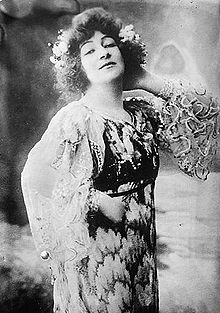
Then, in 1631, the central tower fell with no warning and crushed large sections of the abbey. During the Revolution the abbey was suppressed, and sold for auction in 1791. Several more bad years followed when it was used as a factory. But then George Stacpoole, a quirky Irishman hoping to ingratiate himself with the pope, bought the abbey and lived there until 1896. On his death, he gave the property to the French Benedictines, but they were expelled by the French government in 1901 and had to seek exile in Belgium. Then – and this is the time that especially concerns us – Maurice Maeterlinck rented the abbey from 1907 to 1914, and lived there with his lover Georgette LeBlanc.** According to Mahony they entertained lavishly and rehearsed many of his plays. This is Georgette when she is not dressed as a nun.
Mahony does not mention Maurice and Georgette dressing up as monks and nuns and roller-skating through the vast courtyards and cloisters and halls of St Wandrille. Nor does he mention Maeterlinck’s bees.
In 1931 the Benedictines got the monastery back and they are still there, praying in silence and being hospitable to visitors, but given the history of the abbey, we hope that the monks have a plan B.

This block of 1951 stamps of St Wandrille Abbey sold on eBay for $13.00 on the last day of last year.


*Not to be confused with Patrick Leigh Fermor’s A Time to Keep Silence, in which he describes his stay with the monks of St Wandrille Abbey.

**I can highly recommend Georgette’s memoir, Souvenirs: My Life with Maeterlinck, in which she recounts how she stalked and seduced and landed Maeterlinck as her lover.

Tuesday, May 24, 2011

SQD banned in China; Hold the MSG

This just in from our dear friend Paco who is over in Beijing, explaining to Chinese retailers What Women Want and Why We Buy.

"Please take some pride in knowing that your blog (and many others) are deemed sufficiently subversive to the Chinese Communist Party, that it is blocked for Chinese readers. All your twisted finial piety worship and honeyed entries, does not conceal the truth that you are secretly funded by the Catholic Church to propagate the worship of Saints."

Of course I am honored to be in what I assume is very august company.But I can't help but wonder what I would have to do to be placed on the Index Librorum Prohibitorum, the Catholic Church's most exclusive club, populated by such notables as Galileo, Casanova, La Fontaine, Sartre and Maeterlinck.About whom we might ask: was it his very explicit The Life of the Bee that was the deciding factor in his listing?

Thursday, July 22, 2010

Thirteen hundred and twenty-two years ago today, Saint Wandrille (or Wandregisilus) did not die a gruesome martyr’s death. He was not charbroiled on the pyre and then removed for beheading while having his entrails drawn out on a windlass. He was not thrown into the roiling water with a millstone tied around his neck. He was not mauled by a bear, chewed by a lion, or devoured by a dragon. He was not skinned alive while being forced to watch Mel Gibson’s all-Aramaic “The Passion”. No, in mid July he took to bed with a slight cold, had an ecstasy and died surrounded by his faithful monks.
Before his unmartyred death, Saint Wandrille founded the Abbey at Fontanelle in Normandy, which Maurice Maeterlinck and his lover Georgette Leblanc would rent in 1906, while Maeterlinck was experiencing depression and the two of them were having relationship issues, although they called it neurasthenia. While staying at the abbey Georgette often wore an abbess’s habit and Maurice roller-skated through the abbey’s vast halls and courtyards; he also wrote his great socialist essay, The Intelligence of Flowers.
I am interested in Maeterlinck because he is Belgian and because he wrote one of the most beautiful books ever written about bees, The Life of the Bee. I don’t know what the connection is between those two facts, but I do know that there are four bee museums in Belgium, where most countries have none and others have one. And perhaps while my parents are in Brussels this week*, they will visit one of those four bee museums, although because this is Belgium, it will probably be closed all week and my father will have no memory of the visit two weeks later. But that is fine because he will surely remember the first time he and my mother visited Belgium after they were married in 1951, and they dined with her beloved Oncle Augustín who kept a life size horizontal portrait of his entombed dead son, the great Belgian resistance hero, Paul Brancart, hanging above the sideboard in the dining room. Paul died young to protect the integrity of Belgium, so that it could go on to argue about the supremacy of French or Flemish well into the next century.
How were Maeterlinck and LeBlanc able to rent an entire monastery for their rest cure, you may well ask, and how can I do the same? Sorry. Not this one. In the anti-church hysteria concomitant with the French Revolution (consider the poor nuns in Dialogues de Carmelites), the monastery of St Wandrille was suppressed in 1791 and then sold at auction to become a factory. Later still the Stacpoole family owned it until 1896 when a very religious Stacpoole returned the abbey to the Benedictines; in 1896 they installed their first abbot since the French Revolution.
This does not explain how ten years later, in 1906, the depressed Maeterlinck and his lover were able to rent the place. Roller skating has since been banned in the cloister.

Nor does it explain this passage from Sabine Baring-Gould’s 1882 edition of his Lives of the Saints:
Of [Wandrille’s] relics only two arms remain, one at Fontanelle the other at Bron. Of the noble abbey, the cloisters exist and part of the abbey I turned into a factory. Of the four churches, one the great abbey church, a magnificent specimen of architecture of the 13th century, nothing remains. In 1828 much of this great church existed. Since then the proprietor M. Cyprien Lenoir – let his name go down gibbeted to posterity – has blown it up with gunpowder.

Baring-Gould does not mention the skull of St Wandrille, perhaps because it was not found, in Liège, Belgium, until sometime in the 19th century. And then returned to the Abbey in 1967. Clearly, neither the arms nor the skull were at the abbey when Maeterlinck was roller-skating through its unhallowed halls.
Just now, the Abbey is closed for renovations until Christmas. Which would not be at all surprising if it happened to be in Belgium. But it is not.

*Staying with a second cousin who has planned every meal well in advance. Tonight they will dine on tomate-crevettes, followed by a pheasant Brabançonne with frites, an endive salad, ending with stinky cheeses from Didant.