Translate

Thursday, June 26, 2014

Notes on Riding Amtrak back from Boston

For the first half of the trip, until Old Saybrook, across the aisle was a white-haired older man (actually, he was probably my age; such is the disconnect between my perception of my own youth and other’s old age). As soon as we pulled out of Boston he took a pair of blue jeans from his knapsack and went forward to the rest room. He returned wearing the blue jeans, and then folded his trousers very neatly, aligning the creases with military exactitude. (I recalled Bonne Maman telling when her father was in the Belgian Cavalry father had learned to put his dress trousers under his mattress to keep them pressed.) Then he read the newspaper. After that he read on his kindle or nook or device of some kind.
In New London another older man with white hair (though this one had a mustache and glasses with black frames) got into the same seat. He heaved his duffle bag onto the overheard rack with some difficulty. He did not change his pants. But he took a small zippered kit out of his backpack; it was full of small vials with colorless liquid. He filled a hypodermic needle and injected himself in the belly. It looked to me that he stuck the needle right through his shirt but I couldn’t be sure, and I didn’t want to stare any more obviously than I already was. Then he read a novel by Agatha Christie for the rest of the trip. An actual paperback book.
Just before pulling into New Rochelle I discovered the SKY MALL catalog in the seat pocket in front of me. The SKY MALL catalog is one of the strangest and most mysterious catalogs I have ever encountered, because it is full of things that are completely and totally useless under any circumstances, and other things that might be useful, but why would you buy them while riding a plane or a train? Vying for the Most Useless and/or Bizarre Category were the Towl Hub Towel Holder with 4 USB ports, and the Bigfoot Bashful Yeti Tree Sculpture.

Tuesday, June 10, 2014

Moving Day in Bright Orange


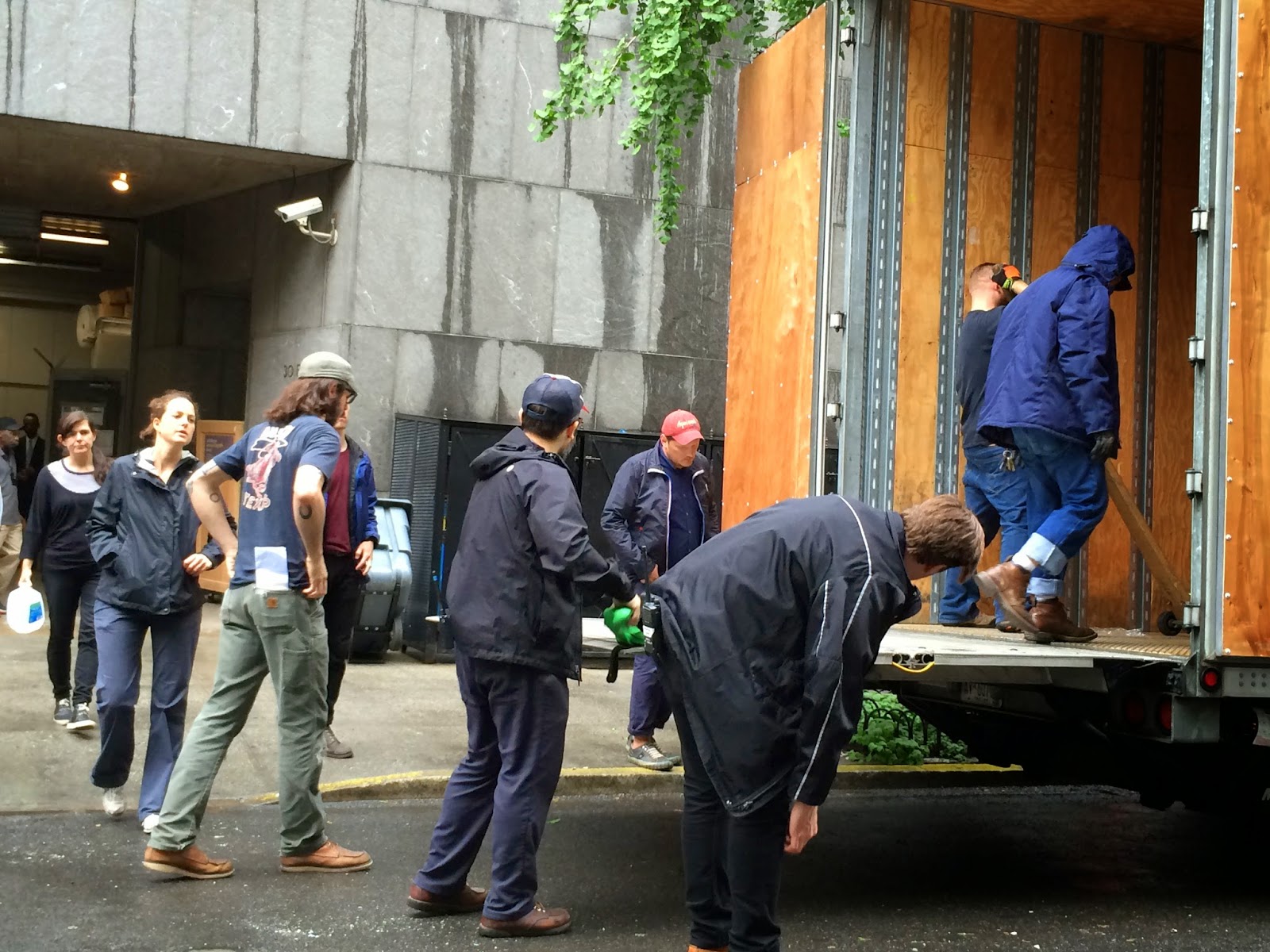
How many people does it take to unload a Jeff Koons in a bright orange crate at the Whitney loading dock?

1 guy/driver from Marshall Arts (Martial arts. Get it? Well, it took me a while.)
1 forklift driver
3 guys with tape measures
1 guy with a walkie-talkie
1 guy with a horseshoe tattooed on his elbow, moving the bright green cones around
1 strong guy with a spider web tattooed on his elbow
1 woman with bright pink shoelaces in her sneakers
1 guy with purple sneakers
1 guy with a purple baseball cap (different guy)
1 guy with a Tweety Bird tee shirt
Lots of guys with bright green nylon ratcheted tie-downs
Several guys in black tee shirts

Not needed was the beekeeper on the roof

Friday, June 6, 2014

Sort of about cemeteries


Because tomorrow I am going to a memorial service for man who died several months ago in his late 90’s, and was a Christian Scientist, and because I was taught many years ago (when I was related, though marriage, to several very devout Christian Scientists, one of whom regarded a lapsed Catholic, like myself, with pierced ears and a predilection for saints, as a barbarian) that Christians Scientists do not believe in death and hence do not have cemeteries, I have naturally been thinking about cemeteries.
I never understood what exactly was meant when CS’s said they did not believe in death. It seemed to be like saying you did not believe you had five fingers. Or a nose.
Tomorrow’s deceased was not, according to his daughter, a particularly devout Christian Scientist, though the soi-disant religion and its practitioners figured in his life in important ways.

As fond as I am of cemeteries I have always disliked our family’s cemetery. Because it is ugly – mostly -and flat. It is not “our” family’s cemetery in a proprietary sense. It is simply the local catholic cemetery where my grandparents, all four of them, and my father and his brother’s wife are all buried, and where my mother and uncle will be buried at some future time. It seems shameful and shallow to dislike the burial place of one’s few ancestors simply on the grounds of its pedestrian ugliness. But what other grounds could I have?
My mother, who is nothing if not an arbiter of architectural correctness and the landscaping principles of Capability Brown, has never spoken ill of the cemetery in question. She is actually quite proud of her father’s tombstone, a Coptic cross. Her father was not a Copt, and tombstones over six feet high are disallowed by the diocese of Boston. But my mother prevailed against the episcopal powers-that-were, and erected an 8-foot high Coptic cross for her Belgian father’s tombstone. Long after she has forgotten the names of her grandchildren, my mother will gleefully recall her victory over the graveyard guidelines of the diocese of Boston.
My real fondness for cemeteries presumably began when I was at Milton Academy Girls School. Across the street was the Milton Cemetery, beautiful, undulating, and forested in parts, with a pond, Gothiccrypts, and aged fieldstones. We would sneak over there to smoke cigarettes and recite Coleridge, leaning against purple slate gravestones carved with luxurious weeping willows and winged cherubs.
Nowadays, at least once a year we stop by, or maybe only wave to, the graves of CSB’s great-grandparents, in the tiny cemetery in Bingham, Maine, on the shores of the Kennebec River where once massive logs floated down to Skowhegan.
In Duxbury, Massachusetts there is a classic old New England graveyard, where Jeff and I used to make rubbings of pithy epitaphs. I was pregnant with my first child, and it seemed to me then that half the graves belonged to young women who had died in childbirth, and the other half memorialized their infant children. Yet I kept going back there. Jeff’s memorial service was held in the adjacent Unitarian church in Duxbury, but he is not buried there, or anywhere.

Jeff and I never owned a plot in a graveyard anywhere. Neither have CSB and I pre-invested in a final resting place. Throw us to the winds.

One cold night this past January my friend Lis and I went outside to get into the car and drive to JFK. But there on the lawn in front of the house was a strange white van. On the grass. A man climbed out of the van and walked in our direction. I shouted out: Who are you and what are you doing here? Initially he could not speak coherently at all. I went inside to call the local police. Ten minutes later the local police had still not arrived. I called again. (We would learn later that the officer dispatched went to wrong address and finding no one home, returned to the station and did nothing. Yes, not reassuring.) Meanwhile, the van’s driver was wandering around the front lawn making plaintive noises, and insisting that he was not drunk.
Finally a young policeman arrived, and seemed quite relieved when he saw the van and the wandering man. He knew them both. He told us his name. The wandering man and his brother, descended from Italian stonecutters, own the local gravestone business. I had driven past their stone yard hundreds, maybe even thousands, of times on my way to the Cooperative Nursery School with the friendly dinosaur logo, sometime last century.
Finally, Lis and I headed to JFK to fetch the weary traveler. We were giddy. On the Major Deegan we were laughing uproariously because we thought the funniest thing imaginable was that this nighttime intruder who could not walk straight was in fact a carver of gravestones.
No one else seems to think this convergence of details is remotely funny. I still like to visit beautiful cemeteries.


Thursday, May 29, 2014

The persistence of a mother

This morning I received in the mail a package from my mother. Packages from my mother arrive with some regularly, more so now that she has embarked on clearing out her house. (More on that hilarious, futile and sometimes tragic endeavor, at another time. When I write another novel.)
This package came with a note: Dear Christine, Years ago, when Philip and I were in Greece I bought the enclosed, which I no longer wear – Hope you will like it and use it.
The enclosed, very securely scotch-taped to a piece of cardboard inside the box, is large dangly necklace with cabochons set in silver or a silver-like metal and all chained together to make a kind of V.
Here is the story:
She bought the necklace in Syria.Not Greece. I know, because I was there with her and we each bought one because they were amusing and very cheap.
The last time I was at my mother’s house, she showed me this necklace and asked me if I would like it. I said, No, thanks. I have one just like it and I never wear it. Please give it to someone else.
Hence: it arrives in the mail.

Memorial Day circa then, now

Ah, the pure delight of small naked children running on green grass under the sprinkler. Their squealing. Their delights and ours. While carpenter bees hover under the eaves of shed and contemplate their next desecration. While chickens peck at watermelon rinds. While honeybees gather nectar from clover and apple blossoms and pink chestnuts. While CSB cleans propolis and wax build up from the honeybee supers. While young mothers discuss the hilarities of potty training and the writing of Junot Diaz. While the grandmother pretends to read the Sunday Times Styles section. While the dog slumbers in the shade of the hammock, of the tree, of any shade he can find. While time holds its breath, stays still and then hurtles along.
Please note "photoshopped for propriety" photo.

Wednesday, April 16, 2014

A few items from the Aged P Archives

Whenever I am back at my mother’s house, my childhood home, also my father’s childhood home, I try to help my mother clean out the attic and basement, closets and cabinets. It is tedious work and requires frequent hand washing and sinus-clearing. But it is not without serendipity. Among the rooms full of old guidebooks, the half-ton of old opera 78’s, the collection of “Empty wine bottles with good memories”, one can find picture that call to mind half-remembered stories, and pictures that rise more questions than they answer.

In the back of my father’s closet was this: A half-filled photograph album, of a kind we will never see again, the pages are thick black paper and the pictures are neatly slotted within four golden picture corners, and the captions are written in white ink.
This particular album appears to chronicle a few early business trips, and the portion of his honeymoon that was business as well.

The very first picture is of my newlywed parents (note the popularity of plaids and tartans) and the Kohler family in Germany. The two young girls are Bine (Christine) Kohler and her sister Renata. Their father, Herr Kohler, was a textile man and often came to the States to do business with my grandfather and father. We knew him as Hair Curler. Many years later Bine stayed with us for almost a year, and become one of my dearest friends;she still is. Many years after that I was visiting with her in Frankfurt and watched her daughter Anna bicycling off to school, wearing her uniform - a plaid skirt.

Later that same year my father traveled to Japan for business. Presumably my mother was home on Charles Street, pregnant with their first child. How did she occupy her days while her new husband concluded textile business in Osaka?
A letter glued into the album next to the picture reads:
Having just received, after undue delay, a picture taken together on the day of your arrival here, I hasten to enclose it herewith for your consolation. Can you remember the name of the colossal rock-like fellow in the front line? He is called “NAYORAIWA” – being the combination of two nouns: “Nayoro” and “Iwa” – named after his native town’s name “Nayoro” plus the latter, meaning “rock”.”
[Nothing about the name of the lovely young lady seated next to my father.]


Thursday, March 20, 2014

New Words for Your Mental Health, or, Skeuomorphic thixotropism leads to lordotic wordplay

I would be lying if I said I had been feeling rosy of late. But sometimes small things – new words - can make big differences, and it is hard to feel like complete failure, wretch, loser, and ne’er do well, when through no effort of your own, you manage to learn of 4 – count ‘em – four new words.
That’s how many new words I learned last week. (Nothing compared to the 400+ new words my three-year-old grandson learned, but then his brain is oh so much more plastic than mine.) They may not all be new to you. Maybe they are all old hat to you. To me, they are spring chickens, and frankly, much more appealing than the forty spring chickens out in the coop gorging themselves on organic artisanal baby chick feed.

The first word is lordotic, and it is the only one whose provenance I don’t recall. Wherever it was, lordotic was used to describe a character’s less than stellar physique, and now I understand way. “Lordosis is the inward curvature of a portion of the lumbar and cervical vertebral column.” So to say someone is lordotic means that person has a swayback. From the side view: concave in back, convex in front. The word is often used about horses; equine hyperlordosis is called a saddleback. But I rarely refer to horses.

Thixotropic comes courtesy of Eva Crane. In case you missed her obituary in 2007, Eva Crane is one of the great beekeepers and compilers of bee and honey wisdom. Starting with a wedding gift of a single hive – to supplement their wartime sugar ration – this PhD in physics went on to compile everything known about the history of bees and beekeeping. I use the word everything here in its most literal sense: from the ancient Egyptian beekeeping practices to a medieval codex forecasting the honey harvest to the chemical composition of honey to the exact differences in trace mineral content in honeys made from different flowers to every naturalist and scientist who ever studied bees and what they learned. It was in discussing the viscous properties of honey that I learned of thixotropism. As with so many of my favorite words, this one comes from the Greek: thiksis meaning touching, and tropos meaning turning. Heather (Erica) honey is thixotropic. Under static conditions it is fairly thick or solid (I can personally vouch for this), when agitated it becomes fluid and flows easily. This is not true of all naturally thick honeys (pine, honeydew) but you will have to study a lot more of Eva Crane to understand why. Other thixotropic things in nature are clay, synovial fluid and semen. That explains so much.

Meuse…this one was elusive. I heard the word from my Virginia host Sarah’s friend, Sally. She defined it as the imprint of an animal, especially a hare, in the tall grass. I knew exactly what she meant – or thought I did – because come spring when our field grows back the deer will reenter and make their beds. Walking in the field we always find smoothed down spaces of crushed grasses where they slept. The shape of slumber. Like the imprint of CSB’s head on the pillow, minus the deer ticks.
So I understood; but further clarification of meuse proved elusive…a slippery slithering creature in the tall grasses.
There was no meuse in Wiki, the Britannica or the American dictionary. Then at last I was rewarded by the delicious heft of the 13 volumes of the OED. There it was: [from the Old French: muce, musse, mouce, muche..hiding place, hole in a bed]1. An opening or a gap in a fence or hedge through which game, esp. hares, habitually pass and through which they run, for ‘relief’. B. trans. And fig. a loophole or means of escape; a device for, or way of, getting out of a difficulty.
2. The ‘form’ of a hare.

Oddly though, the OED does not include thixotropic or skeuomorph. Yet another reason for multiple references books. Only Eva Crane can be complete, so it seems.

I discovered skeuomorph - a “derivative object that retains ornamental design cues from structures that were necessary in the original” - in a paper by the renowned Welsh hagiographer Tristan Gray Hulse about St Diheuyr ap Hawstylr Gloff. Even though the paper is written in English, at least one third of the words and one hundred percent of the proper nouns are in Welsh, which make for a lot of consonants in unusual combinations. Yet there was skeuomorphic, clearly not Welsh: “some of these [stone houses] suggest a possible skeuomorphic recreation of small reliquaries in wood and metal.” I knew just what he meant, but not really.
Given that almost all the examples of skeuomorphs I found referred to computer or technical objects designed to resemble their analog antecedents, it seems remarkable that the word came to me via a reliquary resembling a pre-Christian stone structure.
And as a lagniappe, I wandered in to the next room and realized that there was my own skeuomorph: previously referred to as my pink neo-Princess iPhone attachment. (Thank you Pat.)