Translate

Wednesday, July 30, 2014

Dispatch from Morphistan #34

Suggested reading while on Morphine
1. Anything in large type
2. The Wikipedia entry on morphine; especially as it relates the facts and myths about Samuel Taylor Coleridge’s opium consumption and the creation of Kubla Khan; especially because you can enlarge the font size as much as you want on Wiki.
3. Amok by Stefan Zweig, and I cannot explain why.
4. The Life of the Bee, by Maurice Maeterlinck, but only if you have read it before multiple times. The key is knowing it almost my heart already.
5. Recipes with many pictures, but do not try to actually cook any of the recipes.
6. Art books, especially books about surrealistic or abstract or extra-abstract art, because you will enjoy them more than at any other time. No photo-realism or Jeff Koons.
7. Proust. Seriously. Pick it up anywhere and anywhere. It makes no difference and it will engage you entirely.
8. In tearing haste, Letters Between Deborah Devonshire and Patrick Leigh Fermor, edited by Charlotte Mosley. Darling Debo and Darling Pad. It is full of descriptions of “curly scimitars glittering[ing] from the saddles” and “ troglodyte villages” and multi-colored flocks of sheep, and beaucoup de gossip. Many thanks dear Nonnie, for this treasure.
9. Audio books: do these count as reading? (Feelings can run to temperature extremes when debating this subject, but not when you are on morphine.)

Tuesday, July 29, 2014

Dispatch from Morphistan. Why this?

Because the old new knee got tired of being the youngest body part.
Because the older newer knee was sick of getting stuck with all the hard work.
Because the old knee got sick and tired.
Because the old knee got bored with being the oldest joint in the corpus.
Because the old new knee insisted.
Because the old old knee had no excuses.
Because symmetry is considered a desirable thing, even when it is not.
Because pain has a way of interfering.
Because pain has a way of interrupting conversations.
Because the patella complained.
Because walking is something you love to do.

Not because of a glorious athletic youth, not on account of marathons run or mountains scaled. Just because. Like someone else’s color blindness and your strabismus. Not because your mother always told you that knees were a woman's ugliest part. Not because you thought otherwise.

Tuesday, July 8, 2014

The Linen Closet at PP


It is never just a linen closet.
It is a dark place.
It is a place emblematic of generations of a family and their attitudes about sleep, textiles, regularity, memory and inertia.
It is illuminated by pulling a truncated chain attached to a white porcelain socket containing a 40-watt light bulb. When a pull on the chain does not turn on the bulb, it is a good idea to screw the bulb in tighter, and hope the mice have not eaten the wires.
The linen closet is visited infrequently during the 2 months of the year when the camp is used, and not at all during the other ten months. Except by mice.
It contains no less than twenty five white cotton flat sheets, all for twin beds. The sheets are singular and similar. The towels are anything but.
It is a linen closet in the Branch camp at Pleasant Pond. The land was acquired and the camp established more than 100 years ago, when Forrest Colby was a Maine state senator and Forest Commissioner. (The name, so they say, is a coincidence.) This particular structure was built in the 1950’s when the log cabin was moved from its original site next to the water, up the hill. CSB’s grandmother Lena Mary gave the plot to her sister and brother-in-law, Florence and Mitch, because her husband Joe found the north woods isolated and crude. (He bought a grand place in Camden, where they dressed for dinner every evening.) Mitch and Florence built the camp, but it didn’t stick, and then they sold the camp to CSB’s parents.
Hence this linen closet goes back to CSB’s mother’s* hegemony, from the 1960’s onward. Joan last visited the pond one summer early this century, and then never came again. Certainly since that last visit to her ancestral shores, the linen closet has not, so far as I can tell, been cleaned, tidied, organized or much perused. Items are removed and then items are put back in, willy-nilly. What was in the back of any shelf remained in the back, and was pushed farther back, and became more inaccessible.
I set out to clean the linen closet because an ordinary search did not reveal the king size sheets I sought.
For decades there have been only twin beds at the camp, and also the log cabin. A few years ago we did the radical thing and bought a larger, a king size mattress, for the main bedroom. Then we bought two sets of king size sheets. King size sheets should be easily distinguished from twin size sheets. They are bigger. So it seemed somehow remiss on my part that I could not find a set of king size sheets, amidst the lopsided stacks of sheets and towels.
I removed everything from the linen closet, and washed the shelves, and cleaned up the mouse droppings. I purged the most obviously shredded and threadbare towels and sheets. In the far back of an upper shelf I found a collection of bed covers. These are very lightweight cotton covers that go over the blanket and are tucked under the folded-over bed sheet, and then covered with the bedspread proper. They are something one would always (and only) find in proper WASP households of a generation ago. They are as evocative as rotary telephones.
All the sheets in the linen closet were white and twin. The towels were in all colors, all faded. Several were monogrammed. They came in several sizes. Finding two towels of the same color felt like an accomplishment. Finding a matching facecloth felt like a victory. I refolded and restacked all the towels. I organized them by color in the order of the spectrum.
I kept looking for the stash of pillowcases. In every linen closet I have ever tided, there has been a pile of assorted and mismatched pillowcases. More pillow cases than sets of sheets. But I was not finding them.
Now the shelves have been washed, and the sheets and towels are back in the linen closet, and there are labels indicating where to place King Sheets, Mattress Pads (top shelf), Twin Fitted, Twin Flat (second to top shelf), Bath towels, Wash clothes (third shelf), Tablecloths and Napkins, Beach towels (bottom shelf). And aprons. There are several vintage aprons.
I never found the missing king size sheets. Or the stash of pillowcases.

*Her copies of the Social Register are still neatly aligned on the shelf by the desk telephone. (Summer 1987 through Summer 2002) I look forward to referring to them one day.

Thursday, June 26, 2014

Notes on Riding Amtrak back from Boston

For the first half of the trip, until Old Saybrook, across the aisle was a white-haired older man (actually, he was probably my age; such is the disconnect between my perception of my own youth and other’s old age). As soon as we pulled out of Boston he took a pair of blue jeans from his knapsack and went forward to the rest room. He returned wearing the blue jeans, and then folded his trousers very neatly, aligning the creases with military exactitude. (I recalled Bonne Maman telling when her father was in the Belgian Cavalry father had learned to put his dress trousers under his mattress to keep them pressed.) Then he read the newspaper. After that he read on his kindle or nook or device of some kind.
In New London another older man with white hair (though this one had a mustache and glasses with black frames) got into the same seat. He heaved his duffle bag onto the overheard rack with some difficulty. He did not change his pants. But he took a small zippered kit out of his backpack; it was full of small vials with colorless liquid. He filled a hypodermic needle and injected himself in the belly. It looked to me that he stuck the needle right through his shirt but I couldn’t be sure, and I didn’t want to stare any more obviously than I already was. Then he read a novel by Agatha Christie for the rest of the trip. An actual paperback book.
Just before pulling into New Rochelle I discovered the SKY MALL catalog in the seat pocket in front of me. The SKY MALL catalog is one of the strangest and most mysterious catalogs I have ever encountered, because it is full of things that are completely and totally useless under any circumstances, and other things that might be useful, but why would you buy them while riding a plane or a train? Vying for the Most Useless and/or Bizarre Category were the Towl Hub Towel Holder with 4 USB ports, and the Bigfoot Bashful Yeti Tree Sculpture.

Tuesday, June 10, 2014

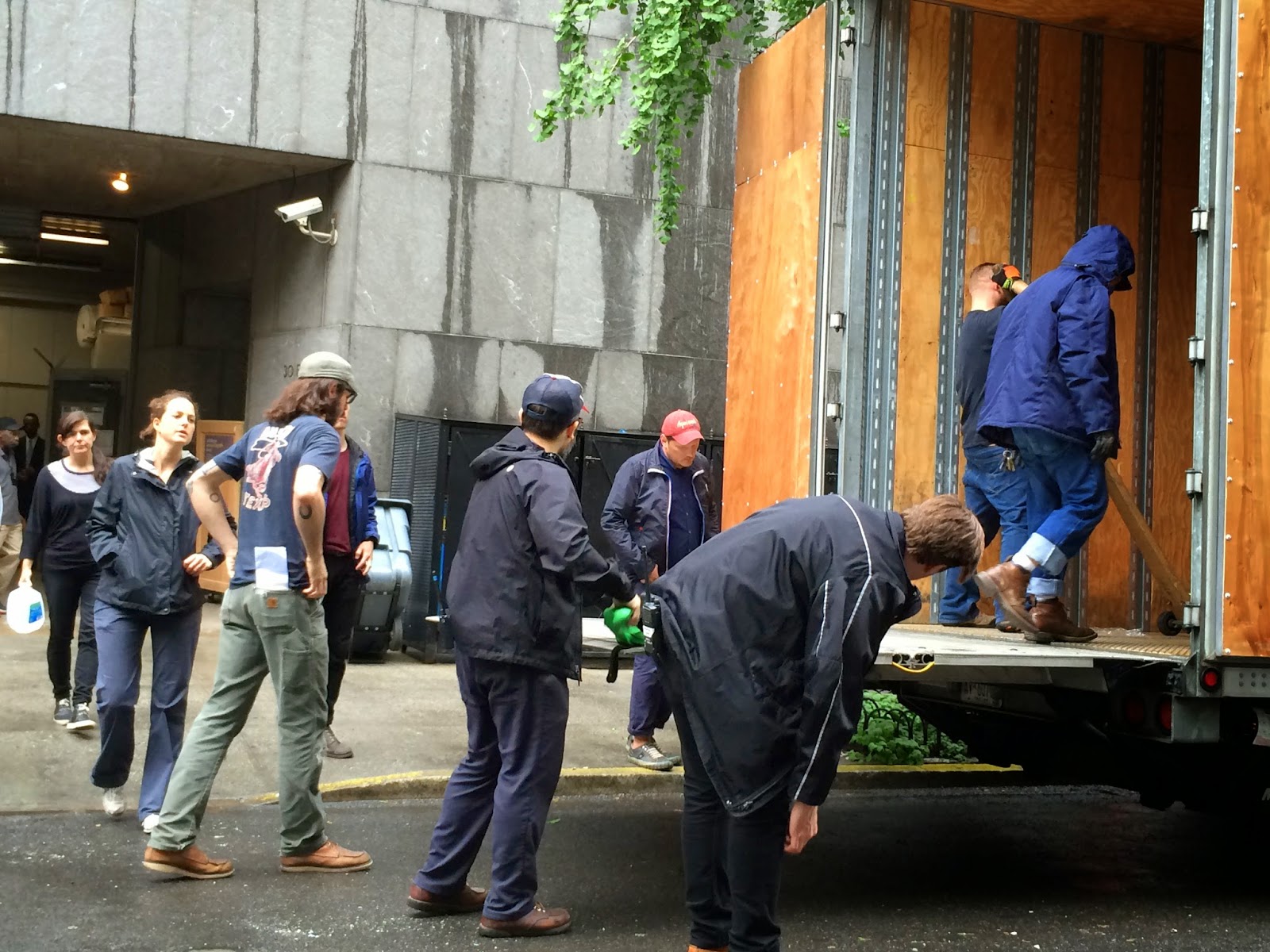
Moving Day in Bright Orange


How many people does it take to unload a Jeff Koons in a bright orange crate at the Whitney loading dock?

1 guy/driver from Marshall Arts (Martial arts. Get it? Well, it took me a while.)
1 forklift driver
3 guys with tape measures
1 guy with a walkie-talkie
1 guy with a horseshoe tattooed on his elbow, moving the bright green cones around
1 strong guy with a spider web tattooed on his elbow
1 woman with bright pink shoelaces in her sneakers
1 guy with purple sneakers
1 guy with a purple baseball cap (different guy)
1 guy with a Tweety Bird tee shirt
Lots of guys with bright green nylon ratcheted tie-downs
Several guys in black tee shirts

Not needed was the beekeeper on the roof

Friday, June 6, 2014

Sort of about cemeteries


Because tomorrow I am going to a memorial service for man who died several months ago in his late 90’s, and was a Christian Scientist, and because I was taught many years ago (when I was related, though marriage, to several very devout Christian Scientists, one of whom regarded a lapsed Catholic, like myself, with pierced ears and a predilection for saints, as a barbarian) that Christians Scientists do not believe in death and hence do not have cemeteries, I have naturally been thinking about cemeteries.
I never understood what exactly was meant when CS’s said they did not believe in death. It seemed to be like saying you did not believe you had five fingers. Or a nose.
Tomorrow’s deceased was not, according to his daughter, a particularly devout Christian Scientist, though the soi-disant religion and its practitioners figured in his life in important ways.

As fond as I am of cemeteries I have always disliked our family’s cemetery. Because it is ugly – mostly -and flat. It is not “our” family’s cemetery in a proprietary sense. It is simply the local catholic cemetery where my grandparents, all four of them, and my father and his brother’s wife are all buried, and where my mother and uncle will be buried at some future time. It seems shameful and shallow to dislike the burial place of one’s few ancestors simply on the grounds of its pedestrian ugliness. But what other grounds could I have?
My mother, who is nothing if not an arbiter of architectural correctness and the landscaping principles of Capability Brown, has never spoken ill of the cemetery in question. She is actually quite proud of her father’s tombstone, a Coptic cross. Her father was not a Copt, and tombstones over six feet high are disallowed by the diocese of Boston. But my mother prevailed against the episcopal powers-that-were, and erected an 8-foot high Coptic cross for her Belgian father’s tombstone. Long after she has forgotten the names of her grandchildren, my mother will gleefully recall her victory over the graveyard guidelines of the diocese of Boston.
My real fondness for cemeteries presumably began when I was at Milton Academy Girls School. Across the street was the Milton Cemetery, beautiful, undulating, and forested in parts, with a pond, Gothiccrypts, and aged fieldstones. We would sneak over there to smoke cigarettes and recite Coleridge, leaning against purple slate gravestones carved with luxurious weeping willows and winged cherubs.
Nowadays, at least once a year we stop by, or maybe only wave to, the graves of CSB’s great-grandparents, in the tiny cemetery in Bingham, Maine, on the shores of the Kennebec River where once massive logs floated down to Skowhegan.
In Duxbury, Massachusetts there is a classic old New England graveyard, where Jeff and I used to make rubbings of pithy epitaphs. I was pregnant with my first child, and it seemed to me then that half the graves belonged to young women who had died in childbirth, and the other half memorialized their infant children. Yet I kept going back there. Jeff’s memorial service was held in the adjacent Unitarian church in Duxbury, but he is not buried there, or anywhere.

Jeff and I never owned a plot in a graveyard anywhere. Neither have CSB and I pre-invested in a final resting place. Throw us to the winds.

One cold night this past January my friend Lis and I went outside to get into the car and drive to JFK. But there on the lawn in front of the house was a strange white van. On the grass. A man climbed out of the van and walked in our direction. I shouted out: Who are you and what are you doing here? Initially he could not speak coherently at all. I went inside to call the local police. Ten minutes later the local police had still not arrived. I called again. (We would learn later that the officer dispatched went to wrong address and finding no one home, returned to the station and did nothing. Yes, not reassuring.) Meanwhile, the van’s driver was wandering around the front lawn making plaintive noises, and insisting that he was not drunk.
Finally a young policeman arrived, and seemed quite relieved when he saw the van and the wandering man. He knew them both. He told us his name. The wandering man and his brother, descended from Italian stonecutters, own the local gravestone business. I had driven past their stone yard hundreds, maybe even thousands, of times on my way to the Cooperative Nursery School with the friendly dinosaur logo, sometime last century.
Finally, Lis and I headed to JFK to fetch the weary traveler. We were giddy. On the Major Deegan we were laughing uproariously because we thought the funniest thing imaginable was that this nighttime intruder who could not walk straight was in fact a carver of gravestones.
No one else seems to think this convergence of details is remotely funny. I still like to visit beautiful cemeteries.


Thursday, May 29, 2014

The persistence of a mother

This morning I received in the mail a package from my mother. Packages from my mother arrive with some regularly, more so now that she has embarked on clearing out her house. (More on that hilarious, futile and sometimes tragic endeavor, at another time. When I write another novel.)
This package came with a note: Dear Christine, Years ago, when Philip and I were in Greece I bought the enclosed, which I no longer wear – Hope you will like it and use it.
The enclosed, very securely scotch-taped to a piece of cardboard inside the box, is large dangly necklace with cabochons set in silver or a silver-like metal and all chained together to make a kind of V.
Here is the story:
She bought the necklace in Syria.Not Greece. I know, because I was there with her and we each bought one because they were amusing and very cheap.
The last time I was at my mother’s house, she showed me this necklace and asked me if I would like it. I said, No, thanks. I have one just like it and I never wear it. Please give it to someone else.
Hence: it arrives in the mail.