
During recent meetings about Leigh Fibers, textile waste processing company in Spartanburg, SC, I learned quite a lot about the challenges of the recycling industry. Nothing is easy when you are dealing with junk.
You do realize that the cheaper virgin materials are, the less like likely industries are to recycle or buy recycled products? For example, when oil is cheap, the interest in recycling used polypropylene drops through the trapdoor.
That is just one of the many depressing facts I learned in our 17th floor conference room.
But, honoring the delightful signage on the factory floor that a decade ago gave me Sort Quench, and Dump, I gathered a few other random phrases from the arcane world of recycling and manufacturing, always looking for interesting titles. Titles for what? That remains to be seen.
These are what I came with. I welcome your comments, and favorites.
SCRAP CONNECTIONS
PULPING CRIMPING STAPLE CUTTING
A NON-TRIVIAL PROBLEM
ZERO TO LANDFILL
LENGTH BEFORE DEGASSING
TRANSVERSE FISSURES
Showing posts with label Leigh Fibers. Show all posts
Showing posts with label Leigh Fibers. Show all posts
Monday, May 14, 2018

Tuesday, January 8, 2013
R.I.P. Philip Lehner
This is the notice that appeared in today's New York Times. What it doesn't say is how remarkable his death was, surrounded by his wife, a grandson and all five children, singing hymns and reciting poetry, Yeats, Kinnell, and Robert Service, specifically. (Though there was some concern that the off-key singing hastened his end.) We had brought him home from the hospital a week earlier to start with hospice care, and many friends and relatives were able to visit him at home and say good-bye. Saturday afternoon his closest friends from Central America, Alfonso and Carlos, arrived and visited with him - though by then be was not responsive. Still, his impressive eyebrows twitched until the last.
LEHNER--Philip, born October 24, 1924 of Hingham, MA, died peacefully at home on January 5, 2013, surrounded by family. The son of Hans Lehner, from Germany, and Germaine L'Eveque, from France, Philip was born in Boston.
 He entered Harvard College in 1941. During sophomore year, he was selected into the Navy Intelligence Service. After one year learning Japanese in a Navy intensive language program, he was stationed in Hawaii translating intercepted Japanese messages. Philip quickly was promoted to Lieutenant (jg), one of the youngest naval officers in WWII. At the battle of Okinawa, he interrogated Japanese prisoners.
 He assisted Admiral Jerauld Wright as a translator at the surrender of the Japanese naval forces in Korea, and joined an intelligence team to determine the Japanese military capacity. He returned to Harvard and graduated Phi Beta Kappa in 1948. He joined Leigh Textile Company, a family fiber recycling business based in Boston. Philip and his family members built Leigh Fibers into the largest textile and fiber reprocessing and recycling company in the United States. Leigh opened an office in Montreal and eventually became the largest textile waste company in Canada. On round-the-world voyages trading textile waste, Philip's facility with languages - German, French, and Spanish as well as Japanese - allowed him to form close relations around the globe. In the early 1960's Philip partnered with two other families from Central America, to establish Grasas y Aceites, S.A., which grew to be the largest vegetable oil mill in Nicaragua. Philip bought Cafetalera Aquiares, a coffee farm in Costa Rica that has become a model for ecologically sound management. Philip led his partners to invest in Ingenio Taboga, helping to build it into the largest and most sustainably managed sugar cane operation in Costa Rica. Philip loved sailing in Hingham Harbor and in Maine, passing on that love to all his children.
 Philip established funds at Harvard, Smith, MIT, Brown & Nichols, and Milton Academy, and supported environmental and childhood education programs. Philip is survived by Monique Brancart Lehner, his wife of 61 years, his brother Pete of Hingham, MA, five children - Christine (Chucker) of Hastings-on-Hudson, NY; Carl (Sandra) of Holderness, NH; Michael (Monica) of Boston, MA; Peter (Fritz) of New York, NY; and Brigitte Kingsbury (Hal) of Cape Elizabeth, ME, 15 grandchildren, and two great-grandchildren. Donations in Philip's memory may be made to: The Trustees of Reservations, 572 Essex Street, Beverly, Massachusetts 01915; www.thetrustees.org.
There will be a funeral service at St Paul's Church in Hingham, Massachusetts this Thursday, January 10th, at 11 a.m.
Thursday, May 6, 2010
Travel is broadening

While CSB hived the bees and the chicks grew into polychromatic feathered chickens of still-undetermined-gender, I was flying down to South Carolina seated next to a man watching a B&W movie on his laptop. I wish I could tell you that my eyes did not stray from my sheaf of business papers, riddled as they were with mysterious acronyms. But my eyes did, again and again.
 There was Tallulah Bankhead, afloat in the ocean with a bunch of men, and her hair only looked better with every passing day of starvation, thirst, seasickness and death-defying waves. Trying to be subtle, I looked over again and again to see how Tallulah and the men were doing, thinking perhaps that I would learn something useful in the unlikely event of a landing over water.
Don’t let the sheaf of papers fool you, for most of the flight down I was trying to recall the exact words of the witches’ false assurance to Macbeth.
"Macbeth shall never vanquish'd be until
Great Birnam wood to high Dunsinane hill
Shall come against him."
And why was it so important to know the exact words? Because all along the Whitestone Parkway there were forklifts moving good-sized cedars and poplars, looking like nothing so much as the Great Birnam wood on the move, and making me pity poor misguided & manipulated Macbeth.
Every day in South Carolina we drove from our hotel (think multiple prom dresses, some sketchy trips in the elevator and a whole girls’ soccer team) to the Leigh Fibers factory. (Leigh was started by my grandfather; my father, uncle, a brother and a cousin have all worked there since forever; the rest of us go down periodically in order to be less ignorant in the arcana of shoddy, combers, linters and aramids. )
On account of not opting for full coverage, I am not the person of choice to drive a rental car. But still, I experienced the gauntlet of temptation between the hotel and the ramp for I-85. Midway between the LOVE TEMPLE (U.P.H), about which certain imaginations get fervid, and the Krispy Kreme, about which my favorite daughter waxes poetic, is the world famous penis-burger of Spartanburg, SC. We don’t actually know if it is officially called the penis-burger, or if it is world famous, but we know what we thought it looked like. What else we don’t know is why.

Then came the OYSTER ROAST.
While I was eyeing the boiled peanuts and wondering how long it would take me to develop a taste for boiled peanuts, or whether I was genetically predetermined (the Walloonish strain) to never like boiled peanuts no matter how great the temptation, my father was coughing his way through yet another evening. His cough has persisted now for longer than any of us can remember; it is body-wrenching, esophagus-splitting, barrier-breaking and soul searching. It is beyond his control. Sometimes if he is very quiet it will stop for a while, but he likes to talk.
While we were shucking oysters with some of the finest oyster shuckers in South Carolina and Florida (try Googling oyster shucking mitts any time you seek some x-rated diversion), and slurping up those tasty members of the phlegm family, my father was choking on his dinner and passing out on his plate.
While we were digging into Low Country Boil, a dish hitherto unknown to me and now a favorite (among its many merits, it has neither boiled peanuts nor okra) my parents were in an ambulance on their way to the hospital, where they know the names of the children of all the ER nurses.
And I was in deep contemplation of chocolate covered strawberries when my mother finally reached the cell phone of one of her offspring.
(All of which may be one way of relating that I have been in South Carolina with all my brothers and sister and cousins, and then Massachusetts with my distressed mother and coughing father. He is out of the hospital.)
Tuesday, April 13, 2010
Forklift Rodeo, the Finale

Your blogger with Lamar Nelson, Forklift Rodeo Mastermind, Historian, Archeologist and Archivist

The course.
(Note: this was meant to be posted last night, but airlines delays got us home too late.)
Last night in the fragrant southern evening, swooning by the Mahonia (an evergreen shrub with dark blue berries named for the horticulturalist Bernard McMahan who introduced the plant from the Lewis and Clark expedition), amid my cousin’s woodland hellebores, we espied the holes of voles. Or moles. The more you try to distinguish between moles and voles, the more confusing it becomes. (Yes, I know the obvious answer.)
A little research leads me to believe the aforementioned must be voles, because moles are semi-aquatic, quasi-blind mammals that subsist mostly on earthworms, while voles are rodents sometimes called meadow mice and their diet consists of the roots of all the plants you especially like in your garden, and Douglas fir needles.
This morning we debouched from the Hampton Inn, situated snugly between Denny’s and Arby’s on Route 85 and just across from the worldwide headquarters of Cryovac, the Sealed Air Corporation, and headed back to the Forklift Rodeo for the nail-biting finale.
We are once again in the sunshine, gathered behind the Traffic Center at Leigh Fibers; on two sides we are sheltered by a copse of long-needle pines planted 50 years ago by Lamar’s father. A freight train rattles past the ridge just on the other side of the pines.
In the world at large the Polish president’s twin brother is overcoming his grief in order to take over his brother’s perch atop the Polish government; this will be a boon to geneticists as well as writers of international & political intrigue. In Malta they are debating whether or not to remove a certain vertical sculpture deemed to be potentially offensive to the Pope, as it would be almost the first thing he would see upon landing at the Malta International Airport in Luqa. In Italy they are celebrating the feast Margaret of Citta di Castello (died 1320). Her claim to fame is that she levitated while praying. Try it, and you will see that this is not simple.

We here at Leigh are holding our breath to know whether Brian Hunter will keep his spot at the top of the standings, or whether brother Hilton will beat his sibling’s time.

And now I can tell you. As of 3 pm, Brian remains in first place. Hilton performed admirably, coming in at 5:44. He held onto second place for several rounds, until Paul Hayes did the course in 5:35. Then Henry Bridges upset the rankings further by whipping through the course in 5: 39, beating out Hilton for third place, as well as beating his son, Cory’s time by almost three minutes. The triumph of experience over youth, hah!

The Hunter brothers taking sustenance.
Once again, the fun was not limited to nail-biting suspense, cutthroat competition and tallying the penalty times. A barbecued lunch of burgers, dogs and ribs was cooked and served up by Southeastern Forklift, one of the companies vying for the pleasure of selling 26 new forklifts and 48 batteries to Leigh Fibers. This catering coup was accomplished by none other than Organizer Extraordinaire, Lamar Nelson.

Scorekeepers, Course Managers and Contenders, Paul Middleton and Paul Hayes
The afternoon featured several competitors of the female persuasion, not one of whom had any previous experience on a forklift. Jennifer Lackey of HR blew away her competition (and vastly improved on her time of 2 years ago) with 15:35. Parris Hicks-Chernez was a speed demon on the course, but lost ground with her accumulated penalties (Several traffic cones lost their lives, or their shapes.)

Kathy Higaki of Marketing dressed for the occasion.
I could go on, but it’s time to fly home. This is especially frustrating because, so I am told by my sources, José Garcia, the last contestant to drive the course, is fast and efficicent and could upset all the current standings. So stay tuned.
Have I mentioned that the prizes are really great? (And donated, again, thanks to Lamar.)

Monday, April 12, 2010
Forklift Rodeo
In Chile, they may be celebrating Saint Teresa de los Andes for her short and holy life, and of course fishermen across the world are surely tossing out a lure in honor of Saint Zeno who is their patron saint, but here at Leigh Fibers in Spartanburg South Carolina, we are attending the triennial Forklift Rodeo.
The Forklift Rodeo is the brainchild of Lamar Nelson, the Shipping Manager here at Leigh. Lamar is a man of myriad interests and skills. He is part Cherokee and has built a sweat lodge in his Spartanburg backyard. His collection of arrowheads is a valued resource source for historians of South Carolina.Just for starters.
As we watch the men and women of Leigh Fibers drive their forklifts though a slalom course of traffic cones topped with tennis balls, lift bales without disrupting the bucket of water on top and perform other feats of speed and dexterity, Lamar tells me how they have identified the largest Holly Tree in South Carolina (or is Spartanburg County?) in the nature trail in the woods across from Leigh’s plant, where he has also identified at least sixty native plants (so far) including two varieties of orchid.
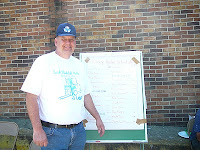
Lamar believes that maintaining one’s forklift skills should be entertaining, both to the driver and the spectator.
Several years ago he came up with the plan for a Forklift Rodeo at Leigh, and researched similar events on the web. He had to modify the course for the squeeze clamp forklifts used here to pick up the 600 lb bales of recycled fiber materials.
The result is a day of thrills, camaraderie, and great prizes.
It’s a deceptively hard course. Unlike the robots used to perform brain surgery, the forklift is not an overly sensitive machine. Or it is far too sensitive. Choose your excuse.
The task at Station #1 is to lift up 2 bales with a bucket of water on top, and get those bales to the dock and then back to their original spot, exactly, without losing more than an inch of water from the bucket. Each lost inch adds 30 seconds to your time.
At Station #3 you must grab and clamp a bale with a barrel on top and a soccer ball on top of the barrel, and get this wedding cake from x to y without losing the ball. We watch with baited breath as the ball careens from side to side across the top of the barrel, dangerously close to bouncing over the rim and off into the penalty zone (10 seconds).

At Station #10, the task is to clamp a bale wearing twin clown hats: two traffic cones with tennis balls perched atop each one, then take this package through a tight squeeze of bales with water filled balloons on top and on to the finish line. Without breaking a water balloon or losing a tennis ball.
There are penalties for lost water, a dropped balloon, for knocking off the soccer ball or tennis balls, and for dropping the bale outside of the drop zone.
As of this afternoon Brian Hunter broke the six-minute barrier and vaulted to first place with 5:15; Otto Johnson is in second with 5:59. Cathy Alexander (with the grey mullet, seen above.) made good time but lost a lot on penalties.
Your faithful blogger, having been granted a temporary and very provisional forklift Learner’s Permit*, did the course in 28 minutes and 1 second, with excellent coaching and no water buckets.
Lest you think it is all fun out there on the forklift course, be assured it is not. There are also tee shirts with a Western motif, designed by Parris Chernez-Hicks, and food. In particular, three homemade sheet cakes. Managing Director Heidi emerged briefly from the conference room to oversee the activities, and insisted upon digging into the chocolate cake. Being a world-renowned connoisseur of chocolate, she deemed it excellent. But Dee Dees, who actually baked the cakes, was distressed that we did not also try the strawberry cake and the Heath Bar Crunch cake, her favorites. We did. And they were good.
Tomorrow promises to be equally exciting, with several top contenders slated to perform the course, including several of last year’s top five, as well as ringers, Parris and Jennifer Lackey.
*If you are with the South Carolina Department of Motor Vehicles, I am only kidding.
The Forklift Rodeo is the brainchild of Lamar Nelson, the Shipping Manager here at Leigh. Lamar is a man of myriad interests and skills. He is part Cherokee and has built a sweat lodge in his Spartanburg backyard. His collection of arrowheads is a valued resource source for historians of South Carolina.Just for starters.
As we watch the men and women of Leigh Fibers drive their forklifts though a slalom course of traffic cones topped with tennis balls, lift bales without disrupting the bucket of water on top and perform other feats of speed and dexterity, Lamar tells me how they have identified the largest Holly Tree in South Carolina (or is Spartanburg County?) in the nature trail in the woods across from Leigh’s plant, where he has also identified at least sixty native plants (so far) including two varieties of orchid.

Lamar believes that maintaining one’s forklift skills should be entertaining, both to the driver and the spectator.
Several years ago he came up with the plan for a Forklift Rodeo at Leigh, and researched similar events on the web. He had to modify the course for the squeeze clamp forklifts used here to pick up the 600 lb bales of recycled fiber materials.
The result is a day of thrills, camaraderie, and great prizes.
It’s a deceptively hard course. Unlike the robots used to perform brain surgery, the forklift is not an overly sensitive machine. Or it is far too sensitive. Choose your excuse.
The task at Station #1 is to lift up 2 bales with a bucket of water on top, and get those bales to the dock and then back to their original spot, exactly, without losing more than an inch of water from the bucket. Each lost inch adds 30 seconds to your time.

At Station #3 you must grab and clamp a bale with a barrel on top and a soccer ball on top of the barrel, and get this wedding cake from x to y without losing the ball. We watch with baited breath as the ball careens from side to side across the top of the barrel, dangerously close to bouncing over the rim and off into the penalty zone (10 seconds).

At Station #10, the task is to clamp a bale wearing twin clown hats: two traffic cones with tennis balls perched atop each one, then take this package through a tight squeeze of bales with water filled balloons on top and on to the finish line. Without breaking a water balloon or losing a tennis ball.
There are penalties for lost water, a dropped balloon, for knocking off the soccer ball or tennis balls, and for dropping the bale outside of the drop zone.
As of this afternoon Brian Hunter broke the six-minute barrier and vaulted to first place with 5:15; Otto Johnson is in second with 5:59. Cathy Alexander (with the grey mullet, seen above.) made good time but lost a lot on penalties.
Your faithful blogger, having been granted a temporary and very provisional forklift Learner’s Permit*, did the course in 28 minutes and 1 second, with excellent coaching and no water buckets.
Lest you think it is all fun out there on the forklift course, be assured it is not.
 There are also tee shirts with a Western motif, designed by Parris Chernez-Hicks, and food. In particular, three homemade sheet cakes. Managing Director Heidi emerged briefly from the conference room to oversee the activities, and insisted upon digging into the chocolate cake. Being a world-renowned connoisseur of chocolate, she deemed it excellent. But Dee Dees, who actually baked the cakes, was distressed that we did not also try the strawberry cake and the Heath Bar Crunch cake, her favorites. We did. And they were good.
Tomorrow promises to be equally exciting, with several top contenders slated to perform the course, including several of last year’s top five, as well as ringers, Parris and Jennifer Lackey.
*If you are with the South Carolina Department of Motor Vehicles, I am only kidding.
Subscribe to:
Posts (Atom)


 Posts

