Translate

Showing posts with label hudson river. Show all posts

Monday, April 27, 2015

More False Departures / Encore les Faux Departs

The project continues, and I am getting to know this grandfather who wrote so lovingly of his family, and especially his wife – and in that matter I trust his judgment because she would later become my own beloved Bonne Maman.

Since you last heard, Bon Papa was en route to the Caltex headquarters in NY, planning to go to Cairo. He and his colleagues are traveling aboard the “Challenger” of the Union Pacific RR. He writes in loving detail of the towns and landscapes they pass through, especially the western vistas he so extravagantly admires: “Several ranches as described by Zane Grey”. Or: “Evanston, Utah = it was here I had my troubles with our Dodge car, 7 months ago, but that turned out well.” Or: “This evening we arrived in Omaha, the capital of Nebraska, the state always “dry”, which did not allow us, all evening, to enjoy our whiskeys. Frigid wind and we didn’t leave the station during our half hour stop.” Or: “From Albany, the capital of NY, we passed the Hudson River, whose banks are covered with ice. It is a beautiful spectacle – seen from our well-heated Pullman. The large factories on the riverbanks that I know: Phelps Dodge, Anaconda Copper Co, Fisher Body, De Lavat Steam engines…and many more. We arrived at the formidable Grand Central Station at 9 am.” (I translated formidable, the French, as formidable, the English. I know that is not properly correct, that it means something more on the lines of wonderful. But I like the word.)
While awaiting his Egyptian visa, Bon Papa worked at the office and toured New York, methodically and enthusiastically, and wrote about it for his wife.

On the 6th of February he learned that the Egyptian authorities had refused to grant him an entry visa. This news shocked my grandfather and shocked his boss at Caltex and even shocked the Egyptian consul. He had lived happily in Alexandria from 1931 to 1939, and had many friends and contacts in Egypt, friends who awaited his return.
That same afternoon, the General Manager asked Bon Papa if he spoke Spanish (he did, quite well). The G-M said (This is all written in French; the shabby translations are mine), “You know, perhaps, that the US is investing nearby to Santiago de Cuba about 20 miles from Guantanamo. $18 million for development of nickel and manganese, 2 metals absolutely necessary for war. And we miss a great deal of that. Time is pushing. The development will not be late in starting. This representation (“un chiffre d’affaire”) of the turnover of an oil field from $3 to 4 million per year, and we want it. You need to arrange that we will get this business. …Besides this, you know that the sugar business of Cuba are the largest in the world. Certain mills produce 15,000 tons of sugar cane per day. They are situated in the eastern provinces. Yours. We have to accept we have no clients; it is not acceptable and you need to correct this situation. There is the Cuban RR, but we have never had anything to do with them, and we would like to take our share of the profits. That would be one of your missions.”
About this new posting to Cuba, Bon Papa wrote: Here is the good American method. Precise, quick and broad. This work pleases me at the outset. I saw right away all the possible risks. There is a director and vice- director already in Havana, who would be the obvious ones to fill this spot. But they haven’t succeeded, it seems, and we have more hope in me.
I didn’t wait to study all that can help me in my new functions. I studied for 8 or 9 hours a day to better know the technical side of the exploitation of the mines, of sugar mills and railroads.
Every day I read aloud about 50 pages from a novel, in the Spanish language. I prepare eagerly.

And he went to movies. He went to a movie almost every day. As I translate, I am compiling a list of the movies he went to, imagining that I will see the same movies and know him better. Movies he saw from mid-January to the end of March, 1942 include but are not limited to: Tobacco Road, The Corsican Brothers, Chocolate Soldiers, Hudson Bay, Design for Scandal, Ruggles of Red Gap, Woman of the Year, Louisiana Purchase, The Mutinies of Elsinore, The Last of the Duanes, White Fang, Mister V, Remember the Day, Two Faced Woman, Riders of Sage Brush, Adventures of Martin Eden, Bedtime Story, Reap the Wild Wind, and Sullivan’s Travels.
He loved the moves, but I think he loved the Rockettes more. I have not kept count of his visits to Radio City Music Hall.
.


Saturday, July 14, 2012

What is really a river?

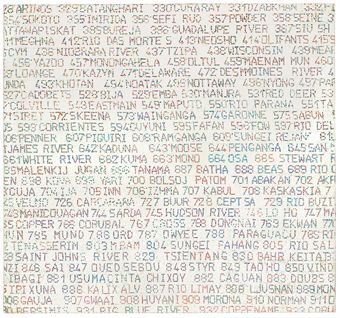
Perhaps because we think we are so very funny when we pose with objects of art, or with half-naked and very buff bouncers at some store on Fifth Avenue, my dear friends B and M-A (the only person I know who is actually, genuinely descended from/related to a saint: St. André Bessette) and I went to see the Alighieri Boetti show at MOMA yesterday. I will take some credit for having dragged them there; I have been longing to go since it opened. Boetti creates maps, or he created maps along with Afghani weavers, and I have been obsessed with maps since my days as a stellar student in parochial school making maps for everything, and dreaming of becoming a cartographer.

Until it became clear that modern mapmaking involved accuracy, and a facility with mathematics, and I headed straight for the funhouse of fiction.

And not only maps, but also words and letters. One huge woven piece listed the 1000 longest rivers on earth, in order. And while there may be agreement as to the 10 longest and even the 100 longest, after that it begins to require some research to determine the length of these rivers.
More than you would think. In fact the project was a 7-year collaboration of Boetti with his first wife. I get that.
I looked and looked for the Hudson River (315 miles long or 507 kms) and could not find it. I looked on the 2nd floor in the big atrium space where I saw the first iteration of I mille fiume piu linghi del mundo, and looked and looked, but could not find the Hudson River. Yes, I know that – though it looms large in my life and viewshed – the Hudson is not a huge river. But the last river listed, the 1000th, was the Agusan, (217.8 miles or 350 kilometers) on the island of Mindanao.
This is definitely shorter than the Hudson by almost 100 miles, unless Boetti was classifying the Hudson, as some hydrologists do, as an estuary all the way to Albany, which I suppose could make the ‘river’ part even shorter. But that seemed like the kind of distinction that could cloud the issue for countless bodies of water all over the planet, so I doubted it, and kept looking for the Hudson.
Up on the 6th floor where the bulk of the exhibition was, there was another version of I mille fiume piu linghi del mundo, also in descending order, but this time indicating their length in kilometers, rather than their ordinal value. And I kept searching for the Hudson. We found the Connecticut and the Osage and the Rio Plata, but we did not find the Kennebec (170 miles or 270 kms) where not so long ago forests full of vast trees floated down river to the mills of Skowhegan and Madison; nor did we find the Rio San Juan (119 miles or 192 kms), where Horatio Nelson lost his eye in 1780, while fighting the pirate Henry Morgan. Everyone in Nicaragua knows this for a fact, and they will tell you that his eyeball is still at the bottom of the Rio San Juan. Although if you contact the Nelson Society in London – which I did a few years ago - a very nice gentlemen will gently inform you that Nelson never lost his eye at all. And never in Nicaragua. He had a spot of malaria is all.
I did not stop there. At home I had a book with a reproduction of the I mille fiume piu linghi del mundo, and after not much time at all I found it: The Hudson River, there at spot #744. This was an enormous relief. (This was also an example of the kind of thing one can obsess about that serves ABSOLUTELY NO PURPOSE.) But to continue.
Right ahead of the Hudson, in position #743, is the Sarda. What and where is the Sarda River? It turns out this question is not so easily answered. The Sarda comprises part of the border between India and Nepal and that is the only uncontested thing about it. Some Nepalese call it the Mahakali River and other Nepalese, the Pahiri, call it Kali Gad. As the Kali River, its length is listed as 350 kms, or 217 miles. Also as the Kali, the river is famous for the Kali River goonch attacks, by the man-eating goonch catfish. But when I read about the Sarda River, it is given a length of 223 kms (138 miles) in Nepal and 323 kms (200 miles) in India, up to its confluence with the Ghagra River. And these two lengths add up to 546 kms, or 339 miles.
Just after the Hudson, is Lo Ho, in position #745. If you put Lo Ho into your internet search engine, you will get a bunch of real estate concerns in the lower east side of Manhattan, and only at the bottom of the page will you find: Lo Ho, also Ilo Ho, a river in China, 421 kms long, or Lo Ho, also Peilo Ho, another river in China, 500 kms long. “Geody” will give you Loho Jhal. Loho River in Baluchistan, Pakistan, and you can even see a Google earth picture that looks like the moon, or the beach at low tide with my footprints. But I think the one in Pakistan is what we know as the Daro River. Which begs the question as to why they have to alternately call it the Lo Ho, when the earth is already replete with Lo Ho’s. There is also a Lô River in Vietname – where they call it Song Lô – and that is 470 kms long.
Tragically, the index of my Times Atlas of the World, Seventh Comprehensive Edition, 11 pounds, lists no Lo Ho’s anywhere. There is a Loholoho in Celebes, and that is all.
Can you imagine going through this about 1000 times? I for one, think it would be lovely.