Translate

Friday, August 24, 2012

Another slippery slope to worry about


It turns out that the Vatican and I have more in common than our preference for funny hats and white robes with a simple – but elegant – gold trim.

Yes, we both worry about Global Warming.
Just last month the Vatican was so worried about GW that it allowed a priest in the tiny village of Fiesch, at the foot of the receding Aletsch Glacier, to alter a centuries old prayer. The old prayer asked for divine intervention to push back & shrink the glacier. The newly-authorized prayer asks the Almighty to do just the opposite: keep that glacier from getting any smaller.

But this is not the innocent volte-face it may seem. In fact this is a slippery slope if ever there was one, a Vaseline coated declivity straight to hell. A nosedive into that morass the pundits call ‘science’.

What is next?
Will the virginity of the BVM be questioned and then re-addressed, in light of her having actually given birth?
Will the Cardinals all have a conclave and decide to marry their childhood sweethearts?
Scariest of all, will it turn out the Shroud of Turin is not the genuine imprint of Christ’s pained face but your uncle’s precious rag for buffing his 1949 Chevy?


Monday, August 13, 2012

A few things about Georgian Bay, the science of food, and a quiz:


Before we could arrive at Georgian Bay we had to cross the border into Canada, and we did this at the Thousand Islands Bridge (really 5 connected bridges and I highly recommend it) over the Saint Lawrence Seaway. Once across the great divide (while more intensely guarded than I recall from my youth, its rigors cannot hold a candle to harassment at various Nicaraguan and Syrian borders I have had the pleasure of crossing) I felt the call the nature and wanted to stop. But RR was at the wheel, and the sharp words she had exchanged with the Canadian Border guard had upset her.
Border Guard: Are you bringing in any food, fruits or vegetables?
RR: No.
BG: What do you have in the back seat?
RR: Just some sandwiches and granola bars.
BG: Sandwiches are food.

So we did not stop at the handy rest area just after the border station but continued to Gananoque (rhymes with Cataraqui, if that helps.), and pulled into the first possible place, a Ramada Inn. And what a good idea that was. Because downstairs in the Ramada Inn, alongside the rest rooms, was displayed the world’s largest collection of Antique Blow Torches. Subsequent researches - at least 5 minutes on the Internet - have revealed that this is not as strange as it sounds; there is in fact a lively trade in antique blow torches on both eBay and Etsy. Upstairs at the Ramada Inn, no one would tell who was the guiding light of the blow torch collection. But if you are ever in Gananoque, I recommend a visit.


We kept driving. Next to come was Tiny.
Tiny is which of the following? 1. a term of endearment, 2. a descriptor of size, 3. a lady’s lapdog, 4. a township in Ontario, 5. A particle recently discovered by scientists using the Supercollider.
Besides being all of the above, Tiny is nearby to Penetanguishene which played some kind of part in the War of 1812 (Bicentennial Alert). One of the things that distinguish Canadians from Americans is that Canadians actually know something about the War of 1812, and we do not.
Here is what we did at the cottage on Tiny Beach: we swam, we wrote stories, we read books, we painted and we looked for Benji the lost dog. Some read more books, one of us drew beautiful sketches, and two of us even played the violins. I took numerous photographs of my feet on the sand and in the rocks.

But mostly, we cooked meals and then dined on the deck overlooking the expanse of Georgian Bay.


RR, our hostess at the cottage on Tiny Beach, was raised as a Christian Scientist and has a prodigious capacity for memorization. Hence, she can recite – with emphasis - the CS Statement of Being. Because my ex-late-husband was related to several, I once spent lots of time with Christian Scientists (neither Christian nor scientific, as has been noted elsewhere), and some of them I loved dearly. But to my shame, I never properly absorbed the CS S of B. I did this time, when RR displayed her mnemonic abilities and declaimed the S of B on the deck, as the uncannily warm waters of Lake Huron lapped the shore behind her. I listened carefully for once and I was shocked. I heard a doctrine that denied the very existence of what we did and enjoyed at Tiny.
“Spirit is immortal truth
Matter is mortal error….
Matter is the unreal & temporal…therefore Man is not material, he is spiritual.”

In other words, illness and death do not exist, and neither do pleasures of the flesh. Gastronomy, for instance.

Question for extra credit: Have you ever heard of a Christian Scientist chef? Are there any foods you associate with CS? Have you ever heard the name Mary Baker Eddy and the expression ‘fine dining’ in the same sentence?
A: Of course you have not, no, and no.

Aside from dining well in contravention of all CS tenets, I was reading John Lanchester’s Debt to Pleasure. This delightful novel is told by a (possibly) homicidal lunatic/gastronome and uses the conceit of seasonal menus to organize the narrative. Reclining on Tiny Beach with the warm waters of Lake Huron lapping at our toes (immersion in the water to thwart the biting sand-fleas), I also felt compelled to read aloud pithy and hilarious passages (and some pages had several) to my fellow recliners. Actually, the only person who was ever willing to listen was M-A, who had recommended the book to me in the first place and so was well acquainted with the very passages I chose to iterate. Lanchester’s narrator’s knowledge of edible and toxic mushrooms is legion, and the secret of his Croque Monsieur is Dijon mustard; I always thought that was my secret.
I promise you that when I made Croque Monsieurs one day for lunch I had not yet read the passage in Debt to Pleasure with Tarquin Winot’s recipe. It was an excellent lunch too, served with fresh tomatoes and followed by a clafoutis with Ontario peaches. We drank pink wine from Provence, about which much has been said on other occasions.


As mesmerizing as it was to hear the recitation of Mary Baker Eddy’s creed - her Statement of Being - I cannot say that we gave much thought to her repudiation of the mortal world as we dined on fresh vegetables, grilled lamb chops and homemade naan, and especially not as we drank the aforementioned pink wine from Provence. But on another occasion, I studied the kitchen cabinet replete with cereals and granolas (more of the not-food brought over the border by RR) boasting of their flax, bran, oats and grains edible and inedible, boasting of their benefits to health and digestion. And I wondered if there could be any connection between the invention of Christian Science (ca. 1879) and that era’s promulgation of ‘healthy’ and scientific eating methods, eating methods designed to give the opposite of pleasure. Consider John Harvey Kellogg (1852-1943): while superintendent of the Battle Creek Sanatorium, he formulated his ideas about eating and digestion. He extolled the benefits of a “squeaky clean intestine”, and to that end, he advocated nuts, ‘granose biscuits’ and enemas. No one has ever asked for a last meal of corn flakes. Kellogg’s like-minded contemporary Horace Fletcher was known as the “great Masticator” because he advocated that each bite be chewed 32 times. At which point all flavor and texture was effectively eradicated.
Could we lay the blame for the unfortunate scientification of food, at the tiny feet of Mary Baker Eddy?
Back to the splendors of Georgian Bay: we neglected to grill any local walleye (known for their excellent vision and sharp teeth), our own small dereliction of the exigencies of la gourmandise.


Oh, to happily split an infinitive

Yes, it is true. Fourteen years ago today, the Oxford English Dictionary declared that we speakers and writers of the English language were now allowed - encouraged even - to legally and gleefully split our infinitives. No more would we be put in the stocks by annoying pendants for declaring that we wish to quickly run to the store, in order to cheaply acquire some Calamine lotion for the poison ivy that afflicts several of our body parts. If the OED, the arbiter of all things grammatical and etymological, says it is okay to blithely split, then split away.

Monday, July 23, 2012

My mother battles the geese

You may know my mother, the estimable Monique, as the take-no-prisoners architectural historian, as the Maven of Fenestration, as the Correct Color tsarina and as the Ray Kroc of omelettes, but there is another side to her, a dark underbelly to all that sweetness and light, and just the other day that sinister side broke through the surface and shook her neighbors on Fulling Mill Pond to their very core.
Let’s just say it: Monique is a rabid anseri-phobe.
And her exquisite front lawn & gardens - not to mention her back lawn, orchard and surrounding fields – lure all the geese in a 50-mile radius, just as the Amazonian highlands lure seekers of hallucinations and insect-borne diseases.
Geese come to my mother’s lawn and nibble the greenery and leave their squirts of greenish goo. They honk incessantly. They honk without melody or rhythm. They defy her inhospitality. She shouts at them, cursing in French and Arabic. She waves her arms and stamps her feet. Upon waking in the morning you look outside to the perfect lawn extending far out back to the stone wall and the woods beyond. And littering, speckling, and ruining that perfect lawn will be dozens of geese, a gaggle as they are called on the ground. In the air they are called a skein or a wedge, but they are too fat or lazy to fly. And why should they, when the pickings are so delicious on my mother’s lawn?
So the other night we were having cocktails when we noticed an unusually large gaggle of geese on the front lawn. Monique decided to take up arms. She took out her slingshot, which is technically called a wrist rocket & was the gift of one of her bellicose sons, and went in search of projectiles. Specifically, she looked for pistachios. She told me she usually shoots pistachio nuts at the geese.

“Huh? Could this explain why you still have so many geese?” I asked.
“Of course not.”
But there were no pistachio nuts. I suggested pebbles. No, rocks. Rocks as large as possible, given that the idea is to injure the geese and discourage their tenure.
“We don’t have any rocks,” my mother said.
“This is New England,” I said. “Of course you have rocks.”
“Not on my lawn.”
So she went in search of artillery, and returned with a bag of gourmet pasta. Penne pasta. Then, holding the bag of penne pasta between her front teeth and armed with her wrist rocket, she went out to the front lawn and began shooting at the geese.
I cannot say for certain whether she actually hit a goose, but her shooing and shouting and Arabic imprecations did in fact move the geese from the lawn down towards the street. (Fulling Mill Pond is across the street, and if the geese have to be anywhere, they should be in the pond rather than the lawn.) The geese began crossing the street, and as sometimes happens on country roads, the cars driving by slowed down and then stopped to allow the geese to cross the road.
This infuriated my mother. To have gone to all this trouble to banish the geese, and then to have them coddled by namby-pamby animal-loving drivers, seemed profoundly unfair.
“Don’t slow down,” she shouted. “Run them over. Look what they’ve done.”
But the cars slowed and stopped, and the geese took their sweet time crossing the road.
“Step on the gas!” my mother urged them. “”Look at my driveway.” And indeed her driveway was as redolent of green & white-flecked squirts as a newly daubed Abstract Expressionist masterpiece.


Tuesday, July 17, 2012


I found this treasure in a box my mother unloaded on me last month. In it were reams of school papers from my academic heyday at parochial school (all those A+'s in religion), stacks of crayon drawings revealing a total lack of artistic talent, swimming certificates and this, from a ski trip to Ste Adele, Quebec sometime in the 1960's.Everything but this has gone straight into the recycling bin.
CSB took one look and said, "It's a good thing I know you now. Those glasses would have scared off a bear."
He did not mention the snowball hat or the braces.

Saturday, July 14, 2012

What is really a river?

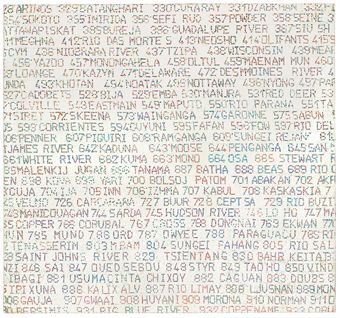
Perhaps because we think we are so very funny when we pose with objects of art, or with half-naked and very buff bouncers at some store on Fifth Avenue, my dear friends B and M-A (the only person I know who is actually, genuinely descended from/related to a saint: St. André Bessette) and I went to see the Alighieri Boetti show at MOMA yesterday. I will take some credit for having dragged them there; I have been longing to go since it opened. Boetti creates maps, or he created maps along with Afghani weavers, and I have been obsessed with maps since my days as a stellar student in parochial school making maps for everything, and dreaming of becoming a cartographer.

Until it became clear that modern mapmaking involved accuracy, and a facility with mathematics, and I headed straight for the funhouse of fiction.

And not only maps, but also words and letters. One huge woven piece listed the 1000 longest rivers on earth, in order. And while there may be agreement as to the 10 longest and even the 100 longest, after that it begins to require some research to determine the length of these rivers.
More than you would think. In fact the project was a 7-year collaboration of Boetti with his first wife. I get that.
I looked and looked for the Hudson River (315 miles long or 507 kms) and could not find it. I looked on the 2nd floor in the big atrium space where I saw the first iteration of I mille fiume piu linghi del mundo, and looked and looked, but could not find the Hudson River. Yes, I know that – though it looms large in my life and viewshed – the Hudson is not a huge river. But the last river listed, the 1000th, was the Agusan, (217.8 miles or 350 kilometers) on the island of Mindanao.
This is definitely shorter than the Hudson by almost 100 miles, unless Boetti was classifying the Hudson, as some hydrologists do, as an estuary all the way to Albany, which I suppose could make the ‘river’ part even shorter. But that seemed like the kind of distinction that could cloud the issue for countless bodies of water all over the planet, so I doubted it, and kept looking for the Hudson.
Up on the 6th floor where the bulk of the exhibition was, there was another version of I mille fiume piu linghi del mundo, also in descending order, but this time indicating their length in kilometers, rather than their ordinal value. And I kept searching for the Hudson. We found the Connecticut and the Osage and the Rio Plata, but we did not find the Kennebec (170 miles or 270 kms) where not so long ago forests full of vast trees floated down river to the mills of Skowhegan and Madison; nor did we find the Rio San Juan (119 miles or 192 kms), where Horatio Nelson lost his eye in 1780, while fighting the pirate Henry Morgan. Everyone in Nicaragua knows this for a fact, and they will tell you that his eyeball is still at the bottom of the Rio San Juan. Although if you contact the Nelson Society in London – which I did a few years ago - a very nice gentlemen will gently inform you that Nelson never lost his eye at all. And never in Nicaragua. He had a spot of malaria is all.
I did not stop there. At home I had a book with a reproduction of the I mille fiume piu linghi del mundo, and after not much time at all I found it: The Hudson River, there at spot #744. This was an enormous relief. (This was also an example of the kind of thing one can obsess about that serves ABSOLUTELY NO PURPOSE.) But to continue.
Right ahead of the Hudson, in position #743, is the Sarda. What and where is the Sarda River? It turns out this question is not so easily answered. The Sarda comprises part of the border between India and Nepal and that is the only uncontested thing about it. Some Nepalese call it the Mahakali River and other Nepalese, the Pahiri, call it Kali Gad. As the Kali River, its length is listed as 350 kms, or 217 miles. Also as the Kali, the river is famous for the Kali River goonch attacks, by the man-eating goonch catfish. But when I read about the Sarda River, it is given a length of 223 kms (138 miles) in Nepal and 323 kms (200 miles) in India, up to its confluence with the Ghagra River. And these two lengths add up to 546 kms, or 339 miles.
Just after the Hudson, is Lo Ho, in position #745. If you put Lo Ho into your internet search engine, you will get a bunch of real estate concerns in the lower east side of Manhattan, and only at the bottom of the page will you find: Lo Ho, also Ilo Ho, a river in China, 421 kms long, or Lo Ho, also Peilo Ho, another river in China, 500 kms long. “Geody” will give you Loho Jhal. Loho River in Baluchistan, Pakistan, and you can even see a Google earth picture that looks like the moon, or the beach at low tide with my footprints. But I think the one in Pakistan is what we know as the Daro River. Which begs the question as to why they have to alternately call it the Lo Ho, when the earth is already replete with Lo Ho’s. There is also a Lô River in Vietname – where they call it Song Lô – and that is 470 kms long.
Tragically, the index of my Times Atlas of the World, Seventh Comprehensive Edition, 11 pounds, lists no Lo Ho’s anywhere. There is a Loholoho in Celebes, and that is all.
Can you imagine going through this about 1000 times? I for one, think it would be lovely.