Translate

Showing posts with label flannery o'connor. Show all posts

Tuesday, December 23, 2014

Nothing in Common Goes South, Part 2, Day 9 or 10, or both

Day by day our relationship deepens. We are in sync. Often we don’t even need to communicate with words, so visceral is the connection.
William Shatner and I have gone from mere acquaintances to bosom buddies, BFFs, bonded at the hip and the fingertip. I honestly don’t know how it is for the rest of you, because I know William Shatner is pointing at me personally and that he is doing his best negotiating on my behalf. I know that when Captain Kirk is putting up his dukes, he is doing it to assure me alone (& CSB by association) the best possible price at the No-tell Motel in Savannah, Georgia. In fact, Captain Kirk directs us to the Cotton Sail Hotel, in an old cotton warehouse and with a river view. One morning we will watch a container ship slide by, and I will be thinking of William Shatner.

There are many wonderful things to see and do in Savannah, most of which involve old houses, lovely squares, and cemeteries, but it goes without saying that the one thing above all I long to visit in Savannah is the childhood home of Flannery O’Connor, at 207 East Charlton Street, off Lafayette Square, and a stone’s throw from the ginormous Cathedral of St John the Baptist.
I am particularly eager to see the “kiddie koop” Flannery slept in as a babe, because my mother had the identical model of "kiddie koop"* for us, including the screened top, and I used it a generation later for my number one daughter when we lived in a house on the salt marsh with a vast and various population of biting spiders.
According to the guidebook and the website, the house is open from 1 to 4 pm, on Wednesday through Sunday. Or we could say: it is closed on Mondays and Tuesdays. I have timed our travels to ensure that we are in Savannah on the proper days.
I am also eager to see the backyard where Flannery raised the chicken that learned to walk backward – a news sensation in the late 1920’s. http://www.britishpathe.com/video/do-you-reverse-1
So after lunch on Wednesday we walk over to East Charlton Street. And here I am, sad, bereft and downtrodden, because for reasons unknown and clearly spurious, Flannery O’Connor’s childhood home is CLOSED when it is meant to be open. I call the number listed on the sign and leave a rather long message to the effect that I am bereft, sad and downtrodden that the house is closed and that I have made a special trip from the land of Yankees to visit it, and someone should call me immediately to explain and rectify the situation.
No one calls.
The house never opens while we are in Savannah.

This is me, sad, bereft and downtrodden outside Flannery O'Connor's closed Childhood Home.
Just now I revisited the website and found this message, which was not on their website back when we were in Savannah, and perhaps was put on the website in response to my pathetic and tragic phone message.
We apologize that we will have several exceptions to our regular hours over the next few months, and appreciate your patience with our changing schedule. If you are devastated that your trip to Savannah will not be complete without a tour of the Childhood Home, please get in touch via email with a week or so notice, and we will make a heroic, if not always successful, attempt to accommodate.

Or maybe I just should have put William Shatner onto the case of Flannery O’Connor’s childhood home?


*Through the miracle of Google, I have learned many poultry farmers are using kiddie koops for their chickens. Or they are on the Internet.

Friday, November 21, 2014

Nothing in Common Goes South, Part 2, Day 5: All the Andalusias


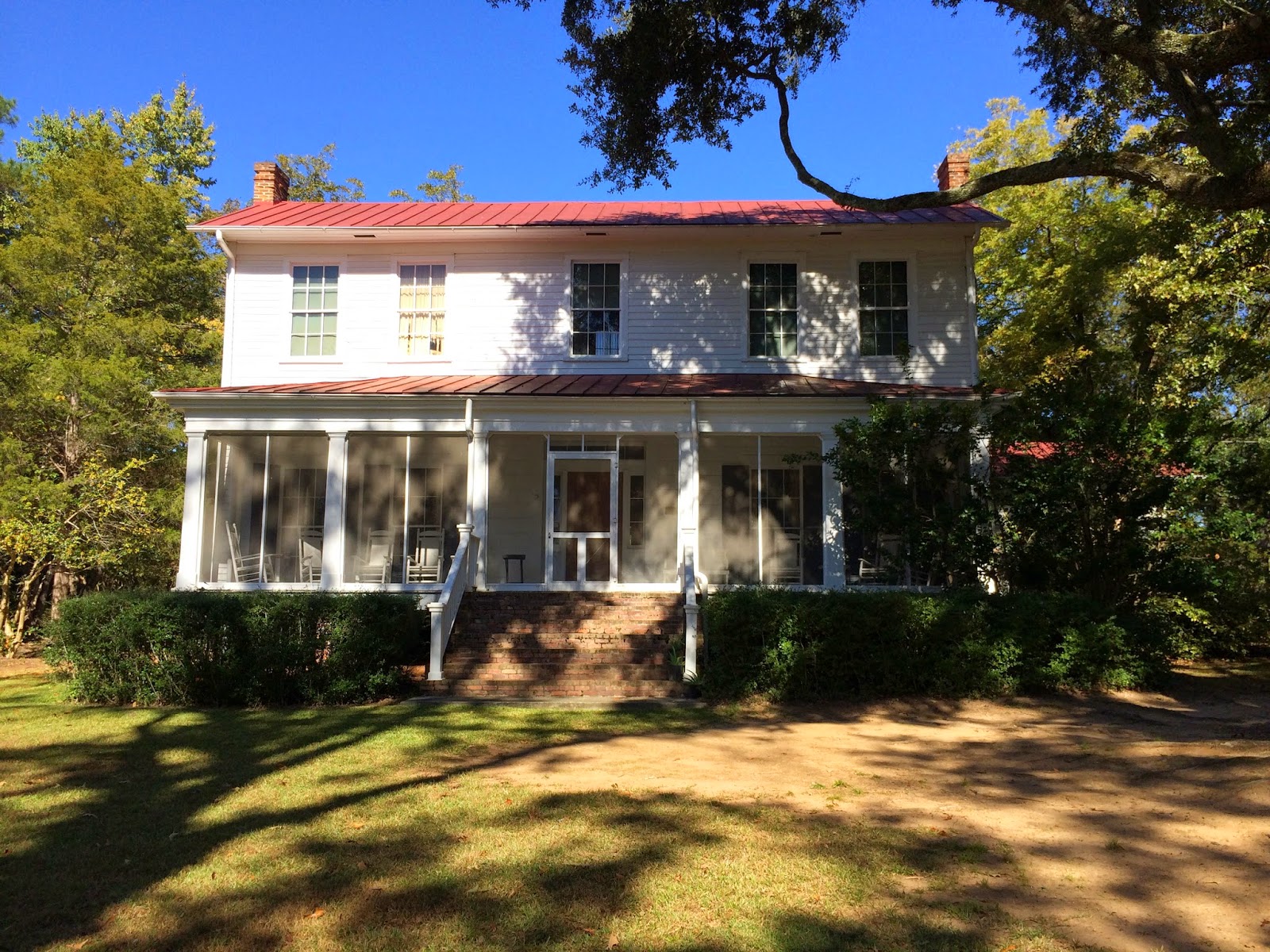
Andalusia is not only an autonomous region in Spain. It is also the home of Flannery O’Connor, where she wrote most of her great stories and where her mother managed a dairy farm. It was the home of over fifty peacocks and other fowl, both exotic and ordinary.

The name Andalusia, the autonomous region in southern Spain, comes from the Arabic: Al-Andalus. Most Spanish words starting with al derive from the Arabic; I love knowing this simple fact, and conjuring up the words that comprise that group: words for cotton, lunch, warehouse, and pillow. The origin of the name Andalusia, the former dairy farm in Milledgeville, is shrouded in the mists of time and the Spanish moss.

Andalusia is in the town of Milledgeville, Georgia. When O’Connor and her mother lived and farmed there, it was considered to be outside of town and in the country. Now it shares its address of North Columbia Street - also known as Route 441 - with a Ford dealership, Holiday Inn, Econo-Lodge, Wal-Mart and more chain store you haven’t even heard of, Appleby’s, Domino’s Pizza, Papa John’s, Firehouse Subs and Longhorn Steakhouse. That is, Andalusia is tucked between strip malls and is across the street from strip malls, miles and miles of strip malls, leading into the older downtown of Milledgeville.

Unlike most people in my demographic (Yankee, geeky, parochial) I have known of Milledgeville for a long time, that is to say, I have known it is a place in Georgia where Flannery O’Connor lived with her peacocks and her mother.

I knew nothing else about Milledgeville. I never knew that it was, from 1804 until 1868, the capital of Georgia, which explains why the enormous pink stucco Greek revival mansion is known as the Old Governor’s Mansion. I had no idea that Milledgeville’s Georgia State Lunatic, Idiot, and Epileptic Asylum was once the largest mental institution in the world.* Nor did I know that for most Georgians, Milledgeville is best known as the home of this vast mental institution. According to April Moon, the lovely docent at Flannery O’Connor’s house, when she told her grandparents she was moving to Milledgeville, they asked if she was crazy. If you tell someone in Georgia you used to live in Milledgeville, they will ask, “When did they let you out?”
This is the Green Building at the Central State Hospital. From 1947 until 1977 it housed "white convalescent patients who suffered from conditions such as schizophrenia. These patients were likely to never leave."

I did not know that in 1825 the Marquis de Lafayette, by then a hero of two revolutions, visited Milledgeville and was honored with a barbecue and a formal ball.

Andalusia has always been in the back of my mind as a place I wanted to visit, if I ever got to southern Georgia. Over time it became clear, even to me, that I would never happen to be in southern Georgia, and that I would need to purposefully go to southern Georgia in order to see Andalusia. CSB had no idea that he too had always longed to see Andalusia.

So we brave the strip mall gauntlet and turn into the dirt driveway where a smallish sign announces “Andalusia” and we drive through a grove of cedars, oaks and longleaf pines up to the old farmhouse.
We walk through Flannery O’Connor’s house and admire the 1950’s refrigerator she proudly bought with the earnings from her first novel. We also admire the chicken costume sewn by the lovely docent, April, in homage to O’Connor’s penchant for sewing clothes for her chickens. One of the things I come away with from Andalusia is the understanding that I don’t love my chickens nearly enough. It would never occur to me to name our rooster Haile Selassie. Down the gentle hill from the farmhouse is a pond, surrounded by tall oaks and noisome with frogs. My delight upon spying a turtle basking in the mud at the edge of the pond is perhaps hyperbolic. I have no picture because the thing about turtles in ponds is that they blend in so well: their brownish carapace is one with muddy shores. This is how they avoid being constantly annoyed by people, like me, who are endlessly intrigued by the very fact of a turtle.
Because it is a simple farmhouse, because the oaks are taller now and getting taller, because the yard has its share of rusted farm tools, because there are only three peacocks left and they reside in an apiary because there are coyotes about, because it is so close and yet so far from the strip malls, Andalusia is absolutely worth going all the way to southern Georgia.

* This is such an amazing fact that I have to credit my source: A Literary Guide to Flannery O’Connor’s Georgia, by Sarah Gordon. U of Georgia press, Athens: 2008

Thursday, November 14, 2013

Nothing in Common goes South, Day #1

How long has it been since we first mooted this brilliant idea of a southern road trip? All I know is that since that initial glimmer of a trip that would include literary shrines, Nascar races, country music and Civil War battlefields, the trip was delayed, postponed, and postponed again; and always for a reason: it was planting season, or bee season, or too hot or too cold, or one of the dogs was ill, or a relative was dying. Since that initial glimmer I managed to forget much of the reading I did in preparation for the trip. (The annals of Yoknapatawpha County; Look Home Sweet Homeward; A Good Man is Harder than Ever to Find; Delta Gay Wedding; and Carl Carmer’s Stars Fell off Alabama.) CSB was in better shape, since he made the wise decision to engage in no preparatory reading.
First we had to clear the dates with the chicken sitters and the dog sitters, because we are blessed with most excellent chicken sitters and dog sitters. And then we had to be fairly sure that no one was likely to be born or get very ill while we were away. And of course the garden had to be more or less finished for the season.
Then it was Halloween - and we never get trick-or-treaters here at Let it Bee Farm because it is rather lonely and there is a long driveway and in every way it is ideally suited to scare small children in the dark - and we set off. The first adventure was getting lost in New Jersey. How can you get lost heading straight south on a highway in New Jersey? It’s not as if I have not driven into or through New Jersey before. But while CSB was reading the Times, I managed to get on I-95 instead of the NJ Turnpike, or something like that. I was afraid that we might miss the Walt Whitman rest area. I didn’t actually plan to stop at the Walt Whitman rest area but I just like to consider the delightful randomness of a thruway service plaza named for a radical, freethinking, tree hugging poet. Otherwise, the rest areas/service plazas in New Jersey are a great opportunity to use Google while driving. You want to know the real story of Molly Pitcher? Google her and you will learn that she may not be an actual person, but a composite. But if she was a real person, her name was probably Mary Ludwig Hays McCauley, whose husband fought with the Continental Army at Valley Forge, and Mary traveled along with them and brought water (pitchers of water) to the soldiers. You will also learn that Fort Bragg holds an annual “Molly Pitcher Day” when they demonstrate weapon systems for the whole family.
In quick succession, we traversed New Jersey, Delaware, and Maryland. That morning and afternoon of traversing whole states was tantalizing and deceptive, and reinforced my skewed notion of the size of the rest of the states of the United States. If where I live is the center of the universe, the apex of civilization, and the Omphalos of the world, (and is it not?) then surely everything else is smaller and ancillary. How very wrong. Our first day would be the last day when we would get across any state in less than a day.
The excitement of day one involved neither a literary shrine nor a battlefield or even country music. They were bears. Bears high in a tree. Very high in a tall oak tree. On the Skyline Drive in the Shenandoah National Park we encountered a mother bear and a cub collecting and munching on acorns. (Sadly, the photographic evidence is more like evidence of my sub-par camera skills.)) It was a rather skinny oak tree, and they were about fifty feet high and incredibly agile. I feel confident that had I ever gotten that high up in a tree I would not have scampered from limb to limb and managed to gather acorns at the same time. I feel even more confident that if my cub were on the limb just below me I would have been apoplectic with worry lest he fall. The wind was blowing, and the oak tree was swaying in the wind, and the bears on the limbs were swaying, and still they collected acorns.
Of course I was entranced. How many times have I not seen a moose in Maine? Close to a thousand times. Yet here I had just barely entered the Shenandoah and I saw bears. Not suburban bears scavenging in garbage. But happy National Park protected bears bulking up for the winter.