Translate

Showing posts with label william shatner. Show all posts

Tuesday, December 23, 2014

Nothing in Common Goes South, Part 2, Day 9 or 10, or both

Day by day our relationship deepens. We are in sync. Often we don’t even need to communicate with words, so visceral is the connection.
William Shatner and I have gone from mere acquaintances to bosom buddies, BFFs, bonded at the hip and the fingertip. I honestly don’t know how it is for the rest of you, because I know William Shatner is pointing at me personally and that he is doing his best negotiating on my behalf. I know that when Captain Kirk is putting up his dukes, he is doing it to assure me alone (& CSB by association) the best possible price at the No-tell Motel in Savannah, Georgia. In fact, Captain Kirk directs us to the Cotton Sail Hotel, in an old cotton warehouse and with a river view. One morning we will watch a container ship slide by, and I will be thinking of William Shatner.

There are many wonderful things to see and do in Savannah, most of which involve old houses, lovely squares, and cemeteries, but it goes without saying that the one thing above all I long to visit in Savannah is the childhood home of Flannery O’Connor, at 207 East Charlton Street, off Lafayette Square, and a stone’s throw from the ginormous Cathedral of St John the Baptist.
I am particularly eager to see the “kiddie koop” Flannery slept in as a babe, because my mother had the identical model of "kiddie koop"* for us, including the screened top, and I used it a generation later for my number one daughter when we lived in a house on the salt marsh with a vast and various population of biting spiders.
According to the guidebook and the website, the house is open from 1 to 4 pm, on Wednesday through Sunday. Or we could say: it is closed on Mondays and Tuesdays. I have timed our travels to ensure that we are in Savannah on the proper days.
I am also eager to see the backyard where Flannery raised the chicken that learned to walk backward – a news sensation in the late 1920’s. http://www.britishpathe.com/video/do-you-reverse-1
So after lunch on Wednesday we walk over to East Charlton Street. And here I am, sad, bereft and downtrodden, because for reasons unknown and clearly spurious, Flannery O’Connor’s childhood home is CLOSED when it is meant to be open. I call the number listed on the sign and leave a rather long message to the effect that I am bereft, sad and downtrodden that the house is closed and that I have made a special trip from the land of Yankees to visit it, and someone should call me immediately to explain and rectify the situation.
No one calls.
The house never opens while we are in Savannah.

This is me, sad, bereft and downtrodden outside Flannery O'Connor's closed Childhood Home.
Just now I revisited the website and found this message, which was not on their website back when we were in Savannah, and perhaps was put on the website in response to my pathetic and tragic phone message.
We apologize that we will have several exceptions to our regular hours over the next few months, and appreciate your patience with our changing schedule. If you are devastated that your trip to Savannah will not be complete without a tour of the Childhood Home, please get in touch via email with a week or so notice, and we will make a heroic, if not always successful, attempt to accommodate.

Or maybe I just should have put William Shatner onto the case of Flannery O’Connor’s childhood home?


*Through the miracle of Google, I have learned many poultry farmers are using kiddie koops for their chickens. Or they are on the Internet.

Tuesday, November 25, 2014

Nothing in Common goes South, Part 2, Day #6

We are pulling out of the vast campus that used to be the Georgia State Lunatic, Idiot and Epileptic Asylum, when my cell phone rings. I see on the caller ID that it is Bill P, and I know that something is up with my mother. He tells me that the police will be hand-delivering the notice from the Dept. of Transportation revoking my mother’s license. (I am visited by an eerie recollection of the time when Lilla’s late-lamented mother was likewise visited by the local police, in North Wales, likewise on account of her driving mishaps, and she sent the constable to the back - that is the servants’ - door. This, of course, will not be an option at my mother’s house.) Knowing that my mother will quickly pocket the document, then hide it, and then forget where she has hidden it, I ask Bill if he can possibly get me a copy. He says he will try.
We are driving south, toward the southernmost point of our journey, which will be Waycross, Georgia, the gateway to the Okefenokee Swamp, the swamp I have longed to visit, the swamp I have dreamt of, the swamp I have imagined, the swamp inhabited by a witty and wise Possum, a cigar-smoking Alligator, and an owl who speaks in dark Gothic script. On the way we pass cotton fields, lots of cotton fields. If you live in southern Georgia cotton fields, fields of cotton, are not an exotic sight. If you live outside NYC, they are. So I want to stop the car and walk into a field of cotton and actually pick some cotton and extract the cottonseed. CSB pulls over, and as I get out, he warns me about: rattlesnakes, fire ants, and crackers with guns. He stays in the car and watches as I cross the ditch and wander into the cotton.

Many years ago I read that Aldous Huxley* had a specially constructed traveling trunk in which he kept the entire set of the Encyclopedia Britannica. Presumably it was the iconic 11th edition, all 29 volumes. Those were the halcyon days of porters. Because Huxley could not imagine traveling without that wonderful source of knowledge, that repository of obscure facts and incontrovertible argument-winner. I love this detail because I too cannot imagine traveling without having the population of Macon, Georgia or the number of bales of cotton produced by South Carolina (400,000) or the symptoms of lupus, as suffered by Flannery O’Connor, at my fingertips.
I cannot verify Huxley’s bespoke trunk anywhere. I have looked in all the obvious places (the encyclopedia) and some less obvious. I would give quite a lot to find the source. I would be sad to learn it was Somerset Maugham who had the bespoke trunk, but I would accept the fact gracefully.
Unlike Aldous Huxley, or whoever it was, we do not have to carry around 144 pounds of information and develop incurable curvature of the spine, because we have iPhones and on my smart talking pink device I can look up ….almost anything. One of the many delights we discovered on our road trip was that in the Wikipedia entry for more or less every town in American, along with the demographics, geography and history, there is a section called: Notable People. All sorts of small towns have all sorts of notable people. True, most of them are high school football players. Then there are the surprises.
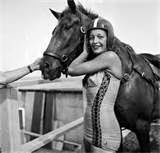
Among the notable residents, past and present, of Waycross, Georgia, I doubt there is anyone quite as intriguing as Sonora Webster Carver, the Horse Diver.
I very much hope I am not the only person who has never before heard of – or even conceived of - horse diving as a career option. It was in 1923 that Sonora ((1904-2003) responded to an ad seeking a horse diver, placed by William “Doc” Carver. He signed her on and soon she was the star of the show: riding a horse up to a sixty-foot tower and then hanging on for dear as it dove into a puddle below. Sonora soon married Doc’s son, Al, who took over the show and brought it to the Atlantic City Pier. That was where Sonora was blinded, when she hit the water off balance. But she kept right on diving with her horse for another 11 years.
It seems worth noting that she lived to be 99 years old.

And now it is time to reignite my torrid relationship with William Shatner.

*Based on the number of books she owned by each author, Aldous Huxley was my paternal grandmother’s second favorite writer, between H.G. Wells, #1 by a long margin, and Tagore at #3.