Translate

Showing posts with label waycross georgia. Show all posts

Saturday, December 13, 2014

Nothing in Common Goes South, Part 2, Day 8 something

What we see between Waycross and Savannah


What we don't see between Waycross and Savannah, or anywhere else

An old wooden church, in the vernacular style, that CSB has read about, and wants to see, because he loves old buildings and in particular old buildings on the verge of collapsing and in need of restoration, called the Smyrna Church. We drive down the Smyrna church road which quickly becomes a very rutted dirt. We see houses falling down and lots of beautifully weathered old timber. We see porches separate from their houses. We see a couple of donkeys and several chickens. We have seen so many other churches, but we don't see the Smyrna church.

The island of Sea Island
So, having spent vacations on Sea Island when he was a lad prone to falling into scuppernong bushes, CSB wanted to show me the place. We took a few wrong turns – I was following the church signs and not the road signs – and crossed a few bridges, and finally found ourselves at the gatehouse for Sea Island. Where there was an armed guard. A very polite armed guard.
CSB pulled up.
Guard: Your name, sir.
CSB gave his name and explained he wanted to show his dear wife some of the settings of his boyish escapades.
Guard: Do you have a property on the island, sir?
CSB: No as I explained…
Guard: Sir, do you have reservations here?
CSB: No, we just want to drive through and see the old place.
Guard: I am afraid you can’t do that, sir.
CSB: We can’t?!
Guard: I believe you can call the Cloisters and reserve a room – they start at $500 a night.
CSB: What if I just told you I have a reservation at the Cloisters?
Guard: I would call the desk to confirm that, sir.
CSB: What if we just drove through the barrier and took a quick look?
Guard: I would call the police and they would arrest you, sir.
CSB: What if my wife takes a picture of you rejecting us and posts it on her blog?
Guard: That is her privilege, sir. Then I would have to arrest her.

Sunday, December 7, 2014

Nothing in Common Goes South, Part 2, Day Seven - "It's a finger of speech."

All I knew was that I really wanted to go to the Okefenokee Swamp and that I had wanted to go there for as long as I could remember. When we planned NiCGS, Part 2, the idea was that the Okefenokee would be our southernmost terminus, and everything else fell into place around that point.
Then one day came the coup de foudre, the light-dawns-over-Marblehead-moment, the Jupiter-zap: Pogo Possum lived in the Okefenokee Swamp. Many years ago, in my bean sprout days, my father read Walt Kelly’s Pogo in the Boston Globe every morning. It amused him. I didn't get the satire on political campaigns, or the mockery of Joe McCarthy as Simple Malarkey, and the Jack Acid Society…but I could get that it amused my father. He approved of Pogo.
So it wasn’t really the swamp I was after, but some glimmer of a memory of my father, some connection to the father that in fact I knew very little because he traveled so much and when he was around, he was more interested in the three sons. I couldn’t get his attention when I was a child, but I could pay homage to the wit and wisdom of Pogo and Albert the Alligator and I too could quote Pogo: “Don’t talk life so serious…It ain’t no how permanent.”

So from a simple ‘wildlife adventure’, our trip to the Okefenokee is transformed into a pilgrimage, a quest of sorts. I am looking for Pogo Possum, in order to find my father.
CSB is agreeable. True, it isn’t Andalusia, but he is happy to come to the swamp. He recalls going there as a boy with his father: they rented a canoe and paddled under looming cypresses. It was mysterious and hidden. They surprised alligators and were surprised by water moccasins. He does not recall any possums, but he wasn’t seeking one either.
After a long day driving (recall the daring foray into the cotton fields) we eat in, happily ensconced at the Waycross Comfort Suites -thanks to more repartee with my guy, William Shatner. We dine on car snacks: nuts, dried tomatoes, clementines, and dark chocolate, and drink some white wine. (Foolishly, we leave the white wine behind in the Comfort Suites mini-frig, and we will regret this.) Here is our view:

The next morning, it is bloody-hell, nose-numbing freezing cold the next morning. In Waycross, Georgia. On the cusp of the Okefenokee. Almost into Florida. I am outraged and indignant. Also very cold.

Upon cursory reading of the website, it becomes obvious that we will give a pass to the Okefenokee Swamp Park, with its Serpentarium and ‘railroad’ tours, and go further south to the Okefenokee National Wildlife Refuge.

This involves a lengthy chat with the lady at the entrance booth. She is wearing a lilac sweater. She is friendly, very friendly. She wants us to buy a Yearlong Senior Pass to National Wildlife Refuges. “A great deal,” she says. “That y’all won’t regret.” CSB hesitates because we are unlikely to go to another wildlife refuge this year. She is insistent. CSB mentions that there is a car waiting behind us. She says we needn’t worry. CSB says that back in New York that car would be honking impatiently. (He does not specify that he would be the one honking.) She is interested to learn that we are Yankees from New York. She tells CSB that y’all in New York are responsible for the terrible president we now have, and CSB tells her that we actually like that terrible president. She looks incredulous. The lady in lilac promises us that no one in Georgia or the Okefenokee will ever get impatient or honk a horn. CSB caves and buys the Senior Pass to all National Wildlife Refuges. He tells the lady in the booth, “Lilac is your color.”

Then we are at the swamp, and well, it is not quite what I imagined. Feared. Hoped.

Most of it burned down in 2007. Lightning struck in April, and fire overtook the swamp until July; its smoke could be seen in the skies of Atlanta and Orlando. Pretty much the whole swamp went up in flames. Then again in April of 2011, the Honey Prairie fire ignited. It was not declared to be extinguished until a year later.
These fires meant that the towering bald cypresses draped in mosses, the swamp tupelos were gone. The hammocks were denuded of their evergreen oaks and longleaf pine. The flora that had been home and hiding place to all that fauna, to Pogo, Albert Alligator, Churchy LaFemme, Howland Owl, Mam’selle Hepzibah and Porky Pine, was no more.

We tread a boardwalk over the prairie, see a mother alligator and three or four babies, and we climb a five-story tower, for the view. We take a boat trip along canals and see exactly two alligators and some birds. It is so cold we wrap up in fleece blankets provide by the refuge. I am wearing: a tee shirt, a flannel shirt, a cashmere sweater, a fleece jacket –the black one featuring the FANNIN/LEHNER/ PRESERVATION CONSULTANTS logo stitched over my left breast – and a very old red barn jacket that will turn out to have a hole in the right side pocket. I have a fleece hat and a pair of lightweight pale yellow gloves, which I had thought I might have to wear in the mountains on North Carolina. It was never my intention to wear them on the Okefenokee. CSB is wearing about 3 fewer layers than I am, and he complains of the cold far less than I do.
The swamp is still beautiful and the water is black and shimmering. I do not find Pogo Possum, no more than Peter Matthiessen saw the snow leopard, but all day long I thought about what my father found so funny, and muttered to myself, “We have seen the enemy and he is us.”

Tuesday, November 25, 2014

Nothing in Common goes South, Part 2, Day #6

We are pulling out of the vast campus that used to be the Georgia State Lunatic, Idiot and Epileptic Asylum, when my cell phone rings. I see on the caller ID that it is Bill P, and I know that something is up with my mother. He tells me that the police will be hand-delivering the notice from the Dept. of Transportation revoking my mother’s license. (I am visited by an eerie recollection of the time when Lilla’s late-lamented mother was likewise visited by the local police, in North Wales, likewise on account of her driving mishaps, and she sent the constable to the back - that is the servants’ - door. This, of course, will not be an option at my mother’s house.) Knowing that my mother will quickly pocket the document, then hide it, and then forget where she has hidden it, I ask Bill if he can possibly get me a copy. He says he will try.
We are driving south, toward the southernmost point of our journey, which will be Waycross, Georgia, the gateway to the Okefenokee Swamp, the swamp I have longed to visit, the swamp I have dreamt of, the swamp I have imagined, the swamp inhabited by a witty and wise Possum, a cigar-smoking Alligator, and an owl who speaks in dark Gothic script. On the way we pass cotton fields, lots of cotton fields. If you live in southern Georgia cotton fields, fields of cotton, are not an exotic sight. If you live outside NYC, they are. So I want to stop the car and walk into a field of cotton and actually pick some cotton and extract the cottonseed. CSB pulls over, and as I get out, he warns me about: rattlesnakes, fire ants, and crackers with guns. He stays in the car and watches as I cross the ditch and wander into the cotton.

Many years ago I read that Aldous Huxley* had a specially constructed traveling trunk in which he kept the entire set of the Encyclopedia Britannica. Presumably it was the iconic 11th edition, all 29 volumes. Those were the halcyon days of porters. Because Huxley could not imagine traveling without that wonderful source of knowledge, that repository of obscure facts and incontrovertible argument-winner. I love this detail because I too cannot imagine traveling without having the population of Macon, Georgia or the number of bales of cotton produced by South Carolina (400,000) or the symptoms of lupus, as suffered by Flannery O’Connor, at my fingertips.
I cannot verify Huxley’s bespoke trunk anywhere. I have looked in all the obvious places (the encyclopedia) and some less obvious. I would give quite a lot to find the source. I would be sad to learn it was Somerset Maugham who had the bespoke trunk, but I would accept the fact gracefully.
Unlike Aldous Huxley, or whoever it was, we do not have to carry around 144 pounds of information and develop incurable curvature of the spine, because we have iPhones and on my smart talking pink device I can look up ….almost anything. One of the many delights we discovered on our road trip was that in the Wikipedia entry for more or less every town in American, along with the demographics, geography and history, there is a section called: Notable People. All sorts of small towns have all sorts of notable people. True, most of them are high school football players. Then there are the surprises.
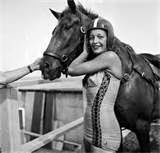
Among the notable residents, past and present, of Waycross, Georgia, I doubt there is anyone quite as intriguing as Sonora Webster Carver, the Horse Diver.
I very much hope I am not the only person who has never before heard of – or even conceived of - horse diving as a career option. It was in 1923 that Sonora ((1904-2003) responded to an ad seeking a horse diver, placed by William “Doc” Carver. He signed her on and soon she was the star of the show: riding a horse up to a sixty-foot tower and then hanging on for dear as it dove into a puddle below. Sonora soon married Doc’s son, Al, who took over the show and brought it to the Atlantic City Pier. That was where Sonora was blinded, when she hit the water off balance. But she kept right on diving with her horse for another 11 years.
It seems worth noting that she lived to be 99 years old.

And now it is time to reignite my torrid relationship with William Shatner.

*Based on the number of books she owned by each author, Aldous Huxley was my paternal grandmother’s second favorite writer, between H.G. Wells, #1 by a long margin, and Tagore at #3.