Translate

Showing posts with label beehives. Show all posts

Wednesday, May 1, 2019

Everything about the Holy Thorn

Of all the things I expected from a sojourn in the Umbrian countryside (olive trees, wild boars, pasta, Roman noses, Etruscan vases, vin de table), the very last was the semiannual appearance of the Holy Thorn in Montone.

As we all know, a couple of weeks ago, Notre Dame in Paris was burning. Watchers around the world were horrified. But a mere twenty-four hours later, things were not looking so bleak. The Crown of Thorns and the beehives on the roof were unhurt by the fire. We received several emails from bee-loving friends with the news of the still-flying bees. But I had to learn of the Crown of Thorn’s escape on my own.

Then we were visiting friends at their exquisitely restored tobacco-drying barn, Bacciana. Montone is a walled town in Umbria, with some lovely restaurants, no decent postcards, and the ex-church of San Francesco featuring frescoes in terrible condition. But of the frescoes that are still extant, there are a cephalophore* and a very young and nubile Saint Sebastian.
While roaming around town reading menus, we learned that on every Easter Monday Montone celebrates the Gift of the Holy Thorn (Donazione della Santa Spina) with a day of pageantry, costumes, archery, puppetry, and handsome men in bicolored tights. Religiosity and shapely calves. What could be better?

In the 15th century, the Venetians, grateful for his help in defeating the Turkish invaders, gave Montone’s local squire, Braccio Fortebraccio** a single thorn from the crown of thorns: the Santa Spina. The Venetians had acquired the Crown a couple of centuries earlier, as collateral for a loan made to the warmongering Baldwin II of Constantinople. Baldwin never redeemed the Crown, but Louis IX of France did. Apparently the Venetians held back a few thorns.

If you care to research the history of the Crown of Thorns, and the various extracted thorns, you must be prepared for conjecture, legend, wishful thinking, and contradictions. Also just plain heresy.
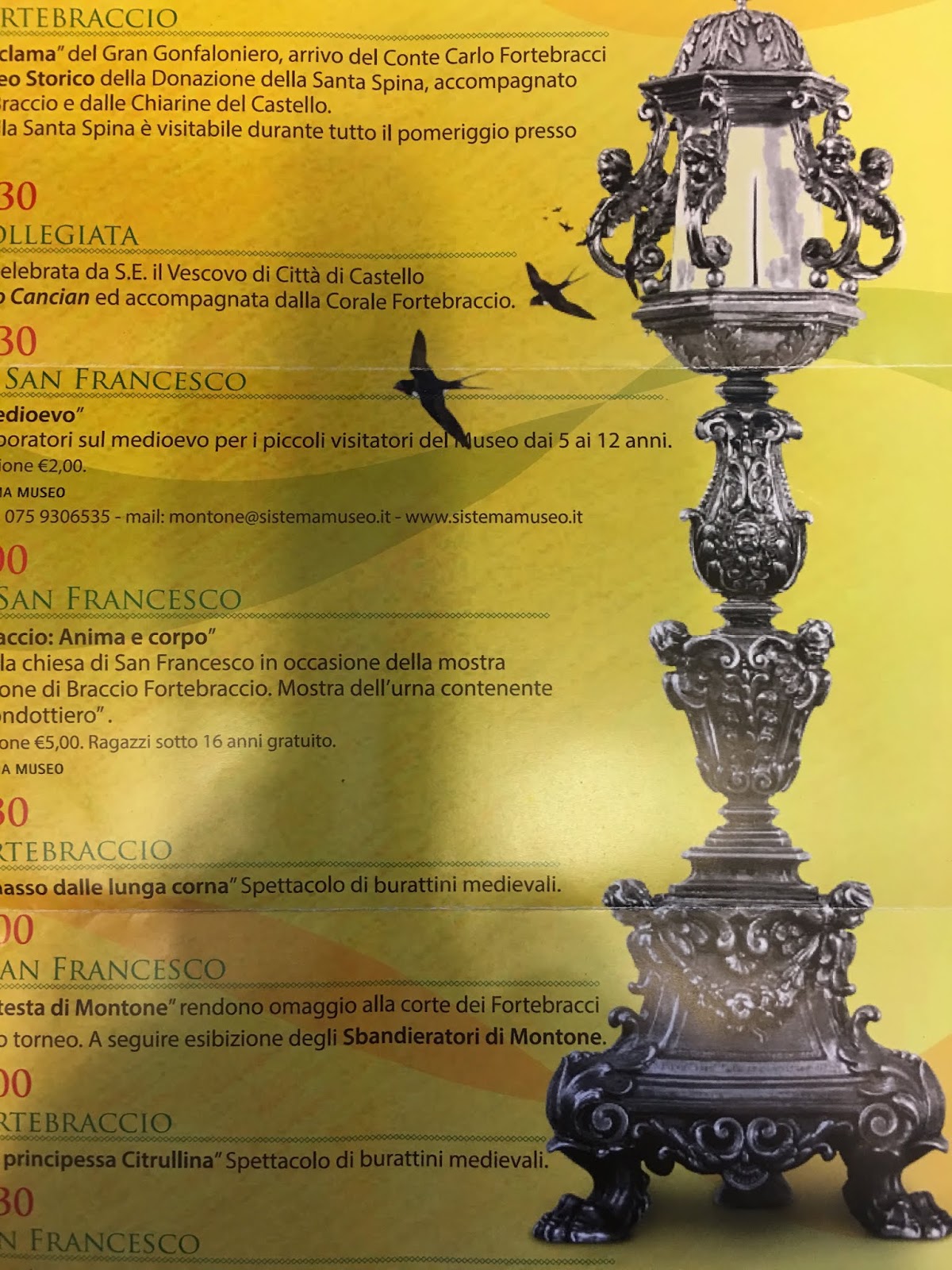
Eagerly, I texted my sister that we would be seeing the Holy Thorn in Montone, and wasn’t this a fantastic coincidence, or just plain serendipity, that we would be in Montone for this celebration? She texted back that according to her research (Wiki) there was no Holy Thorn in Montone. I sent her a picture of the reliquary that was featured in the flyers all around town. She sent me a link to the Wiki page enumerating all the cities in Europe claiming one or more thorns. Montone was not among them. Cities in Belgium, France, the Czech Republic, Spain, Germany, Britain, Ukraine and five cities in Italy all lay claim to a portion, or a branch, or a thorn, or a fragment, of the Crown of Thorns. Even a chapel in Pittsburgh, USA, claims a thorn. But not Montone.

This is obviously yet another example of the fact that you can’t believe something just because you read it on the internet. I was in Montone and I saw the Holy Thorn. Well, I didn’t actually see the Holy Thorn because it was inside its special box. It wasn’t even in the beautiful reliquary shown on all the flyers, because at last year’s celebration, there was a touchy moment when the Montonian carrying the reliquary almost fell off his horse. But I did see the special box that was used in lieu of the reliquary. And I know what I saw.

*Cephalo-phore: a saint who has been decapitated and then carries around his/her head. If you don’t know this already, you haven’t been paying attention.
**His Wiki page also does not mention Montone’s Holy Thorn: a dereliction that makes me suspect a possible conspiracy by the other Thorn-Hoarding cities.


Sunday, February 14, 2010

Happy whichever saint's day you choose

You are probably expecting that I will tell you some new and bizarre factoid about Saint Valentine, today being the anniversary of his beheading in 269 AD during the persecutions of Claudius the Goth, so named on account of his predilection for frightening black mascara. Seriously.

But I am assuming you already know everything there is to know about Saint Valentine and the hagiographic confusion surrounding his feast day on account of there having been two Valentines, so I thought I would hark back a couple of days (to the 11th, to be exact) which was the feast of Saint Gobnata who is not celebrated with greeting cards or pink heart-shaped cookies or 11,500 tons of Candy Hearts or 16,100 tons if the Necco [New England Confectionary Company] factories work seven-day weeks. Unlike St. Valentine, who is honored wherever the vast worldwide network of Hallmark has spread its tentacles, St. Gobnait or Gobnata or Gobhnet (you can see why my sister might sympathize with her) is known in a small corner of County Cork, Ireland.
Back in the 6th century, Gobnata was an abbess (or maybe a cowgirl) who protected her church’s sacred grounds from her enemies by flinging her beehives upon them. In another version, she is warding off cattle rustlers with the bees. And in a version worthy of Ovid, as Gobnata shakes the bees loose they are miraculously transformed into soldiers, and the hive becomes a brass helmet.
So celebrate.

Monday, January 11, 2010

Freya, the bees, and Susanna


What did the bees do with the letters Freya von Moltke hid in her beehives?

Freya von Moltke died on New Years Day in Vermont, at the age of 98. She was the widow of Count Helmuth James von Moltke, one of several German aristocrats and clerics who opposed Hitler and were executed. While her husband was imprisoned, Freya took the incriminating documents as well as his letters to her and hid them in the beehives on their estate at Kreisau. The obit does not mention what honeycomb masterpiece the bees created around those papers, only that they were an invaluable source for historians seeking to learn about the resistance to Hitler.
A couple of years ago I saw this honeycomb vase at MOMA created by a Slovakian artist, well - created by bees, with the nudging of the Slovakian artist. Since then I have been imploring CSB to let me introduce strange objects (a fountain pen, a tiara, a small book) into our beehives to see what the bees make of it. He is still considering this.

Later I went to hear my friend sing in Handel’s 1748 oratorio, “Susanna”. It’s a compelling and disturbing story: the beautiful Susana is seen bathing in the river by the lecherous elders and they accost her.
(In vain would age his ice bespread/To numb each gay desire/Tho’ seventy winters hoar my head/My heart is still on fire.)When she refuses their lewd advances the elders retaliate by accusing her of having carnal knowledge with her young man under a certain tree. She is condemned to die. (The cause is decided, the sentence decreed,/Susanna is guilty, Susanna must bleed.) Only when Daniel comes on the scene (sung by a woman, a soprano) and questions the elders separately is Susanna acquitted. Daniel wisely asks each elder under which tree Susanna was seen fornicating, and they answer with very different trees (a holm tree and a lentisk), trees that could not be mistaken one for the other.
Does this all sound painfully contemporary? It did to me.
Sitting there in my pew, I wondered how the Biblical version read, and since the concert was in a church, I thought, how convenient! I pulled the Bible out from the hymnal shelf and flipped through the book of Daniel. But there was no Susanna to be found.
Later I learned that her story has been deemed apocryphal by the Protestants (in the 39 articles) and so is only found in the RC and Easter Orthodox bibles.
Apocryphal or not, it is a story made for artists: naked bathing beauty, leering older men, and conflict.

Susanna and the Elders by Artemesia Gentileschi.

Susanna by Tintoretto.