Translate

Showing posts with label cephalophores. Show all posts

Wednesday, May 1, 2019

Everything about the Holy Thorn

Of all the things I expected from a sojourn in the Umbrian countryside (olive trees, wild boars, pasta, Roman noses, Etruscan vases, vin de table), the very last was the semiannual appearance of the Holy Thorn in Montone.

As we all know, a couple of weeks ago, Notre Dame in Paris was burning. Watchers around the world were horrified. But a mere twenty-four hours later, things were not looking so bleak. The Crown of Thorns and the beehives on the roof were unhurt by the fire. We received several emails from bee-loving friends with the news of the still-flying bees. But I had to learn of the Crown of Thorn’s escape on my own.

Then we were visiting friends at their exquisitely restored tobacco-drying barn, Bacciana. Montone is a walled town in Umbria, with some lovely restaurants, no decent postcards, and the ex-church of San Francesco featuring frescoes in terrible condition. But of the frescoes that are still extant, there are a cephalophore* and a very young and nubile Saint Sebastian.
While roaming around town reading menus, we learned that on every Easter Monday Montone celebrates the Gift of the Holy Thorn (Donazione della Santa Spina) with a day of pageantry, costumes, archery, puppetry, and handsome men in bicolored tights. Religiosity and shapely calves. What could be better?

In the 15th century, the Venetians, grateful for his help in defeating the Turkish invaders, gave Montone’s local squire, Braccio Fortebraccio** a single thorn from the crown of thorns: the Santa Spina. The Venetians had acquired the Crown a couple of centuries earlier, as collateral for a loan made to the warmongering Baldwin II of Constantinople. Baldwin never redeemed the Crown, but Louis IX of France did. Apparently the Venetians held back a few thorns.

If you care to research the history of the Crown of Thorns, and the various extracted thorns, you must be prepared for conjecture, legend, wishful thinking, and contradictions. Also just plain heresy.
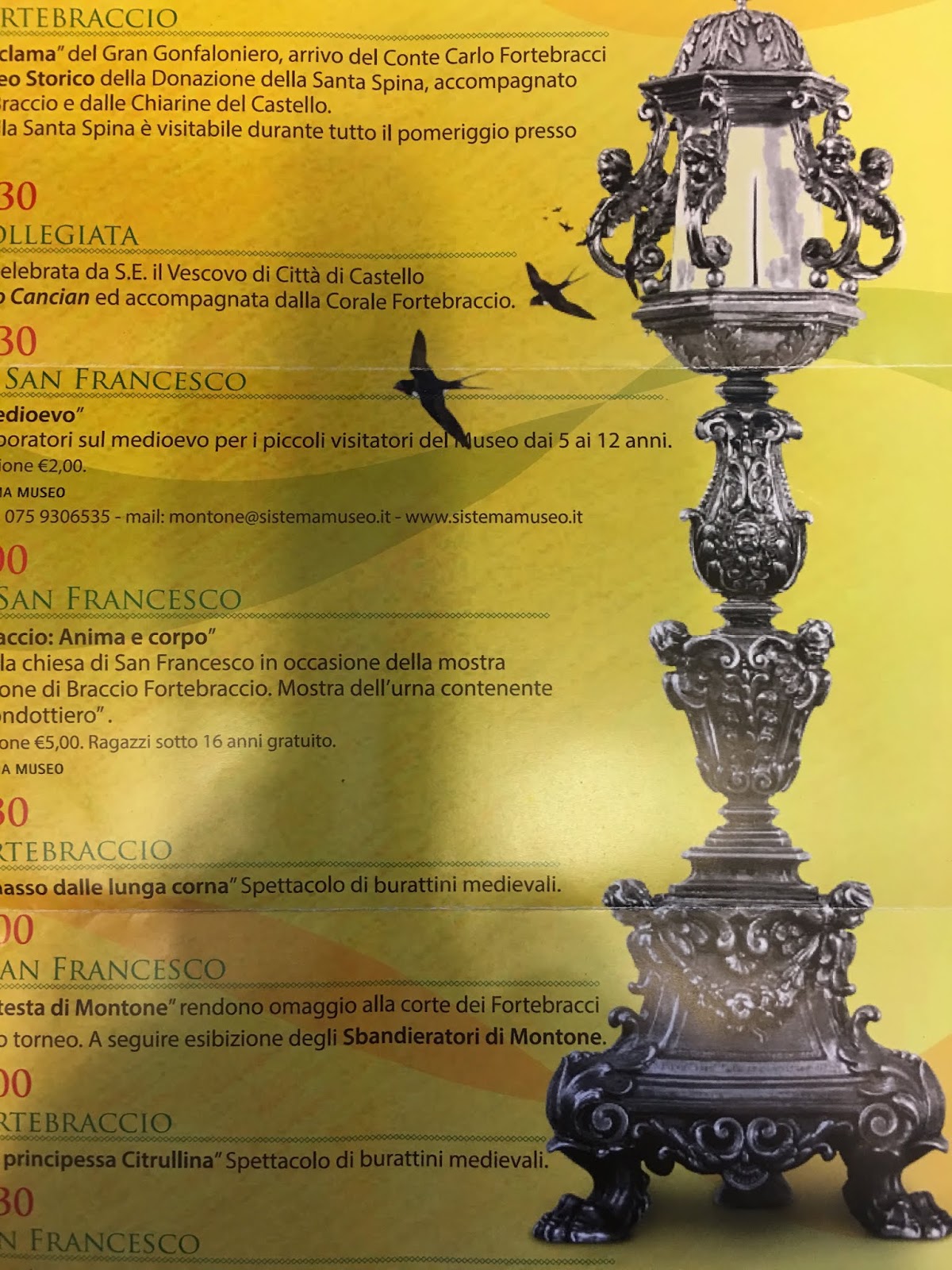
Eagerly, I texted my sister that we would be seeing the Holy Thorn in Montone, and wasn’t this a fantastic coincidence, or just plain serendipity, that we would be in Montone for this celebration? She texted back that according to her research (Wiki) there was no Holy Thorn in Montone. I sent her a picture of the reliquary that was featured in the flyers all around town. She sent me a link to the Wiki page enumerating all the cities in Europe claiming one or more thorns. Montone was not among them. Cities in Belgium, France, the Czech Republic, Spain, Germany, Britain, Ukraine and five cities in Italy all lay claim to a portion, or a branch, or a thorn, or a fragment, of the Crown of Thorns. Even a chapel in Pittsburgh, USA, claims a thorn. But not Montone.

This is obviously yet another example of the fact that you can’t believe something just because you read it on the internet. I was in Montone and I saw the Holy Thorn. Well, I didn’t actually see the Holy Thorn because it was inside its special box. It wasn’t even in the beautiful reliquary shown on all the flyers, because at last year’s celebration, there was a touchy moment when the Montonian carrying the reliquary almost fell off his horse. But I did see the special box that was used in lieu of the reliquary. And I know what I saw.

*Cephalo-phore: a saint who has been decapitated and then carries around his/her head. If you don’t know this already, you haven’t been paying attention.
**His Wiki page also does not mention Montone’s Holy Thorn: a dereliction that makes me suspect a possible conspiracy by the other Thorn-Hoarding cities.


Wednesday, July 24, 2013

It's her day again, Christina the Astonishing

I could not let today slide into tomorrow without noting that it - this day, July 24 - is the feast of Saint Christina the Astonishing. She is not an official saint, but unlike many official saints, she did actually exist.
She was born in 1150 in the region of Liège, which until September 1946 was written as Liége. It is unknown, at least to me, why the change was made from acute to grave. More recently, King Albert II (“Love-Daddy”) of Belgium was in Liège bidding fond farewell to his subjects on the eve of his abdication.
Back in the 12th century, Christina was an orphaned peasant girl with pathological tendencies. At the age of 22, she appeared to die, but most likely had a cataleptic fit. As was the normal course of events, her open coffin was taken to the church for the requiem mass; but just after the singing of the Agnus Dei, Christina sat up in her coffin and soared to the rafters “like a bird” and stayed there for the rest of the mass. All the mourners fled except for her sister, who stayed right until the end. With some cajoling, the priest then persuaded Christina to come down. She told him that she had in fact been dead, and had visited Hell, where she saw many friends, and Purgatory, where she saw many more friends. She also went to Heaven but apparently knew no one there. Christina chose to return to earth in order to liberate the purgatorial souls through her prayers. But back on earth she was often forced into uncomfortable situations in order to get away from the terrible smell of humans: she climbed trees, crawled into ovens, and dove into freezing water. The tales of her adventures (escaping from chains, praying on one foot atop a hurdle, surviving a millrace) and misadventures are legion, and remarkably well documented for the era. After several years of living on the edge, she climbed into a baptismal font and sat in the water, and moved into a convent and lived to be 74.
Despite her not being an official saint, Christina is variously categorized with the Levitating Saints and the Epileptic Saints. Putting saints into categories is something I find appealing. Other categories of interest are Virgin-Mystics, Virgin-Anorexics, Virgin-Hysterics, Married-Couples-who-Never-Consummate-Their-Marriage, Saints who Compiled Alphabets and/or Dictionaries of Hitherto Undocumented Languages, Saints Related to Other Saints, Bilocating Saints and my all-time favorite, the Cephalophores.

Tuesday, March 3, 2009

To and from Rouen


I do not often think of Rouen, where I have never been, but when I do it is first of all as the sad place where Joan of Arc was imprisoned and then burned, on the last day of May 1431, which just so happens to be the year François Villon was born.
Even now, half a millennium later, I still lament the auto-da-fé of young Joan. A girl. Years ago when I was in the habit of swimming laps in my then mother-in-awl’s swimming pool I started thinking about Joan, burning in Rouen, and now all I have to do is start swimming in a relatively straight line, and I will think of her again. It is my fervent hope that some kind soul slipped her some hemlock before they ignited the faggots.

After Joan I think of Flaubert who was born in Rouen and lived there all his life, writing perfect sentences. He did not become a doctor like his father and brother, and for years I thought that his father was the French doctor and father of a great writer who was responsible for the concept of the cordon sanitaire, a quarantine to keep sickness from spreading. But in fact that was Proust’s father, Dr. Adrian Proust, not Flaubert’s father. Still, it seems a reasonable confusion, given that Proust and Flaubert are both French, obsessive; they never married, they wrote brilliantly and I read them both in French class decades ago. My dictionary was attached to my wrist.

But I am thinking of Rouen because today, no yesterday, was the feast of St Leo of Rouen (who is not in Butlers Lives of the Saints at all, putting his entire existence in doubt). Aside from his being bishop of Rouen – known for its rather fabulous ecclesiastical architecture (viz. numerous paintings by Monet) what we know of Leo is that Saracen pirates beheaded him in 900 AD. But that did not stop him. His headless body picked up the removed head and carried it back to the church where he had given his last sermon. And then fully died. Another glorious cephalophore.
And if you know me, you know that I have an unjustifiable fascination with cephalophores. There is something compelling about the notion that the body would object to its untimely truncation. And poignant about the literally mindless impulse to bear one’s head to a place of safety.
The theory I have read, and it makes sense, is that the concept of cephalophores results from the frequent representation in art of beheaded saints holding their heads. If you are carving a saint for the front of a cathedral (St Denis for example) it is much easier to have his body and head be in the same place, even if not in their normal relations. And seeing such images the populace came to the conclusion that the represented saint really did carry his or her head somewhere. However it evolved into yet another category of saints, it clearly relates to the human impulse to make whole what was sundered.