Translate

Monday, July 29, 2013

A Tale of Two Pigs


If we actually thought about it, it would be obvious that of all the porcine related tasks, the hardest by far would be persuading two 300+ pound pigs (Hamlet and Hamlette) to leave their happy home - full of delicious food scraps and silky smooth mud puddles, in the shade of several sassafras trees and with views of the Palisades – and walk into a wooden crate built for the sole purpose of transporting them to the place of their ending.
Perhaps we had not thought about it.
So how did we accomplish this daunting task?

First CSB built a wooden crate large enough to comfortably accommodate both pigs, yet compact enough to make them feel safe and to fit on a U-Haul trailer.
Then he hitched the trailer to his truck and backed it up to the gate of the pig pen. So far so good.
Early this morning CSB installed plywood barriers on both sides of the trailer ramp, and opened the gate. (It should be noted that in a trial run last night, both Hamlets walked in and out of the crate with no complaints.) Then we said encouraging words to the pigs, hoping they would, once again, walk up the ramp and into the crate.
Not this morning, no, they did not.
Meanwhile, our friend Steve came to help. Because he was raised a Mennonite, we expect him to have to be a repository of ancestral agricultural knowledge. He is also well-versed in all aspects of medieval heresies, and there are few subjects I find more entertaining than medieval heresies. (Manicheans, Cathars, Waldensians – I love them all.) To say he is a raging liberal does not do justice to his daughters’ efforts to persuade him to stand for the Pledge of Allegiance at their high school functions, and not embarrass them.
Once it became clear that the Hamlets were not going to enter the crate on their own, we resorted to the first – and often last - line of parental persuasion: bribery. CSB placed some yummy organic swine pellets at the far end of the crate. They turned up their muddy piggy snouts.
Then I went to the garden for arugula and cucumbers, since CSB claims they love arugula beyond all other greens. Sadly, I did not have any garlic French fries on hand, and I know for a fact that they will scarf up garlic French fries.
But still, they were not interested.
Next thing I knew, CSB was reclining inside the crate, cooing sweet nothings to the Hamlets, and suggestively dangling a sprig of arugula. While this was very amusing to watch – at least for Steve and myself – the pigs were blasé. They gamboled some more in their mud puddles.
Our next effort featured the Pavlovian theme. We rattled and clanged their metal feeder at the back of the crate, and hoped for the appropriate response. And it worked, for one of them: Hamlet (the male). He meandered into the crate and with great relief we shut the door.
Then arose a new problem: Assuming we could entice Hamlette to go up the ramp to join her sibling, could we risks opening the crate door and having Hamlet abscond? We practiced opening and closing the crate very quickly. But Hamlette was getting the idea, and she was not inclined to cooperate.
I am sorry to report that I do not have photographic documentation of CSB, splattered with mud, chasing Hamlette around her pen. While he was doing this, I had, so I thought, improved on the food bribe: hot dogs. Organic Beef hot dogs. I held the hot dog to Hameltte's snout, I wiggled the hot dog and sang “This little piggy”. She mostly ignored me. I too was getting rather muddy.
Time was passing, and we were getting nervous that we might conceivably fail to accomplish our task. CSB telephoned the butcher who suggested roping the pig’s hind legs. CSB tried – valiantly – to rope her hind legs. Maybe if you are a cowboy or a horse rustler or a rodeo-type-individual, roping a slippery pig’s hind legs is child’s play. But please take my word for it, that for we mere mortals, it is really hard. Especially if you are doing it inside a slippery muddy pig pen. CSB tried laying out the lasso and then yanking when Hamlette was – for mere nanoseconds – appropriately placed. Mostly this failed. One time he managed to rope one of her legs and the screeching was epic. We were sure the local constabulary would soon be alerted that gruesome deeds were being perpetrated chez Let it Bee. Hamlette got herself free. And happily there were no sirens or blue lights.
(I am going to skip a few intermediary steps, as they were frustrating and increasingly muddy.)
Then Steve – as you will see, I was not wrong about the ancestral husbandry wisdom of Mennonites – suggested creating a kind of chute or funnel. Yes, we channeled Temple Grandin, and it worked.
Using more plywood we created a narrow passageway leading to the ramp, and then made it narrower and narrower until, voilà, Hamlette was snugly in the crate along with Hamlet.
Soon, after hosing down, CSB was on his way to the holistic and very nice slaughterhouse. Quiet descended.

I like to think we learned something from this muddy adventure: more heresy, skip the food bribes.
Adieu dear Hamlet and Hamlette, you had a good life and we will enjoy you in the future.


Thursday, July 25, 2013

Pope sand sculpture


Just in case you missed this - a sand sculpture of the new Pope, on a beach in Rio de Janeiro. (Thank you, Boston Globe, a newspaper which, according to my mother, has more papal coverage than any other major US paper.) I could make some allusion to the Virgin of Guadalupe's image on a tortilla or Jesus on tree bark, but I will eschew the obvious.

Wednesday, July 24, 2013

I went to the Hudson River Museum in order to show my friend, Vivien, the Eastlake furniture and the Arts & Crafts wallpaper at the Glenview mansion, because she has an Arts & Crafts inn in Fort Bragg, California – which town CSB insisted on referring to as Fort Knox and actually got my friend’s 14 year old son to crack a smile. Given that the HRM is 10 minutes from our house I have seen this mansion more times than I can count, with visitors from several states and countries. Some like it better than others. Everyone admires the view of the Palisades.
I was not expecting to be surprised by anything; I thought I might daydream in the presence of stuffed Victorian birds under glass. (The Victorian fondness for stuffed animals under glass strikes me as a PhD thesis topic just waiting to be grabbed up.)
Upon exiting the mansion – not through the proper front door but through what used to be a library window – and reentering the museum we discovered this strange and remarkably cheerful exhibit. I don’t know the last time I used the word cheerful to describe anything in an art museum; it is entirely possible that I never have. But Federico Uribe’s Fantasy River struck me as cheerful. To explain that it is comprised of flora and fauna made of pencils and sneakers and flip flops, garden hoses and spigots, paint brush handles, trowels, spades, bullet casings, screws, rakes, shoelaces, plastic forks and books does not do the trick.
How many times in one afternoon can you think: what a brilliant thing to do with old curly telephone cords (or flip-flops or fake fingernails...). Why didn’t I think of it?
Many times.

It's her day again, Christina the Astonishing

I could not let today slide into tomorrow without noting that it - this day, July 24 - is the feast of Saint Christina the Astonishing. She is not an official saint, but unlike many official saints, she did actually exist.
She was born in 1150 in the region of Liège, which until September 1946 was written as Liége. It is unknown, at least to me, why the change was made from acute to grave. More recently, King Albert II (“Love-Daddy”) of Belgium was in Liège bidding fond farewell to his subjects on the eve of his abdication.
Back in the 12th century, Christina was an orphaned peasant girl with pathological tendencies. At the age of 22, she appeared to die, but most likely had a cataleptic fit. As was the normal course of events, her open coffin was taken to the church for the requiem mass; but just after the singing of the Agnus Dei, Christina sat up in her coffin and soared to the rafters “like a bird” and stayed there for the rest of the mass. All the mourners fled except for her sister, who stayed right until the end. With some cajoling, the priest then persuaded Christina to come down. She told him that she had in fact been dead, and had visited Hell, where she saw many friends, and Purgatory, where she saw many more friends. She also went to Heaven but apparently knew no one there. Christina chose to return to earth in order to liberate the purgatorial souls through her prayers. But back on earth she was often forced into uncomfortable situations in order to get away from the terrible smell of humans: she climbed trees, crawled into ovens, and dove into freezing water. The tales of her adventures (escaping from chains, praying on one foot atop a hurdle, surviving a millrace) and misadventures are legion, and remarkably well documented for the era. After several years of living on the edge, she climbed into a baptismal font and sat in the water, and moved into a convent and lived to be 74.
Despite her not being an official saint, Christina is variously categorized with the Levitating Saints and the Epileptic Saints. Putting saints into categories is something I find appealing. Other categories of interest are Virgin-Mystics, Virgin-Anorexics, Virgin-Hysterics, Married-Couples-who-Never-Consummate-Their-Marriage, Saints who Compiled Alphabets and/or Dictionaries of Hitherto Undocumented Languages, Saints Related to Other Saints, Bilocating Saints and my all-time favorite, the Cephalophores.

Thursday, July 18, 2013

Telegrams, adieu!

Until I learned there would be no more, that in fact there had been no telegrams in the U.S. for seven years, I had no idea how attached I was to telegrams, or the idea of telegrams, or the possibility of telegrams.
This past Sunday the last telegrams were sent in India, the last stronghold of telegrams; they announced births and deaths and offered congratulations. And then the Indian telegraph shut down for good.
Western Union, based in Colorado, ceased sending telegrams back in 2006 and I am chagrined that I never noted its passing. I would like to rectify that.
One of the more cumbersome (and hence delightful) methods of long distance communication I learned about was an electrochemical telegraph devised by Samuel Thomas von Sömmering in 1809. The process involved physically laying as many as 35 wires from one place to another, and submerging each end of the wires in a glass vial of acid, next to a card indicating which letter or number it represents. The transmitter applied eclectic current to his end of the wire, which caused the wire at the receiver’s end to release hydrogen bubbles. Then all you do is match up the bubbles to the letters and voilà, a message: Does your wife like aubergines?

But back to telegrams: Most of us consider Samuel Morse the progenitor of those filmy pieces of paper with words pasted onto them. In 1837 Morse patented an electrical telegraph capable of sending long and short signals (dits and dahs) across several miles of wire. That eponymous code was still considered a useful thing to learn when I was a kid; an uncle of ours once promised that he would give $5 to whichever of we cousins first learned Morse code one summer, and no, I was not the grand prize winner. But I am sure that in one of the Nancy Drew mysteries our heroine, trapped inside the trunk of a car by a wicked villain, was able to pound out the Morse code to signal her plight, and was rescued. Or maybe it was another plucky heroine.
Then came Tesla and Marconi and wireless telegraphy, and the terse but potent messages in what we recognize as telegraphese. In their brevity telegrams can be compared to Tweets, with their 140-character limit. Brevity was important because telegraph companies charged by the word and the beauty of that is the burden of making every word earn its keep. Though I was surprised to learn that the word STOP was free, while punctuation of any kind cost extra, hence the punctuation-less messages with their frequent STOPS.
Like our email and telephone communications (viz. Snowden’s NSA leakage) telegrams were easily intercepted and not exactly secure. So codes were developed, like the one used in this telegram of 1920 I discovered in the parental basement, dating to the days when my grandfather was a cotton merchant in Boston traveling often to Europe. And this one upon which someone, presumably a secretary, has kindly typed the translation. Also in the dusty piles of papers was a key to the code. There is much to wonder about: had my grandfather memorized this list of randomized letters? Did he carry the key secreted on his person, in some hidden pocket or the false bottom of his valise? Just how cutthroat was the cotton business in the 1920’s such that these precautions were deemed necessary?

Also in a cabinet in the parental basement, in a pile mercifully left un-nibbled by the mice, was a stack of congratulatory telegrams sent on the occasion of my parents’ betrothal. Many of them were sent from friends in Cairo to my mother, then a student at Smith, care of the home of her husband to be, the home she still lives in. The best thing about these telegrams is that on each one my beloved grandmother wrote the name and address of the sender, presumably so that my mother could send a proper thank you note. Just to see my Bonne-Maman’s unmistakable Belgian convent script fills me with longing.For the time I am holding these perishable pieces of old paper, she is entirely present: lovely, kind and toujours well-organized.

And now, all relics.

Monday, June 3, 2013

My mother and Moby Dick

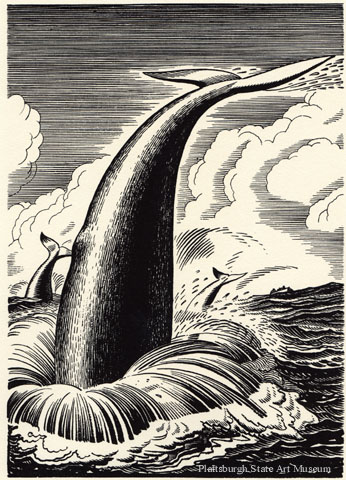
Here is something I need to remember for future reference: my mother does not like Moby Dick as much as I do. The truth: she pretty much hated every minute reading Moby Dick for her class at Harvard. What she had to say about the pleasures of cetological lore does not exist. What she disliked about whale minutiae and viscera would fill the brain of a sperm whale to capacity. (And yes, the sperm whale brain, at 17 pounds, is five times larger than the human brain and has a volume of 8000 cubic meters.)

The only good thing about Moby Dick, as far as my mother is concerned, so far as I can tell, is the fact that the Pequod’s first mate’s name is Starbuck, he of “deep natural reverence [and] wild watery loneliness”, and this means that every time she passes a Starbucks coffee shop she can allude to this convergence of names, each time as if for the first time. Given that there are 13,279 Starbucks in the USA alone, this is an opportunity unlikely to expire. (The founders initially wanted to name their company Pequod, which I would have voted for; this gives you an idea of my business savvy.)

I, on the other hand, consider Moby Dick to be the greatest American novel and one of the funniest novels ever; the novel that keeps on giving. I like Moby Dick so much that I wrote a short story about a character who may or may not resemble the writer, who is obsessed with Moby Dick and spends an entire summer - a summer rife with dramatic life changes – alluding to Melvillian wit and wisdom. (You can read this story, “No I am not a Loose Fish, and Neither Are You”, in the 2006 issue of the Southwest Review,Volume 91,Number 3, which, alas, is not available on line.)

So why did my mother find herself reading Moby Dick?
My father loved taking classes and he loved to be around interesting people. And if there were no interesting people on hand, he was happy to be around uninteresting people. He liked to be around people, and he didn’t much like being left alone. He loved school as a young man, and excelled; his only complain about his undergraduate years at Harvard was that his time there was too brief, having been interrupted by his service during WW2.

My mother likes to give lectures and generally prefers to be around very few people, for short periods of time. Some people she would prefer to never be around.

In the decade before he died Dad enrolled at HILR, Harvard Institute for Learning in Retirement, which allowed him to take classes about current events, environmental degradation, Shakespeare’s plays and modern novels, and be around people. A good day at HILR involved a class discussion on Islam and Petroleum, lunch with an attractive female grandchild and her attractive roommates, then an afternoon class tracing the causes of Climate Change to the Protestant Reformation. He once took a course called the “Traditions of Mysticism and Christianity and Islam” and called me once a week to explain the reading and, please, to write a précis of the 800 page tome assigned that week. But he kept going to class. Only a national emergency or death could stop him from going to class and lunching with an attractive granddaughter.

The only course he actively resisted taking was “This is Your life: Memoir Writing”, and it was the one course above all others I begged him to take.

But for all their love and devotion, my parents were apparently clueless about each other’s social preferences. Which explains why my father persuaded, urged, hectored and implored my mother to join him in taking classes at HILR. Naturally he wanted her company – even though they wisely never took the same course. He also believed, or wanted to believe, that after his death - and he knew quite well he would predecease her, and soon - she would enjoy the classes and the collegiality of HILR. Even his children, their children, could have told you this was delusional.

Nowadays, my mother likes to tell people she took the Moby Dick class because Philip chose it, and she wanted to honor his choice. I don’t contradict her. But in fact she didn’t even look at the catalog until after his death. I know because I was there with her, and in the matter of taking classes, I am more like my father than my mother, so I was drooling over possibilities like the “Philosophy of Yoga”; “T.S. Eliot, Evelyn Waugh and Other Catholic Converts”; “Anti-Matter and Alexandrine Meter”; “The Last String Quartets of Beethoven”. You get the idea.
And so I must take responsibility slash blame for my mother signing up for Moby Dick, and “The Philosophy of Yoga”. (She dropped the P of Y after the second week.) But she stuck with Moby Dick, more or less. More, because she never actually dropped out. Less, because she never finished the book and so never got to Chapter LXXXIX on “Fast-Fish and Loose-Fish”, in which all of jurisprudence and human history is explained, brilliantly and hilariously, in the context of harpooned whales.

Something else I would do well to remember in the future: just because we have the same taste in chocolate and shoes does not mean that my mother and I will find the same books, or classes, interesting. Moby Dick could be the 63-ton tip of that iceberg.

Wednesday, May 29, 2013

Daisy, 2003 - 2013. R.I.P.

In 2003 CSB and I decided that, in order to ensure that traveling would always be complicated and that we would have no disposable income left after vet dog food bills, we would get two dogs. Two, because that way they could entertain each other when we were less than entertaining. We got lucky. We found Daisy and Bruno, litter mates from a local kennel. She was Alpha and he was, well, Beta or Omega. He was the runt, and would forever be the smaller and more submissive one. Then Bruno, at the very young age of six months, developed a lethal form of leukemia. This was not the plan. We had specifically chosen spaniels – rather than the beloved bulldogs – because spaniels were supposed to be sturdy and long-lived, unlike bulldogs who are genetically incapable of copulating or giving birth naturally, and have respiratory trouble, droopy eyelids, and hip dysplasia, for starters.

So ten years ago I spent a lot of time - hours stretching in nights - in the waiting room of the Animal Medical Center on East 68th street in Manhattan. I spent enough time there to learn the painful curvature of the plastic chairs and to get friendly with other vigilant pet-owners, and their animals. I met a small girl and her rabbit, named Whitey. Whitey had stomach cancer. A young man, who always sat at the farthest possible distance from everyone else in the waiting room, had a boa constrictor with a strep throat. I asked him how, initially, he was able to tell that his boa constrictor was unwell. I forget his exact words, but the gist was that it was obvious to him as Bruno’s discomfort was to me. In that waiting room I saw parrots, gerbils, and dogs and cats of every size and permutation. One morning a team of photographers from PEOPLE magazine showed up to do a shoot on the range of exotic animals and their equally exotic owners. Bruno, a Springer spaniel, and I did not qualify as exotic in either case.
Bruno’s prognosis was terrible, as it was for most animals at the Animal Medical Hospital, a tertiary care facility, the crème de la crème of veterinary hospitals. We despaired. But after several blood transfusions and treatment with cyclosporine, a drug so expensive and toxic that I was required to wear gloves when administering it, he got better. He got better and he stayed better.

Daisy and Bruno spent the next ten years playing together, chasing squirrels, birds, field mice, anything. If they got into trouble, we always knew that Daisy was the ringleader. In Maine Daisy leapt off the dock, making almost swan dives into the lake. Bruno, ever cautious, had to be coaxed into the water, and then only on the hottest days.
They were outdoor dogs. They got scruffy and muddy. Especially Daisy who never met a mud puddle she didn’t embrace. Much as I loved their luxuriant soft fur, two or three times a year I took Daisy and Bruno to Pretty Pets to get shorn. So last week, with summer approaching, I took them for their summer buzz cut. And without all her fur, it became clear that Daisy had not merely gained her usual avoirdupois over the winter, but she was bloated and distended. She was not right.
At the animal hospital I got the diagnosis: Daisy, the indomitable, über-energetic Daisy, has cirrhosis of the liver.
I was shocked. Of all the possible ailments, why cirrhosis? Daisy does not drink alcoholic beverages. Did not drink. Was she the innocent repository of the wages of our epicurean ways? Was there some Dorian Gray-ish phenomenon going on in the house whereby we get to drink our cocktails while Daisy’s liver suffers the effects?
There isn’t much to be done for a dog with liver failure, except try to make her as comfortable as possible. The one thing we could do was to drain some of the fluid that was surrounding her organs and causing the painful distension. That is what we did. Before leaving Daisy at the hospital to be drained, I had to sign several papers, including a DNR (Do Not Resuscitate). Or rather, I had to decide whether or not we wanted extraordinary measures used to resuscitate her, in the event that she expired during the procedure. And here is the crazy part: I couldn’t do it. I couldn’t sign the DNR. I have no problem signing a DNR for myself, or for an aging parent, but I couldn’t do it for my dog. Because she couldn’t do it for herself.

Draining her abdomen gave Daisy a few more days, until it didn’t. Until the very last she was valiant and cheerful. She was a great dog. Bruno, CSB and I will miss her like crazy.