Translate

Sunday, February 21, 2021

Introducing Frida von Zweig

Domestication of the dog has not nullified this instinct to lead or be led. This becomes a problem whenever an individual dog does not receive proper guidance, through training, and fancies herself to be the leader, or alpha. There should be no question in a dog’s mind about who the alpha figure is in her life- you are. The Monks of New Skete
In the middle of a pandemic we have acquired a new resident in our house. I should better say that Frida von Zweig, a goldador (her mother’s a Golden, her father’s a Labrador), has moved into our home and allows us to remain. 

 Have you ever been asked by your grown children what you would like for Christmas? And replied, Nothing, we already have too much stuff. And then, quasi-jokingly, said, A dog. We miss our dogs so much. That is the short version of how Frida came to us. The long version goes into hours of research and inquiries within a 2000 mile radius, and organizing, mostly by our son-in-law. 

 We are an older couple of settled habits, and Frida is a puppy. In normal circumstances, of which there are none, our schedule would have remained intact, and our habits would continue, and Frida would adjust. That has not been the case. It turns out that the blood of Genghis Khan and Juana la Loca flows through the veins of Frida. The pleasant schedule we have developed over many years of cohabitation, has been transgressed and rewritten, according to her wishes and needs.


Around 4:30 am CSB, who thankfully is an early riser, takes Frida outside into the cold and the snow, so that she can perform her morning eliminations. Then he escorts her back to her crate so she can rest some more, with her pet mink. CSB leaves for work around 6:15. I am still sleeping. According to my preferred schedule, I wake up around seven and stay in bed with a pot of tea and write five hundred words. Not always the finest words, but still words. This is no longer possible. I still wake around 7, but I must then propel myself to the kitchen where Frida resides and rules. Depending on the weather, I pull on a pair of boots, a sweater over my pajamas, put on my down jacket, get a hat, and gloves or mittens. Then I open the crate with soothing words and pray that Frida will head directly out the back door and urinate. We were initially opposed to the idea that she would urinate on the back porch, but no longer. Now that we have so much snow, deeper snow than my boots can accommodate, and it is so cold, we have relented and allow Frida to perform the morning’s first official urination onto the snow that covers the back porch. After peeing, Frida comes back inside and expects breakfast. I feed her kibble enhanced with eggs and chicken bone broth. She eats and drinks quickly, while I would prefer to slowly sip hot tea and contemplate those five hundred unwritten words, and then make myself two four-minute soft boiled eggs, with soldiers. That’s when things get tricky. Frida loves my boots, and I need my boots to keep my feet warm and dry. I also cannot walk if Frida has attached herself to the little leather strap thing at the back of my L.L. Bean hunting boots. If I ask Frida nicely to let go of my boots, and even offer her a squeaky toy instead, she ignores me. If I remonstrate with her, and firmly take hold of her martingale collar, as advised by the dog trainer we have hired at huge expense, she continues biting at my boots and also nips at my socks and my pants. I have two ankles covered in small puppy-tooth scratches I could show you. Then, as instructed by the trainer, I try to put her back into the crate until she calms down. This only works if we are in the kitchen standing more or less next to the crate.
Frida discovers snow

When we are outside and she nips at my boots, I can be as stern as I like, without interrupting Frida’s nipping in the slightest. According to various texts I have read, this behavior mimics how puppies would act in the wild, with their littermates, in establishing the power structure in the den. Frida is acting thus to assert her dominance over me. She is Alpha, and I am any other Greek letter you like. She is not wrong is assuming her Alpha-ness. In a world of equality among all living things, dogs and humans alike, Frida would most definitely be alpha to my omega. I am simply not the Alpha type, and Frida clearly senses this. However, we do not live in a fair or equal world, and as a human I have a few advantages. At least for now, I am bigger and stronger than she is. I control the food supply. I deliver the treats. I turn on the heat. And, as we did for the Pacha Mama in Santiago Atitlan, we make ritual offerings of squeaky toys, rubber bones, frisbees, and from Chewy.com, IQ treat dispenser balls to make her smarter. I have since rethought the IQ toys, because Frida is already smart enough for a dog.
Exploring the hollow Catalpa tree


 As for the schedule, normally after my breakfast I will go to my desk and write letters to the editor, and answer emails from Nigerian princes asking for money, but no longer. After Frida has had sufficient time to digest her breakfast, which is hardly any time at all for a puppy, we head outside again. With any luck, I am wearing daytime clothes by now. I get my boots back on, often in a corner so that Frida cannot see me and lunge for the boots before we’ve accomplished any eliminations, then my down parka, hat, and gloves. I take hold of Frida’s leash and we head outside. Since the snow is so deep in the back yard, we can only go to the side yard where CSB shoveled paths to the Little Red House, the compost bin, and the bird feeder. I can stay on the paths, mostly, and Frida can jump in and out of snow drifts or run on the paths and crash into my legs. I throw sticks for her to retrieve and praise her to the moon when she does this. She takes her characteristic back squat and makes small piddles wherever and whenever she can. As Prufrock’s life is measured in coffee spoons, so Frida’s days can be measured out in pale yellow patches on snow. I have learned that this is her way of marking her territory, and by now, most of our property is under her hegemony. Then she has to choose the right spot for defecation. Frida will not defecate just anywhere, and certainly not where I might suggest. 

 Another issue is the leash. According to the trainer I am never ever to let her off the leash when we are outside. But what should I do when I am standing in the shoveled path, and Frida leaps through the deep snow toward the field, the woods and beyond? I drop the leash and let her run free. When I do this I think I am just being thoughtful, and allowing her to enjoy the freedom her young limbs are capable of. She thinks that I am subject to her desires, and incapable of reining her in. In other words, that she is Alpha. Having dashed off, with the leash trailing behind her, she finds a likely spot, circles it two or three times, sniffing out whatever scents there might be, then she turns away from any onlookers, arches her back, and neatly extrudes a longish tootsie roll onto the lovely white snow, while I surreptitiously watch to make sure she does the deed, and also praying that she doesn’t shit directly onto the pink leash that follows her. Later I will strap on my snowshoes and go around the yard picking up her poop with compostable baggies. According to the monks of New Skete, it is not advisable for the puppy to see me picking up her poop, or cleaning up her accidents inside, because then she will think my only purpose is to clean up after her. When I first read that I thought that maybe the monks, who in general are very strict about not anthropomorphizing one’s pets, in this case were endowing the puppies with more capacity for inductive reasoning than is likely. Now I am coming round to the monks’ view of things. 


 After performing her toilette and chasing after leaves and twigs to her hearts’ delight, Frida is ready to head back inside and get warm. As am I. She charges across the snow, roars along the path, and dashes up the back stairs as if shot from a cannon, and careens directly into my boots. She takes hold of them with all the strength that razor sharp puppy teeth are capable of. Firmly, dominantly, I tell her to Drop it! Still attached to my boot she shakes her head fiercely, destabilizing me and reinforcing her grip on the leather. I have to physically detach her mouth from my boot, which explains all the scratches and cuts on my hands and wrists. Then, per the trainer’s directions, I must put her in the crate. Until she is repentant. That’s a joke; he didn’t use the word repentant. I, however, quickly repent of crating her up, so that in about fifteen minutes, long enough to maybe advance a load of laundry, I take her out of the crate and we go back outside, and repeat the drill. 

 Don’t think that I have an attachment to those L.L.Bean boots that makes them all the more tempting for Frida. Quite the contrary. I have another pair of boots that are warmer, and taller, thus allowing me to walk in higher snow. But they have a fur fringe on top and most disastrously, they have laces. Frida’s compulsion to nip, bite, cudgel, and own both the laces and the fur fringe is far beyond my ability to attempt training. Instead, I make do with what I hope are less enticing boots. 

 After lunch things get complicated by my hazard orange fleece gloves. Perhaps by midday the boots are boring her, so now whenever I am garbing up to head outside, Frida lunges for my gloves. It is too cold to be outside without gloves, and to let her grab a bright orange glove and run off with it, is to lose face completely, and acknowledge that I am not now nor will ever be Alpha material. 

 I am looking into the local options for Puppy Daycare. Yes, it exists.

Wednesday, January 29, 2020

It's OLMSTED, damn it.

If you thought, as I did, that a couple of years back we (my sister and I) had finished sorting and purging the files from my Mother’s capacious and apparently infinite file cabinets back at the Orchard, you would be wrong, as I was. Several of the files in question had merely decamped to my sister’s house in Maine, “to be sorted later”. That later was last weekend. While winter behaved somewhat wintrily outside, we sat by our living room fire and went through files upon files containing my mother’s correspondence, every last letter saved, every copy of her letters saved as well.

It was after many hours of skimming and consigning to the flames those pounds of paper, heavy weight typing paper as well as feathery onionskin airmail paper, that we were rewarded with a file labeled “Olmsted.”

We all know that in life there are many things we cannot change. If you’ve ever had children or been in a relationship, even with a colony of bees, sooner or later you accept that you cannot change others. If you live in the world, you know that no amount of wishing and letter writing, no amount of gnashing of teeth and beating of breasts can alter the outcome of recent elections.
My mother knew this as well as anyone. But there were things she could change, there were solecisms she could repair, and there were misspellings she could correct. Again and again.

My mother’s Olmsted file contained copies of at least twenty letters she had written over the years in her effort to assure the name of America’s greatest landscape architect its correct orthography. The file also included the original of the document containing the incorrect spelling, and the tragically few acknowledgments or thanks she received for her efforts.
Here are selections from the collected misspellings of Frederick Law Olmsted. FLO, by John Singer Sargent. From Wiki

1. An undated flyer from The Turpin Bannister Chapter of the Society of Architectural Historians, announcing their fall tours. A highlight of one was to be “lectures by two of the editors of the Olmstead Papers (sic) on Dowling and Olmstead (sic) as fathers of the American tradition in landscape architecture.”

2. 1980. An invitation from Senator Oliver Ames to a reception at his home “Langwater” in North Easton, Ma. In a paragraph describing historic Easton, we read of “the landscaping of Frederick Law Olmstead (sic).”

3. October 1981. A mailing from the Membership Director of The Trustees of Reservations, in which she referred to “a fall Olmstead (sic) tour”, and then announcing her intention to “research the Olmstead (sic) society.”

4. February 1983. The Hingham Journal. The first question in their “Hingham Quiz” was: “Who designed the period garden at the Old Ordinary?”. The answer given was Frederick Law Olmstead (sic).

5. March 1983. Newsletter from the Boston Society of Architects, a notice for an exhibit at MIT’s Graduate Center of Design about Central Park, designed by Frederick Law Olmstead” (sic). His name is also misspelled in the listing for lectures.

6. 1984. On page 502 of Samuel Elliot Morrison’s The Oxford History of the American People, the name is rendered as Olmstead (sic).

7. 1987. A flyer from the Metropolitan Museum of Art advertising their inshore cruise, “New England Collections.” It describes the carriage paths in Acadia National Park on MDI as “designed by Frederick Law Olmstead” (sic)

8. 1988. An engraved invitation from the Trustees of Reservations to the annual dinner of the 1891 Society, to be held at Castle Hill, in Ipswich. ….the gardens designed by the Olmstead Brothers (sic).

9. 1989. The Most Beautiful House in the World, by Witold Rybczynski. On page 109 Olmsted is correctly spelled once, but then in the next paragraph, it is given the usual misspelling.

10. January 1990. Flyer from The Old South Meeting House, Boston, advertising a lecture series. On January 18th the lecture was “Frederick Law Olmstead (sic) and the Emerald Necklace”.

11. March 1990. In the Society of Architectural Historians Journal, a list of winners of the Alice David Hitchcock Book Award. The award in 1974 was given to Laura Wood Roper for FLO, A Biography of Frederick Law Olmstead (sic).

12. May 1993. Article in The Boston Globe about the town of Easton, Ma.

13. February 1994. Biltmore Estate Catalogue. The pictures are elegant but the spelling is, again, wrong. Describing the “Olmstead (sic) Garden”, we read ..”Frederick Law Olmstead (sic), the noted designer of New York’s Central Park…”

14. October 1997. A brochure for the Newport Art Association about Central Park misspelled Olmsted’s name. Monique kindly suggested this might be a typographical error, as “he is too well known and recognized not to have his name correctly spelled.”
For this she received a grateful letter from the director of the Newport Art Museum.

15. October 1997. The Hingham Journal. In an otherwise fine article about the Trustees of the Reservations’ properties, the name of the “greatest American landscape architect” was, again, misspelled.

16. January 1998. The Patriot Ledger of Quincy, Ma. Monique noted “You are not the first to make this mistake, but I was unhappy to see it in the Patriot Ledger which I admire and read daily.”

17. Winter 1998. The New England Hosta Society “Hosta News”. A member’s hosta garden in Chestnut Hill was described as having been designed by Frederick Law Olmstead (sic).
In the Spring Hosta Newsletter, thanks were given to an “alert member” for pointing out the egregious error.

18. May 1998. Shockingly, in the Style section of The New York Times, in a paragraph nestled amid Bill Cunningham’s iconic photos of ladies in pastel suits and flowery hats, was this unfortunate reference: “The annual Frederick Law Olmstead (sic) Awards Luncheon…”

19. March 1999. In The New York Times, an article about Vanderbilt’s library at Biltmore, North Carolina. Monique clearly was more than usually disturbed by this. She wrote: “Please, please, please……not in the New York Times……..Banish the “a”, it belongs in homestead, not in Olmsted.”
I am happy to report that Monique received a handwritten thank you from the writer, Peter Applebome, for spotting the error.

20. July 1999. The Boston Globe. In an article about “Eastholm”, the summer home of Richard and Annie Hoe in Seal Harbor, Maine, the beautiful but now overgrown gardens were said to have been designed by Frederick Law Olmstead (sic). Within two days of the article’s publication my mother sent off a correction.

Why did she stop? Is it possible that after the turn of the century the print media consistently spelled Olmsted correctly?
Or did my mother decide that she had done all that was possible to remedy human error in this instance? What happened to her sense of righteous indignation?

When I see my mother now, in the twenty-first century, and she asks me who I am and cheerfully points out the window at the skirts (sic) that are coming inside, then sighs and says, “I saw them, they had everything there. It worked out, it worked out nicely,” I miss the mother who valiantly strove to give Olmsted the correct spelling of his name in the last century.

Tuesday, October 22, 2019

The Best Tempest. Ever.

First my friend Marianna told me that she had been asked to play the part of Prospero in a production on the Tempest on the island of Cuttyhunk.
Cuttyhunk? I said.
Yes, do you know it? She said.
Dolphins off Cuttyhunk.
Of all the beautiful, rocky, sandy, tick-infected, and tiny islands in the world, Cuttyhunk is the one I know the best. This is entirely due to the fishing gene. I do not have the fishing gene. But the fishing gene treads a very wide path through my family tree: I have one uncle, one brother, one cousin, one niece (daughter of brother) and one nephew (son of another brother who does not have the gene) who are all afflicted with the fishing gene. And people with the fishing gene flock to Cuttyhunk like pilgrims to Lourdes.* The rest of us follow because, even without the fishing gene, Cuttyhunk is lovely, remote, quiet, and weird in several very good ways. It is an isle full of noises, sounds and sweet airs that give delight and hurt not.

So, yes, I know Cuttyhunk.
And if my friend is going to be Prospero, I will come to see her.
She tells me the name of the fellow who will produce this island Tempest. I have no idea who he is, but of course my cousin and his wife who spend summers on Cuttyhunk and know its history down to the sassafras yields in 1699 know him, and fill me in on certain particulars.

Months pass.
A year passes.
I ask Marianna when she will be Prospero, and she says the date is not yet fixed. I give her the dates of several upcoming weddings of nieces and nephews (none of the fishing gene genre) so that, assuming she has any say in the matter, The Tempest will not be performed on those dates.
Then there is a date. She had no say, and neither did I, so it was pure lucky chance that the performance occurred on a day when no relative of mine was getting hitched.

One of the Cuttyhunk particulars about which my cousins alerted me was the Triple E threat.
My cousins kindly sent a link to a site where one can buy clothes already permeated with
Permethrin, a chemical insecticide that behaves like natural extracts from the chrysanthemum flower. If only I knew more about the natural behavior of chrysanthemums. My cousin Heidi, my traveling companion and fellow-braver of arachnid threats, and I proceeded to order several articles of clothing thus permeated. I tried not to think too much about the possible ill effects of wearing so much permethrin next to my body. If it repels ticks and mosquitoes, who in the grand scheme of things are similar to me in many ways, then what will it do to me?

The day before my departure for Cuttyhunk, Heidi called to tell me that our ride to the island, aboard the water taxi ‘Seahorse’, was cancelled, due to the Gale Force Winds expected. Of course there were Gale Force Winds and Small Craft Warnings, because we were going to see The Tempest. Get it? The Tempest. Still, no Seahorse.
After several amusing conversations about this uncanny convergence of weather and theater, we decided to take the ferry that departed New Bedford at 6pm. The ferry is larger than the Seahorse, and can manage high seas. Or medium high seas.

Driving to New Bedford I stopped in New Haven for lunch with a friend, and while we were walking from lunch to the Women’s Fountain at Yale, we heard a ruckus. On the corner of York and Elm was a man shouting about Jesus and sinners into a very amplified microphone. I read his sign and learned that it was SIN AWARENESS DAY. I wanted to believe that this particular day, this day when I happened to be in New Haven en route to Cuttyhunk, was the one and only particular SIN AWARENESS DAY. The way March 25th is Mustard Awareness Day and July 26th is Kiss a Wallaby Day.
Naturally I am aware of my sins every day, and most evenings.

Then I met Heidi in New Bedford and we took the ferry to Cuttyhunk.
As previously mentioned, Cuttyhunk is famous for its fishing. It is not famous as the inspiration for Shakespeare’s Tempest. Exactly one 19th writer posited that Shakespeare had read the journals of a sailor who had traveled to Cuttyhunk with Bartholomew Gosnold in 1602. The crew came ashore, collected several bales of wild sassafras, a valuable commodity in London, as it was considered to be a cure for syphilis. Which it was not. Twenty two days later, they all sailed back to England, so that real American history could begin properly in 1620.** The sailor wrote up his journals of sailing to this tiny island full of sassafras, ticks and quahogs, and it is within the realm of possibility that Shakespeare read the journals and was thereby inspired to write The Tempest.
It’s not much to go on, but it makes an excellent raison d’être for producing the play on a tiny island with exactly 12 year-round residents.

I am chagrinned to report that the trip from New Bedford to Cuttyhunk was remarkably smooth. We had lovely views of Penikese at sunset.

The next day presented a sunny countenance, but windy. Very windy. Wind does not bother ticks, but it can send vessels off course and onto the shoals. During the dress rehearsal Prospero shouted her lines over and across the northerly winds.
Then it was showtime, and the wind died down. From all over the island, from all over the fifty acres that are sparsely inhabited, people and golf carts converged on the slope overlooking Westend Pond and the Outer Bunker. Actually, almost everyone came from either the Avalon, or PetesplaceRentals.***

About thirty of us, many wearing multiple layers of clothing sprayed with the above-mentioned permethrin, sat upon blankets and rugs likewise sprayed with permethrin, spread over the rough grass that is home to multitudes of vectors of Triple E, Lyme disease, of ehrlichiosis, of a “torment to lay upon the damned”, of “all the infections that the sun sucks up from bogs, fens, flats, all wound with adders, who with cloven tongues do hiss [] into madness.”
Accompanied by beautiful live music played on a massive bass and two other instruments I can’t recall (and this is why a printed program would have been helpful), the play began.

Prospero “put the wild waters in this roar… and the sea mounting to the welkin’s cheek” and then he allayed them. The sailors “plunged in the foaming brine, and quite the vessel.” Noisemakers were insolent. Dogs were blasphemous. Miranda (played by the excellent Rebecca Blumhagen, and also directed) espied Ferdinand (Zachary Chastain, worthy of her affections), the first young man she has ever seen, and falls instantly and madly in love. “How beauteous mankind is! O brave new world that has such people in it!” Meanwhile, Trinculo, a jester and Stefano, a drunken butler, appear and reappear, popping out of old WW2 bunkers, and amusing us all. As those two, and others, Karis Danish and Nicole Rosenberg were brilliant, riffing with modern inflections, jumping and stumbling in the sea grass, taunting the indefatigable Caliban, poor Hag-Seed, played by Greg Brostrom.
There were revels. There was true love. There were long separated brothers reconciled.
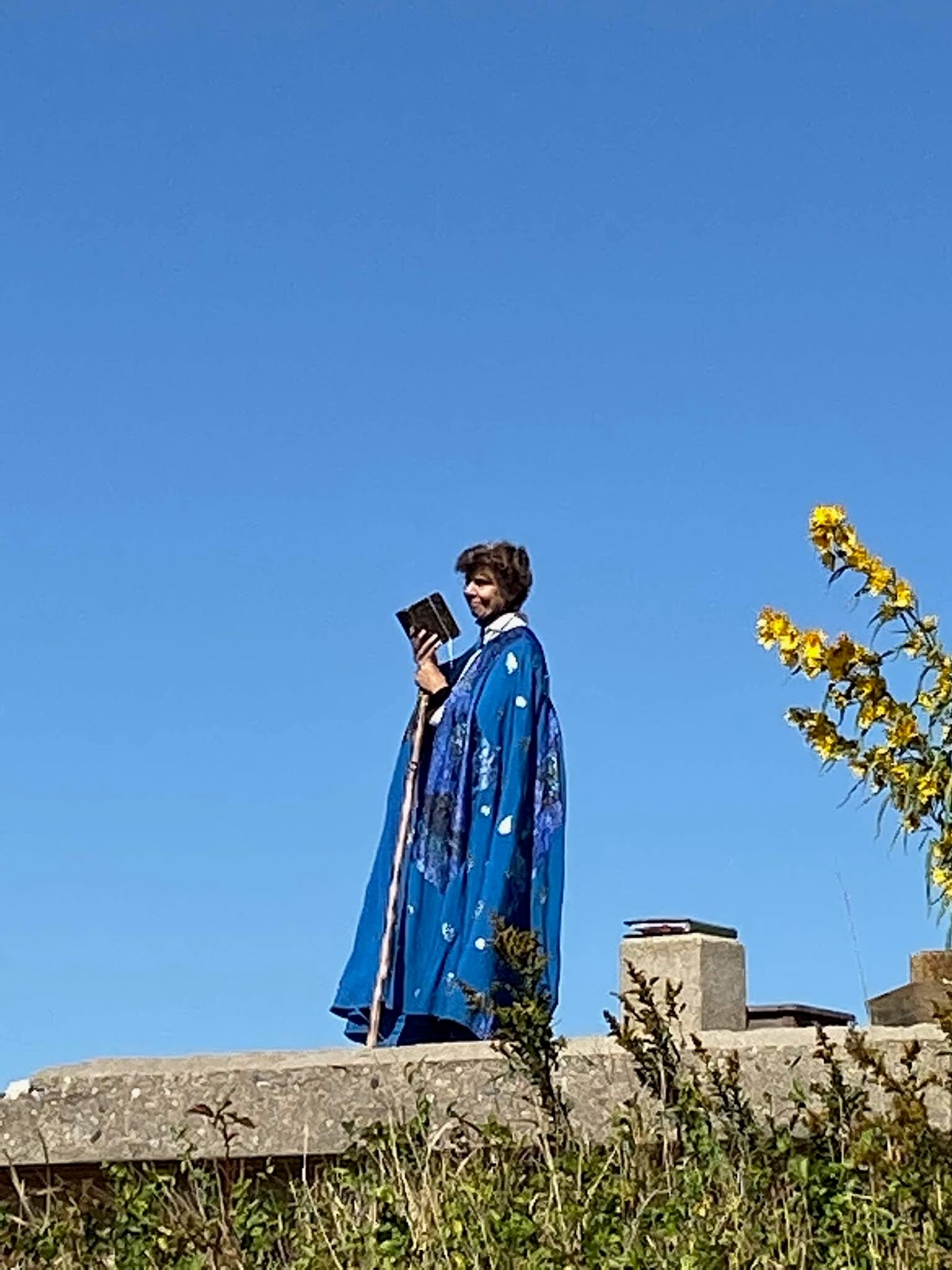
The revels ended, and Prospero abjured his rough magic. Marianna/Prospero declaimed to us, and to the setting sun, that she would “break my staff, bury it certain fathoms in the earth, and deeper than did ever plummet sound I’ll break my book.” It was wonderful, and I didn’t want it to end. Marianna, a mother and grandmother, brought to the role the depth of a true nurturer, with understanding of the great bliss and the great terror, that are the hallmarks of motherhood.

It is true that The Tempest has been performed on every continent but one, and Prospero’s indelible farewells, orations, and lamentations have been articulated, shouted, whispered, uttered, shouted maybe even lip synced by such eminences as John Gielgud, Derek Jacobi, Max von Sydow, Frank Langella, Vanessa Redgrave, and Helen Mirren.

Well, friends, add to their number the remarkable Marianna Houston.

In lieu of the above-lamented non-program, here is the cast as best I can:
Producer: Ben Shattuck + Karis Danis
Director: Rebecca Blumhagen
Choreography: Hannah Cruz
Musicians: René Cruz, Jesse Ciamentaro & someone else?
Ariel: Hannah Cruz
Miranda: Rebecca Blumhagen
Ferdinand: Zachary Chastain
Trinculo/Antonio: Karis Danish
King Alonso/Caliban: Greg Brostrom
Sebastian/Stefano: Nicole Rodenberg
Gonzalo: Jesse Liebman
Prospero: Marianna Houston


*For example: I have another nephew (one among many) who does not have the fishing gene. His girlfriend his Serbian; also partly Bolivian. The girlfriend’s Serbian father, a charming engineer, comes to Cuttyhunk once every year – from Belgrade – in order to fish. He stays at The Fishing Club. When I am visiting with cousins on Cuttyhunk, we sometimes gather at The Fishing Club for a very hearty breakfast. I do not use the Lourdes simile lightly.

** I write as one raised within spitting distance of Plymouth Rock, so I know this for a fact.

*** The Pete (97 and still fishing) of petesplacerentals.com is the original bearer of the familial fishing gene. Actually, no, it was probably his father, my grandfather. My grandfather, Hans Lehner, was born near Augsburg, Germany where it is unlikely he did any ocean fishing. Later, as a businessman in Boston, he fished often with his two sons. For reasons that only a person afflicted with the fish gene can possibly understand, many of the fish they caught were stuffed and mounted on wooden escutcheons and then hung all around the dining room, just below the egg and dart molding. As a child, no matter where one was seated in the ancestral dining room, there was an excellent view of dead and stuffed fish. The swordfish, naturally, was especially appetizing. For dining room décor it can only be topped, in my personal memory palace, by the life-size horizontal death-portrait of a second cousin Paul Brancart, hero of the Belgian resistance, that hung above the side board in the dining room of a great-uncle’s house in La Louvière, Wallonia, Belgium.

Wednesday, May 1, 2019

Everything about the Holy Thorn

Of all the things I expected from a sojourn in the Umbrian countryside (olive trees, wild boars, pasta, Roman noses, Etruscan vases, vin de table), the very last was the semiannual appearance of the Holy Thorn in Montone.

As we all know, a couple of weeks ago, Notre Dame in Paris was burning. Watchers around the world were horrified. But a mere twenty-four hours later, things were not looking so bleak. The Crown of Thorns and the beehives on the roof were unhurt by the fire. We received several emails from bee-loving friends with the news of the still-flying bees. But I had to learn of the Crown of Thorn’s escape on my own.

Then we were visiting friends at their exquisitely restored tobacco-drying barn, Bacciana. Montone is a walled town in Umbria, with some lovely restaurants, no decent postcards, and the ex-church of San Francesco featuring frescoes in terrible condition. But of the frescoes that are still extant, there are a cephalophore* and a very young and nubile Saint Sebastian.
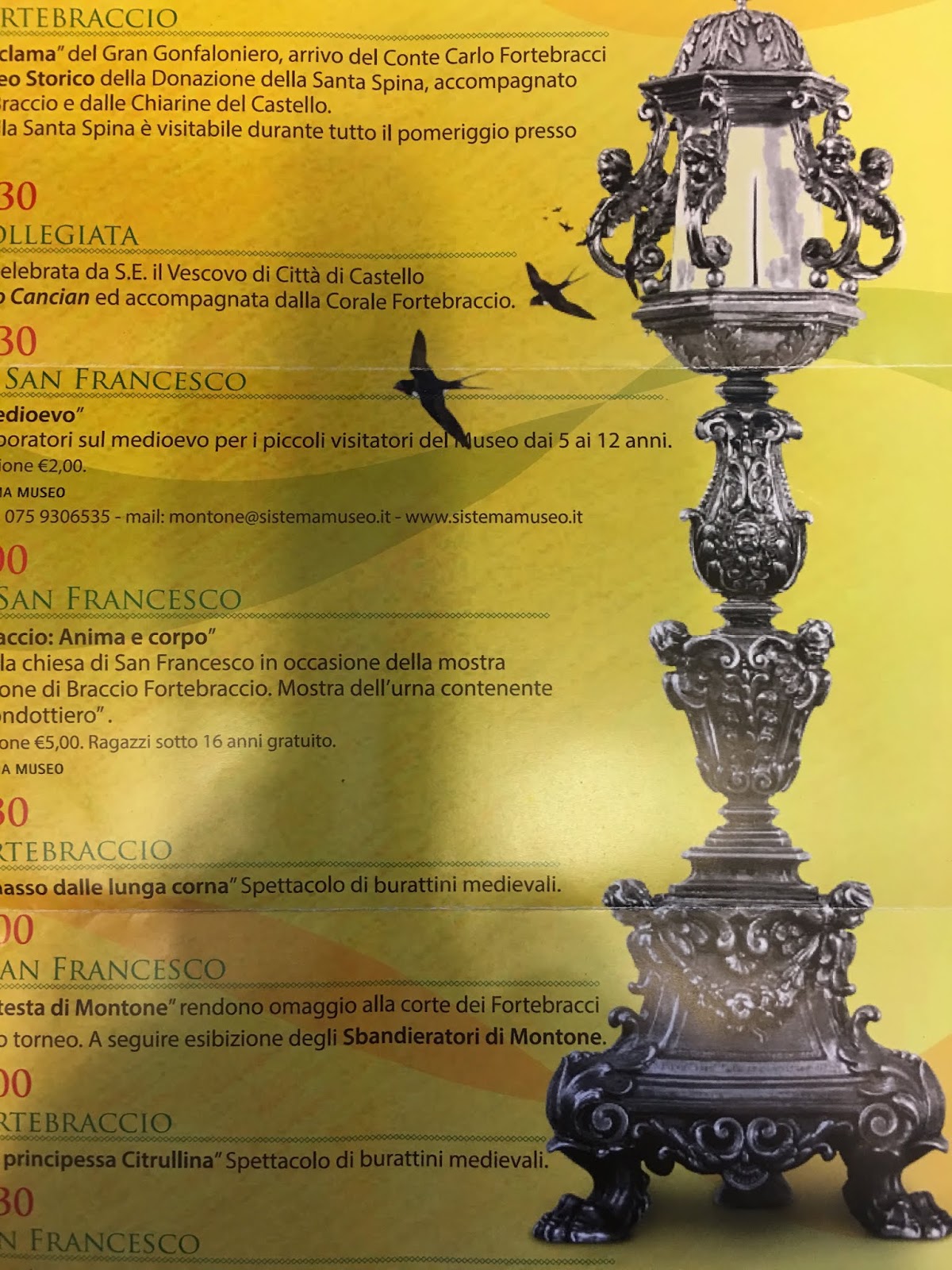
While roaming around town reading menus, we learned that on every Easter Monday Montone celebrates the Gift of the Holy Thorn (Donazione della Santa Spina) with a day of pageantry, costumes, archery, puppetry, and handsome men in bicolored tights. Religiosity and shapely calves. What could be better?

In the 15th century, the Venetians, grateful for his help in defeating the Turkish invaders, gave Montone’s local squire, Braccio Fortebraccio** a single thorn from the crown of thorns: the Santa Spina. The Venetians had acquired the Crown a couple of centuries earlier, as collateral for a loan made to the warmongering Baldwin II of Constantinople. Baldwin never redeemed the Crown, but Louis IX of France did. Apparently the Venetians held back a few thorns.

If you care to research the history of the Crown of Thorns, and the various extracted thorns, you must be prepared for conjecture, legend, wishful thinking, and contradictions. Also just plain heresy.
Eagerly, I texted my sister that we would be seeing the Holy Thorn in Montone, and wasn’t this a fantastic coincidence, or just plain serendipity, that we would be in Montone for this celebration? She texted back that according to her research (Wiki) there was no Holy Thorn in Montone. I sent her a picture of the reliquary that was featured in the flyers all around town. She sent me a link to the Wiki page enumerating all the cities in Europe claiming one or more thorns. Montone was not among them. Cities in Belgium, France, the Czech Republic, Spain, Germany, Britain, Ukraine and five cities in Italy all lay claim to a portion, or a branch, or a thorn, or a fragment, of the Crown of Thorns. Even a chapel in Pittsburgh, USA, claims a thorn. But not Montone.

This is obviously yet another example of the fact that you can’t believe something just because you read it on the internet. I was in Montone and I saw the Holy Thorn. Well, I didn’t actually see the Holy Thorn because it was inside its special box. It wasn’t even in the beautiful reliquary shown on all the flyers, because at last year’s celebration, there was a touchy moment when the Montonian carrying the reliquary almost fell off his horse. But I did see the special box that was used in lieu of the reliquary. And I know what I saw.

*Cephalo-phore: a saint who has been decapitated and then carries around his/her head. If you don’t know this already, you haven’t been paying attention.
**His Wiki page also does not mention Montone’s Holy Thorn: a dereliction that makes me suspect a possible conspiracy by the other Thorn-Hoarding cities.


Monday, February 18, 2019

SUNDAY ROUTINE (with apologies to the New York Times)*

How Christine L, blogger, beekeeper, egg collector, terrible typist, and ranter, spends her Sundays

THE NEW YORK TIMES. “I am a very hardworking person,” Christine told us. “So on Sundays I like to wake up at 8, a full hour earlier than 9, which is when I wake up on Saturdays. Then I roll over and reread the book I was reading last night when I fell asleep with my nose between pages 84 and 85. (Or whatever. Feel free to insert your lucky numbers here.) Lately it’s been Walker Percy’s Love in the Ruins, a book that warrants multiple re-readings because it is so weird and prescient. CSB, meanwhile, has milked the chickens, burned yesterday’s manuscripts, and taken my mother to church. I know it is time to get out of bed when he comes back from the early service and tells me what comments my mother made during the sermon. Examples are: “There many of them have beards [points to the ceiling] and they all have toes,” and “Phew. Now I can find what I lost.” Attendance at the early service ranges from three to seven; CSB reports to me exactly who was present, and how many times my mother counted. In French. My mother, not CSB.”
BREAKFAST LIKE A QUEEN “Then it’s time to caffeinate.” Christine is a tea drinker. We asked her why. “Because I am not a coffee drinker, and those two are the only options.” Unsurprisingly, Christine takes nutrition seriously. “If there is any dessert left over in the frig I will definitely eat that for my first breakfast course. Fruit tarts are best, but in a pinch I will have chocolate mousse or baked Alaska. Second breakfast is always two poached eggs over Gallo Pinto with a dollop of yogurt. Some things never change, nor should they.” In addition to her other attributes, Christine is thoughtful and discreet. “Because yours is a so-called Family Newspaper, I will skip over the next hour of my Sunday Routine. Let your imaginations run wild.”
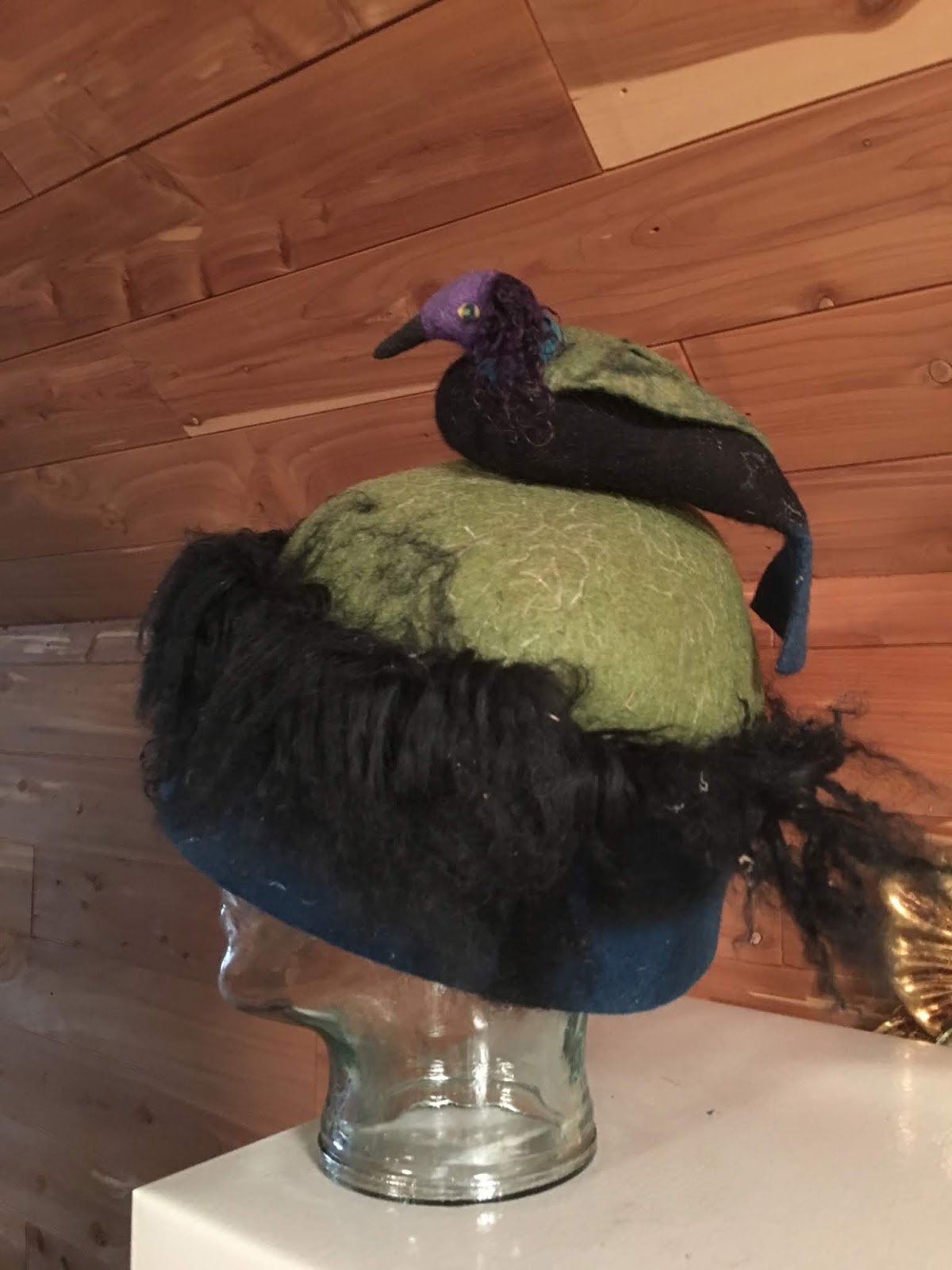
WHAT TO WEAR WHETHER YOU ARE SEEING THE POPE OR NOT… “Since all week long I dress for success with bespoke corduroys pants, flannel shirts, vintage cashmere sweaters with almost no moth holes, and socks featuring bees or chickens, on Sundays I like to turn off my inner fashion-meter. Just this past Sunday I garbed myself in silk pajamas dotted with congealed egg yolk, and a djellaba from Cairo my grandfather wore in 1951. To keep warm I draped myself with a fur stole, but don’t worry, whatever it was has been dead longer than you have been alive. I always wear a hat on Sundays. Sometimes choosing the right one can take a very long time.” We saw a small complement of the hats in question, and can sympathize with challenge to choose just one.
KEEPING FITTER “Friends tell me that exercise is very popular these days, so on Sundays I often exercise. Unless I participated in exercise during the previous week, in which case I will rest. My favorite exercise is ping-pong. I used to be the Costa Rican junior ping pong champion so it tends to be difficult to find players who are willing to compete against me, because I will beat the pants off them and then gloat. Just thinking about the difficulty of finding a suitable opponent tires me out.”
MORE FOOD “On Sundays CSB and I like to throw caution to the winds and radically alter our lunch menu. Just last week I had almond butter instead of peanut butter. That was fun, but one shouldn’t indulge too often.”
KULCHUR “I can’t help noticing that most of the subjects of this feature feel compelled to tell you about their Sunday’s cultural activities. I don’t know where to start. I like art projects that also reduce clutter. My latest masterpiece involves burning old postcards and gluing them onto my grandmother’s watercolors. Since I have thousands of old postcards (still) and hundreds of my grandmother’s paintings (numbers may be inexact), this is a very useful and cultural thing to do.”
AND MORE FOOD “My fondest childhood memories are of Sunday dinners at my grandfather’s house. Under the dining room table my grandfather had a button, cleverly concealed beneath the Persian carpet, which he would depress with his foot to summon the cook. A favorite activity for those of us who were not required to discuss fluctuations in the cotton market was to slide under the table and press the button. Frequently. Relentlessly. Very soon after her untimely death, my grandfather’s cook, Mrs. Herlihy, was nominated for sainthood, on account of her saintly refusal to kill us. Her beatification sped through the Vatican red tape. Countless friends and colleagues of my grandfather eagerly wrote to the Holy See to testify on behalf of Mrs. Herlihy’s sanctity, as well as to confess their dismay that she never once dismembered even one of us. That tells you everything you need to know about our Sunday Dinner Routine.”
AND FINALLY “Come Sunday evening I need to mentally prepare myself for the week ahead. This often involves scuba diving. Bedtime cannot come soon enough.”


*If you are not a regular reader of the Times’ “Sunday Routine” feature, you will probably not find this funny. You will most likely find it puerile and pointless.

Wednesday, February 13, 2019

A Recycling Rant

If you are going to recycle and want to feel good –or just unshitty - about recycling and the possibility of mitigating the imminent environmental collapse of the planet – then do not, as in do not EVER, actually deliver your recycling to your local recycling center or DPW.
Because if you do at least two things will happen.
1. You will despair of the planet.
2. You will think very unpleasant thoughts about your fellow citizens.
The irony being that these fellow citizens, about whom you will think deprecating thoughts, are the very ones who are availing themselves of the recycling bins. But they are doing it so very very badly.

There are two ways to recycle in our town. The first, and for many simplest, is to leave your recycling out on the curb on the appointed pick up days. One blue bin for paper, and another blue bin (in fact the bin may be any color you like, even mauve) for recyclable plastic and glass and metal. Note the adjective RECYLABLE. Recyclable means NO Styrofoam, no broken lights bulbs, no light bulbs at all, no plastic bags (These can be recycled at specific bins outside the local Foodtown), no electronics, no heavy metals, no paint cans.
The second way to recycle in our town to load up your recycling into your car and personally bring it down to the DPW, where they have 4 dumpsters for paper, and 3 smaller dumpsters for plastics.
That seems fairly simple, does it not?

You could point out that all our local efforts to recycle are but a pea shooter directed at the ginormous monster that is Climate Change wrought by human activities and the increase in greenhouse gases, a ginormous monster that will likely devour our planet before our valiant local recycling efforts make any difference at all to the End of Life as We Know It.

I will not point that out because, well because most days a tiny peashooter is all I have at hand. Plus, recycling makes me feel marginally better about being a citizen of such a ponderously wasteful and selfish country.

Which brings me to this specific rant. Here at Let it Bee farm, we bring our recycling to the DPW once every week or two. Also my mother’s recycling, a concept she no longer comprehends. CSB, who feels very strongly about these matters, does not like leaving our recycling at the curb because papers often blow away and get strewn across the road and become dreaded litter. That is why we load up the back of his pickup with our blue bins and go to the DPW, where we put all our paper and cardboard into the large Paper Dumpsters, and we put our plastic and glass and cans into the Mixed Metals Dumpsters. (I have to admit that keeping to this plan becomes especially challenging when we are dealing with plastic water bottles that were pissed into and then thrown out of some tiny-bladdered slob’s car onto the verge along Broadway, where I periodically collect litter. For more about this, see SQD: Rant about Littering.)
The signage makes it quite clear which is which. The signage also states very clearly that NO plastic bags are to be thrown in with the plastic and glass etc.

Here lies the problem. By personally delivering our recycling to the dumpsters at the DPW, I have the opportunity to see what my fellow citizens – obviously well-intentioned citizens who want to recycle and Save the Planet – put into the dumpsters.
Just this week, in the dumpsters designated for paper and cardboard, I saw: aluminum takeout containers, paint cans, heavy plastic detergent containers, a stainless-steel water dispenser, and a fluffy white bathrobe.
It was the bathrobe that put me over the edge. You can blame the bathrobe for this rant. I received a quite similar fluffy white bathrobe as a Christmas gift, and while I did not actually need a bathrobe (fluffy or otherwise,) I have grown fond of it. On account of it being so fluffy. Bathrobes, fluffy or not, never belong in the Paper and Cardboard Dumpster.


I have not even addressed the very compelling question of those plastic windows in envelopes from organizations seeking to part you from your money, or annoy you in other ways.
Nor have I once mentioned what happens to recycling machinery when the wrong materials are fed into the maw.
Also unmentioned is the serious likelihood that because of the co-mingling of contaminated materials, the whole lot will be rejected by the recyclers and added to an already enormous landfill.

Friday, February 8, 2019

Dante and Unanswered questions


Sometimes a small and apparently unimportant question, such as, Why did my mother acquire so many postcards of William Blake’s Lucia carrying Dante in His Sleep? will trigger a slew of other questions. There is a domino effect to questions, as with so much else.
Postcard stashes are one thing. I can forgive myself for not knowing the reason for them. I can even speculate. The watercolor, one of Blake’s illustrations for the Divine Comedy, is owned by the Fogg Museum at Harvard. I guess that this particular surfeit has something to do with the HILR (Harvard Institute for Learning in Retirement) class on Dante’s Paradiso that my father took in 2010. After his strokes, my father forgot discreet decades of his life (Please explain how Cuba came to be Communist, he once said), but his judgment and critical powers were remarkably intact. So, he kept on taking classes at HILR, and, as always, was a diligent and engaging student. That did not stop him from calling on the evening before his class and asking me to read Dante’s Paradiso and come up with 10 or 12 pithy observations and insightful questions. I got off easily. When Dad was studying the Economics of Global Climate Change, he called my sister and asked her to read the assigned text, 836 pages of small print, and give him a detailed synopsis.
Now what do I do with these 20 postcards? Would you like one?
That was just the beginning. In the latest pile we found multiple postcards from Ireland. We had no idea she had even been to Ireland. She had 37 – thirty-seven! – postcards of a detail of the Tara Brooch, from the National Museum of Ireland. Not even the whole brooch, just a detail.

As for the Tara Brooch, it raises more than a few questions, and not just about my mother's stash. Although it is called the Tara Brooch, the piece was found near Bettystown in County Meath, at least 25 kilometers from Tara. It was discovered by either a peasant woman, or her two sons, or one of her sons. The brooch didn’t even start the fashion in Celtic Revival jewelry. That was already in full swing in 1850 when the brooch appeared. And apropos of nothing, my mother was never interested in things Celtic; her tastes ran to the French, the Egyptian, the Ethiopian, and the Vietnamese.

No, that felucca has sailed. I will never ever know why the Dante cards, why the Tara Brooch, why the eight postcards of Mrs Elizabeth Freake and Baby Mary, by an unknown American of the 17th century. So many unknowns.
How can I not be annoyed with the idiotic former self who neglected to ask: What are the full names of the seven suitors who wooed and wanted to wed you, my mother, before you met my father? Why, when you kept so many other things, did you destroy the letters from Mr. Jago? Why did you stop going to Mass for many years, and then start up again? Who was your favorite child? Was there ever a time when you knew more than a few dozen words in Arabic? Did my father ever work for the CIA?
Don’t be too harsh, I tell myself. At least five years before we had the tiniest inkling, my mother was already afflicted with Alzheimer’s. She was just covering it up fairly well. As was my father, on her behalf and his own. They were in denial. Not for nothing was my mother who grew up in Egypt known as Queen of Da Nile. Her mantra was, “If you have nothing nice to say, say nothing at all.” Mine might well have been, “Spit it out. Think later.”
Those fucking questions.
There are so many things I will never know, now that a typical conversation with my mother conversation proceeds thus:
Mom: There’s that nice little thing there in the back….(She is lying on her bed with the duvet pulled up to her chin, and facing the Christmas tree on her screened porch.)
Christine: Do you mean the tree?
M: Yes, the tree.
C: It’s very nice.
M: Everybody thought it was mortar.
C: Mortar or water?
M: Mortar.
C: Oh.
M: Well they wanted to be mean and everybody always…I couldn’t believe it, it was so bad.
C: I’m sorry.
M: Sigh.
C: Everything is fine now.
M: But I have some things. I have some red papers which are white and they’re going to go in here (she lifts the duvet slightly and leans slightly inward) and they’re going to go in here and they …….
C: OK! Mom! Everything is lovely.

One of the more disheartening things I have noticed, whenever I set out to transcribe a conversation with my mother, is how limited my own vocabulary becomes. I use more words, and more complex words, with a three-year-old. My mother can still speak three languages, and can make no sense in any of them. It is like trying to cook a meal with three ingredients, and one is water and one is half a carrot.

Thursday, January 31, 2019

Most recent favorite sentences


Sometimes life is too much with us, and politics are too late and too soon, and your fingers are too cold to type. But sometimes reading a wonderful sentence can cheer you up for a whole day. Sentences are a gift, and for these two I am grateful to Gideon Lewis-Kraus.

They can be found in a Times Magazine article about archeologists finding bones on a island of Vanuatu, and how their discovery and interpretation caused a ruckus in the anthropological world. That was all interesting, but the best parts, for me, were these two sentences:

“A meaningful national identity [of Vanuatu] has been constructed from a common appreciation of ceremonial pig-tusk bracelets and the taking of kava, a very mild narcotic root that looks like primordial pea soup and tastes like a fine astringent dirt.”

“Kava is a cloudy green tonic, served in little miso bowls meant to resemble coconut shells. The custom is to collect your shell, retire to the corner of a nearby shadow, take the entirety at one draft and then spit the particulate remnants; by nightfall, when even the city is blanketed in thick dark, the only regular sounds are the screech of the fruit bats and the hock of spit.”


Pictures from Wikipedia.

Tuesday, January 29, 2019

The In-law Trifecta

I didn’t know what a trifecta was until I met CSB, and he took me to the harness racing at the Windsor Fair in Maine. While we enjoyed fried dough and fried ice cream and fried cotton candy, he explained about exactas and trifectas, and how we could place bets on a horse to win, place, or show. It was all entirely new and wonderful, especially as it involved broadening my vocabulary. I chose horses based on how appealing I found their names. What else could I base it upon? Given the option, I would bet on Abstract Expression instead of Foiled Again, and I would lose. Or I would wager my $2 on Slippery Toad, and he would come in last, or maybe not at all.

So naturally, I knew what CSB was referring to when he pointed out that this past weekend he had survived a trifecta of my siblings: one sister; one sister-in-law, married to #1 brother; one brother (#3) and wife, and their daughter and fiancé. Not to mention a nephew, son of only sister.
He loves them all, but you have to admit, that’s a lot.

If we add in last night, it would be a tetrafecta, a word which thus far does not exist. But it is easy on the tongue, and certainly has more cachet than bifecta, which sounds like a very unfortunate sexual event, and also does not exist.

In gratitude for CSB’s gracious in-law trifecta, I have promised that this weekend I will do something Super Bowl-ish with him. I assume it will involve fried food, and placing my bet on the Surrealists of Cincinnattus.

Monday, December 31, 2018

The Moths and the Murmuration

‘Tis (or ‘twas) the season to deplore the overuse of ‘tis, and summarize the highlights of the past year. In one of these two all-important tasks, I have fallen short.
So, having failed to produce a pithy Christmas card regaling friends and family with our adventures and misadventures of 2018, I thought I could at least bake something.

Not that most of you lucky souls will taste what I baked. It is the concept of baking that I imagined as an antidote to the lack of Christmas letter.

There I was in the kitchen, our lovely kitchen with its three big windows facing west, overlooking the field, the river, and the geologically thoughtful and imposing Palisades. In a certain cabinet I found two bars of fancy chocolate. How long had they been there? Had they been invaded and nibbled by pantry moths? Do pantry moths even like chocolate? They had not. But the question was valid, because on the way to discovering the chocolate, I came across a package of almonds that had been very much invaded and inhabited by moths. It was quite revolting, all the masticated almond crumbs globbed together with the spider-webby stuff the pantry moths leave behind. I took the whole thing outside and gave it the chickens, who love grubs and bugs and squirming larvae.
I started wondering about pantry moths. Evolutionarily, biologically, what exactly is their purpose?
I have no answer to that question.

Initially when I started researching pantry moths, I assumed my moths were the Mediterranean variety, whose ancestors, like mine, were immigrants to North America. (Also known as invasive species.)

That was wrong. My pantry moths, and most pantry moths, are Indianmeal moths. Indianmeal moths are not from India. They should not be confused with almond moths or raison moths, even when they munch on almonds and raisins with gusto. They also don’t mind eating cardboard or plastic if that is the best route to grains or nuts.
One of the things I was most delighted to learn about these moths, my moths and your moths, was that the females “oviposit on the second night after emergence. This is because they require a few hours for the sperm to move from the bursa copulatrix to the vestibulum, where fertilization occurs”.
How often do you get to use the word oviposit? Not enough, in my opinion. The same goes for copulatrix.
[Yes, I know we are dispensing with such gender specific, that is to say, feminized, words such as actress, waitress and aviatrix, but I hope we can keep copulatrix. Just because. ]
And when they do oviposit, the female moths oviposit between 116 and 678 eggs, in a food source, such as my almonds or whole wheat flour. Between exactly 116 and 678 eggs. I checked three sources, both online and in a real book, and they all gave those exact same numbers for the minimum and maximum number of eggs.

Why so much about pantry moths?
Because it seems especially important, at this time of year (birthday of Jesus, shutdown of the US government, wildfires, floods, holidays that conspire to break your heart, long nights, and then, arbitrarily, a new year with a new number) to recognize the depredations of age, usage, indifference, betrayal, neglect, breakage. Hungry moths.

There I was, checking out the moth carnage in the baking supply cabinet, when the light in the kitchen changed. Nothing alarming, just a shadow passing.
It was not a shadow at all. (Not my pictures.)
Outside, right in front of me standing at the window, thousands of starlings flew together from the branches of the birch tree up and over the field. They swooped together, they rose together, they dipped and swooped upward again. This, I later learned, is called “scale-free correlation”. Together they filled the sky, not completely, not as a dark blob, but as a giant pixelated moving wave. Together they curled and landed on the field, and together they alit and returned to the sky. I don’t know how long this Murmuration of Starlings lasted. They swirled and pulsated; their shape ballooned and then narrowed as if a belt were cinching a waist. They grew large and small. I didn’t have my camera, and any way, I couldn’t have captured this sky-filling avian ballet. Watch this on You Tube for an idea. For as long as they flew, ascended, curled back and dropped to the field, lifted in perfect synchronicity from the field and flew in wider circles, I watched. I felt hopeful.
Finally, they swooped northward and then flew in a wide parabola and headed southwest towards the river. I waited, in case they would circle back. But that was it, they went elsewhere.

Who are these starlings, and why do they do what they do?
For starters, starlings, like my ancestors and most of yours, were immigrants to these shores. Though my grandfather, a German cotton broker, did not arrive here with a Shakespearean agenda. Starlings did.
On a snowy day in 1860, Eugene Schieffelin, a German immigrant, released 60 European starlings in Central Park. It was his wish to introduce into North America all the birds mentioned by the plays of Shakespeare. (Clearly, the concept of invasive species was not yet au courant.) Ironically, Schieffelin succeeded with starlings, who get one puny mention in all of Shakespeare, whereas the more frequently mentioned skylarks and nightingales never adapted to North America.
When Schieffelin died in 1906, his obituary in the New York Times listed his memberships in the NY Genealogical and Biological Society, the NY Zoological Society, the American Acclimatization Society, the Union Club, the Society of Colonial Wars, the St Nicholas Club and the St Nicholas Society (Seriously. Both.) There was no mention of the starlings.

These days starlings are considered a nuisance, pests, and hazards. And of course, an invasive species.
According to the Coordinator for the USDA Airports Wildlife Hazards Program, starlings are “lean and mean. In the industry they're often called feathered bullets.”

Along with the enlargement of my vocabulary with oviposit and copulatrix, I was delighted to discover that our government supports an Airports Wildlife Hazards Program.
And so with this, I end the year, and wish you all a Happy, Healthy and Sane 2019.


Friday, November 2, 2018

In living color.

There is so much that is unfair and wretched in the world, that I hesitate to describe the unfairness I encountered late last night, reading The New Yorker. But I will.

It was an article by Margaret Talbot about the discomfiting and often disregarded fact that the ancient Greek statues and Greek buildings were not pristine white. They were painted. Painted colors. Those lustrous white marble torsos, those pure Ionic capitals, those Classic pediments, gleaming white under the Mediterranean sun. They do not represent what the Greeks created, what the ancient Greeks saw each day. “The idea that the ancients disdained bright colors “is the most common misconception about Western aesthetics in the history of Western art.””
It was not a misconception held by my mother. Years ago, as long as I can recall, she knew that the ancient Greeks and Romans painted their statues and facades. Not only did she know it, she insisted on it. She drilled into us that they were painted, that they were anything but pristine white marble. They were in fact polychromatic, lively, bright, even gaudy. If we, her children, learned anything from our mother (and we certainly learned much) we learned about the polychromatic Greek statuary. Also fenestration.
The unfairness lies in the timing of this wonderful article. My mother will not read this article. She will not enjoy the satisfaction of having known of ancient poly-chromaticism all along. She will not make multiple photocopies of the article to send to all her children and selected other relatives and friends, even though we have explained to her multiple times about the merits of simply emailing a link to a given article, and thereby saving paper, postage, etc.
When I read this article about the painted Greek statues, all I wanted to do was talk to my mother, to revel with her in this affirmation of what she had been telling us all along.

But I will not talk to my mother about this article. She is still here, but she is gone. The mother who was so bossy and confident and correct about colors, is gone. The mother who believed that all her grandchildren needed to know that the large front window at the Orchard was a Palladian window, and what that meant, is gone. The mother who encouraged me to paint, just below the kitchen molding, a wide band of a certain intense blue, Izniak tile blue, she is gone. Benjamin Moore, not having the benefit of my mother’s color knowledge, called it “Big Mountain Blue”. However named, the blue is still there, and it looks marvelous. She was so right about that blue.


As an architectural historian, and also a color consultant, my mother made it her business to know what colors were ‘appropriate’ and ‘historically correct’ for your house, your living room, even your bathrooms. In New England, where the slavish devotion to white clapboard approaches cult status, there were brave souls who strove for something more, something with color, and they paid my mother. They paid her real consulting fees to tell them what historically appropriate colors they should paint their houses.
I enjoyed this fact, because of course my mother told me what to do, for free. Gratis. Without a fee, my mother told me what color to paint my house, what color I should dye my hair (I balked, and prevailed), and what color clothing would suit my sallow Belgian complexion. About paint colors, she was invariably right. That is, she chose wonderful colors that
I would never have had the courage, or imagination, to choose. She steered me away from pastels, and I have never looked back.

The current article in the New Yorker, which I recommend, makes an additional point about the painting of Greek statues that even my mother could not have predicted*. Slithering in, on ancient polychromatic cat feet, are political implications. “Some white supremacists have been drawn to classical studies out of a desire to affirm what they imagine to be an unblemished lineage of white Western culture extending back to the Greeks. When they are told that their understanding of classical history is flawed, they often get testy.”**

My mother still knows her colors, some of them, most of the time. She remains very fond of blue.


*Though I may be not properly crediting her. Another thing my mother always insisted on, in the matter of representational art, was that Jesus was not ‘white’. My mother grew up in Cairo. She loved the Middle East. She was well aware that a young man from Galilee was not likely to be the paleface so revered in Western iconography.

**Understatement.

Wednesday, October 31, 2018

My Rant about Black Walnuts and their Drupes


Have I ranted about the black walnut* missile attacks before? Most likely. Most likely I do so on a biannual basis. Specifically, during mast years.
It’s been a great year for black walnuts, Juglans nigra, and for squirrels.** It has been a tragic year for my driveway, my back porch, and for CSB’s windshield.

Yes, I know that the black walnut tree is native, and native plants are good. I also know that the wood of black walnut trees is beautiful and valuable.

My gripe is with the fruits of the tree: the drupes. ***

We have tried, really tried, to find uses for black walnuts, to justify their existence, and in particular justify their voluminous existence in front of my house. You should never, ever, on any planet, on any continent, plant a black walnut tree near your house or driveway. Because, as Richard Powers says in The Overstory, they are “Trees that bomb the ground so only their young can grow.” What he doesn’t say is that their bombs can stain the wood on your back porch, puncture of your car, cause concussions, and sound like fireworks when they hit the driveway.


The problem with the black walnut drupes is exacerbated during wet and windy weather, the autumnal storms which we are experiencing in unprecedented profusion. With the rain the black walnuts become saturated and heavier, and with the wind the branches flail about and broadcast the black walnuts. Here at Let it Bee farm they bombard the back porch where they splatter on impact and stain not only the wooden planks but the white clapboard to a height of over 8 feet. They pour down on any patch of dirt aspiring to grow anything but Juglans nigra. They fall on the driveway by the thousands; and they attack any car foolish enough to be parked within the dripline. These foolish cars end up with pockmarked roofs and hoods, and recently, a shattered windshield. When cars drive over the black walnuts on the driveway – because we can’t spend every minute of every day shoveling them up with an industrial strength snow shovel – the bursting of the drupes sounds like machine gun fire.


Why do we put up with this tree, in the bosom of our abode? Exactly how idiotic are we? Would not a normal, well-adjusted, rational person chop the tree down, stack up the wood, and plant a benign azalea there instead? I often ask myself: what would a normal, well-adjusted person do in this circumstance [take your pick: recalcitrant chickens, political crises, randy squirrels on the roof, dementia]?
I often bemoan the phenomenon in electoral politics whereby huge swaths of the voting public appear to vote against their own best interests.
Yet here we are, living under the tyranny of the Juglans nigra, every year, and especially every other or mast year, complaining bitterly about the mess and the noise and threat of concussion. We could chop the tree down. CSB’s chain saw is not big enough, but there are plenty for excellent arborists who would happily come and take down this old tree, in stages, at some cost. We could even defray the cost of having the tree taken down by selling the wood: according to the all-knowing Internet, a single tree can be worth $20,000.

But we don’t chop it down, and we will not. Because it is a tree that belongs to this continent that has already spent (possibly) one hundred years growing in that spot. I have not spent one hundred years doing anything consistently.

As for justifying the black walnut’s existence in our particular spot, I read recently in Peter Wohlleben’s wonderful The Hidden Life of Trees, that the same compound (Juglone - a natural herbicide) that prevents other plants from growing in its vicinity, is considered so unpleasant by mosquitoes that “Garden lovers are often advised to put a bench under a canopy of walnuts….where they will have the least chance of being bitten by mosquitoes.” He makes no mention of the danger of sitting on that bench in the autumn, when the drupes are hailing down. I have to admit that we are rarely afflicted by mosquitoes when dining on the back porch all summer long.


*I will make a point of referring to the black walnuts that populate my yard as black walnuts, to distinguish them from the walnuts you buy in the grocery store and put in brownies, or not, depending on your familial preferences, which are European walnuts, Juglans regia, also of the Juglandaceae family, but so much easier to open.

**Factoid: Black walnuts make up 10% of the diet of an eastern squirrel. That is true in many places, except my yard, where they make up at least 50%.


***Drupes are “ fleshy fruits with thin skin and a central stone containing the seed”
This word is so delightful, and so much fun to say aloud, that it almost reconciles me to the Assault of the Drupes. But no, it doesn’t really. Other excellent words related to drupes are: drupaceous, drupelets**** and indehiscent.

*****My favorite of the drupe set of words.


Monday, May 21, 2018

Springtime on the Front Porch, tucked inside the Boxwood

April 24May 4May 7May 10May 13May 14May 15May 16May 17May 18May 20 The fledglings have flown. Here lies the empty nest.